Biological significance of sperm-independent calcium oscillations in immature oocytes of mice
Sae Horiike, Woojin Kang, Minoru Ichinose, Ban Sato, Kenji Miyado, Hidehiko Ogawa

TL;DR
This study explores the role of calcium oscillations in immature mouse oocytes and their connection to ovarian function.
Contribution
The study reveals a potential regulatory role of extramitochondrial citrate synthase in calcium oscillations and ovarian development.
Findings
eCs-KO mice showed slower reduction of Ca2+ oscillations during the juvenile period.
Adult eCs-KO mice had ovaries with follicles containing two oocytes.
eCS may suppress spontaneous Ca2+ oscillations to maintain ovarian functions.
Abstract
Sperm-independent Ca 2+ oscillations are induced in immature oocytes, and presumably contribute to oocyte quality; however, its physiological role remains unclear. We studied the significance of Ca 2+ oscillations in ovarian functions using extramitochondrial citrate synthase ( eCs )-deficient (KO) female mice. In wild-type mice, the percentage of Ca 2+ oscillation-induced oocytes gradually decreased during their juvenile period, and dropped at the beginning of their adult period, whereas its percentage reduced more slowly in juvenile eCs -KO mice. Moreover, ovarian follicles containing two oocytes were frequently observed in ovaries of adult eCs -KO female mice. We assume that eCS suppresses spontaneous Ca 2+ oscillations, probably maintaining ovarian functions.
Genes, proteins, chemicals, diseases, species, mutations and cell lines named across the full text — each resolved to its canonical identifier and authoritative record.
Click any figure to enlarge with its caption.
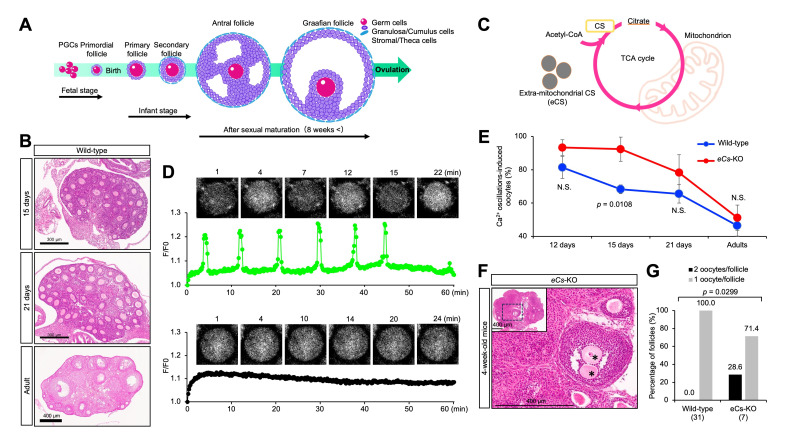 Figure 1
Peer Reviews
No public reviews on file for this paper yet. If you reviewed it on a platform where reviews are public (OpenReview, ICLR, NeurIPS, ICML), you can paste yours below so the community can read it here.
Videos
No videos yet. Explain this paper in a talk, walkthrough, or lecture? Add one.
Taxonomy
TopicsReproductive Biology and Fertility · Sperm and Testicular Function · Erythrocyte Function and Pathophysiology