Synthetic Manihot esculenta Rubisco activase proteins with increased thermotolerance identified via machine learning
Clayton Dilks, Rhiannon LaVine, Claire Buchanan, Daniel Russo, Elizabete Carmo-Silva

TL;DR
Scientists used machine learning to design cassava proteins that work better in heat, which could help crops survive hotter climates.
Contribution
A machine learning approach identified synthetic cassava Rca proteins with enhanced thermotolerance and minimal mutations.
Findings
Over 1,400 synthetic cassava Rca enzymes were screened using machine learning.
Synthetic Rca proteins maintained activity at 8°C higher than wildtype.
A single mutation retained most activity after heat-shock.
Abstract
Adaptation to increasing environmental temperatures is essential to plant survival and human food production. Thermal tolerance is controlled by a complex network of factors in plants including but not limited to genetic variation and environmental context. Rubisco activase (Rca) is a key photosynthetic enzyme with low thermal tolerance. Here, we report a large machine learning-directed screen of >1,400 synthetic cassava Rca enzymes which identified mutations that convey increased thermal stability while minimizing introduced mutations. We demonstrate multiple synthetic proteins that maintain activity at 8°C higher than wildtype cassava Rca including a single mutation that retains most activity post heat-shock.
Genes, proteins, chemicals, diseases, species, mutations and cell lines named across the full text — each resolved to its canonical identifier and authoritative record.
Click any figure to enlarge with its caption.
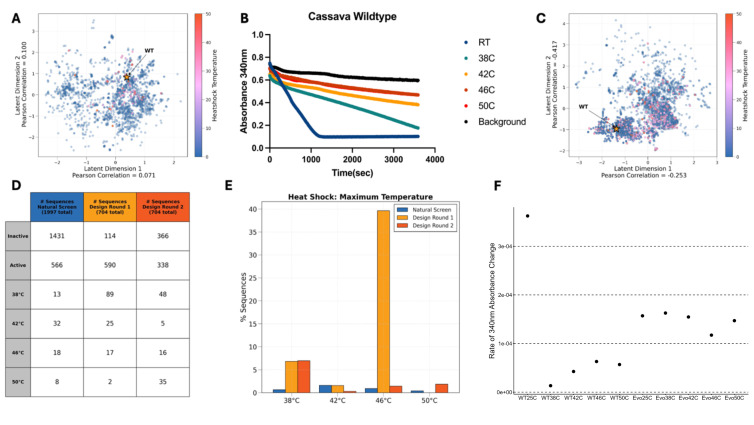 Figure 1
Peer Reviews
No public reviews on file for this paper yet. If you reviewed it on a platform where reviews are public (OpenReview, ICLR, NeurIPS, ICML), you can paste yours below so the community can read it here.
Videos
No videos yet. Explain this paper in a talk, walkthrough, or lecture? Add one.
Taxonomy
TopicsPhotosynthetic Processes and Mechanisms · Cassava research and cyanide · Plant Micronutrient Interactions and Effects