Decreased plasma level of C-type lectin-like receptor 2 (CLEC-2) in patients with breast cancer
Chia-Chi Chen, Chin-Feng Hsuan, Teng-Hung Yu, Chia-Chang Hsu, Cheng-Ching Wu, Wei-Hua Tang, Wei-Chin Hung, Yung-Chuan Lu, Fu-Mei Chung, Yau-Jiunn Lee, Ching-Ting Wei

TL;DR
This study found that lower levels of CLEC-2 in the blood are linked to more advanced breast cancer and worse outcomes.
Contribution
The study identifies CLEC-2 as a potential prognostic marker for breast cancer based on its association with disease progression and survival.
Findings
Breast cancer patients had significantly lower plasma CLEC-2 levels compared to healthy controls.
Low CLEC-2 levels were associated with advanced cancer stages, higher tumor grades, and larger tumor sizes.
Higher CLEC-2 levels were independently linked to better overall survival in breast cancer patients.
Abstract
Background: C-type lectin-like receptor 2 (CLEC-2) is involved in platelet activation, tumor metastasis, and vessel differentiation, but its role in breast cancer remains unclear. This study examined the association between clinical status and plasma levels of CLEC-2 in patients with breast cancer. Methods: Plasma CLEC-2 concentrations were measured using ELISA in breast cancer patients and control subjects. A total of 98 breast cancer patients and 98 age-matched control subjects were enrolled. All study participants were female. Results: CLEC-2 concentrations were significantly lower in the breast cancer patients (231.2 [213.5-250.9] ng/mL) than in the controls (249.2 [235.8-263.4] ng/mL, p < 0.0001). Plasma CLEC-2 levels were lower in patients with advanced stages (T3+T4, AJCC III-IV), histologic grade > 3, and tumor size ≥5 cm. Kaplan-Meier analysis revealed a higher overall…
Genes, proteins, chemicals, diseases, species, mutations and cell lines named across the full text — each resolved to its canonical identifier and authoritative record.
Click any figure to enlarge with its caption.
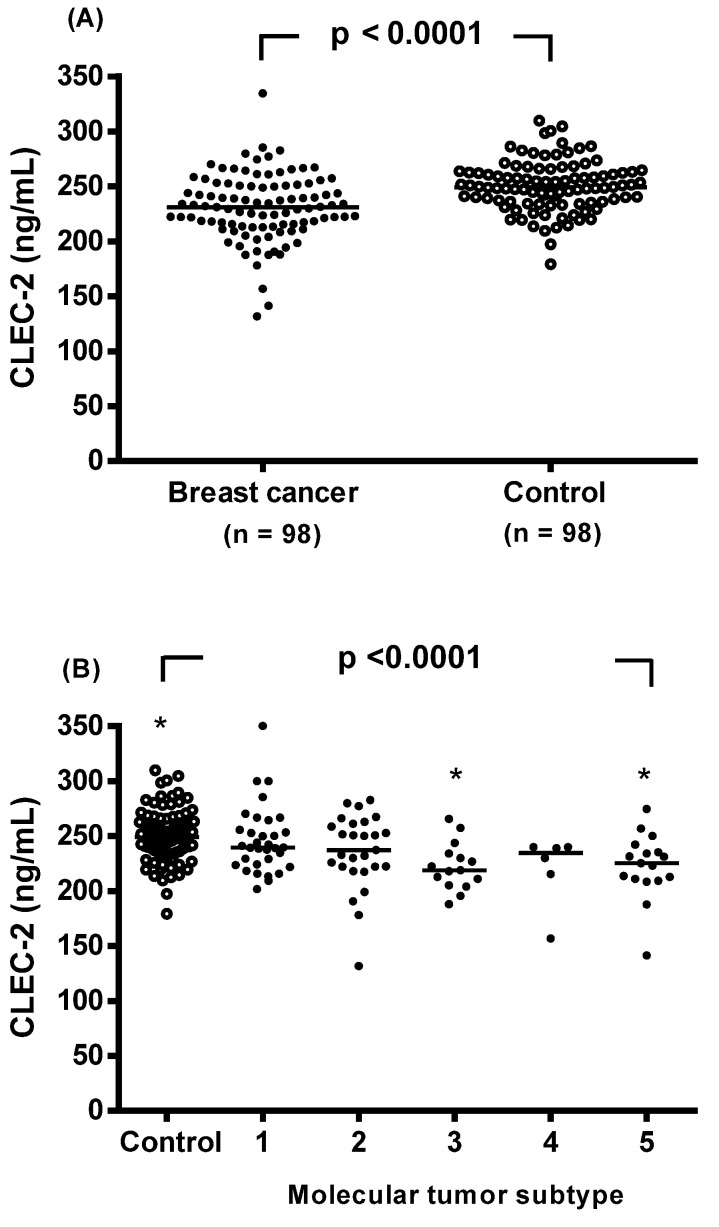 Figure 1
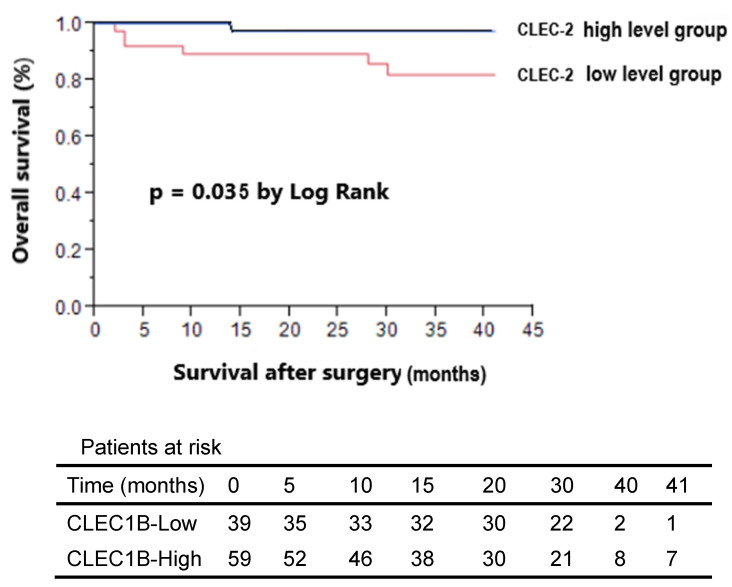 Figure 2
 Figure 3
Peer Reviews
No public reviews on file for this paper yet. If you reviewed it on a platform where reviews are public (OpenReview, ICLR, NeurIPS, ICML), you can paste yours below so the community can read it here.
Videos
No videos yet. Explain this paper in a talk, walkthrough, or lecture? Add one.
Taxonomy
TopicsInflammatory Biomarkers in Disease Prognosis · Extracellular vesicles in disease · Angiogenesis and VEGF in Cancer