Compact subsets of autism screening items predict clinical diagnoses with a machine learning analysis of the QCHAT-10
Lydia J. Sollis, Dennis P. Wall, Peter Y. Washington

TL;DR
This study shows that a short version of an autism screening tool can predict clinical diagnoses across different countries using machine learning.
Contribution
The study demonstrates that compact subsets of QCHAT-10 items can generalize to predict autism diagnoses in independent clinical settings.
Findings
Four-item models focusing on eye contact, gaze following, and pretend play predicted autism with high accuracy.
Machine learning models trained on New Zealand and Saudi Arabian data generalized to Polish clinical diagnoses.
Compact screening tools reduce burden and enable targeted digital phenotyping.
Abstract
Early identification improves life outcomes for individuals with autism. This study addresses a central question: do compact subsets of the most predictive QCHAT-10 items, when fed into machine learning (ML) models trained to reproduce the full questionnaire’s screening result, generalize to predicting clinician-established autism diagnoses in independent clinical settings? We applied ML to the 10-question QCHAT-10, training models on New Zealand (n = 1054) and Saudi Arabian (n = 506) datasets with QCHAT-derived labels and testing on Polish data with clinical diagnoses (n = 252). Recursive Feature Elimination identified four-item models retaining three common features: eye contact, following gaze direction, and pretend play. When tested on clinically-diagnosed Polish cases at the 0.3 prediction threshold, the New Zealand model achieved an AUROC of 85% ± 13 (sensitivity 91%, specificity…
Genes, proteins, chemicals, diseases, species, mutations and cell lines named across the full text — each resolved to its canonical identifier and authoritative record.
Click any figure to enlarge with its caption.
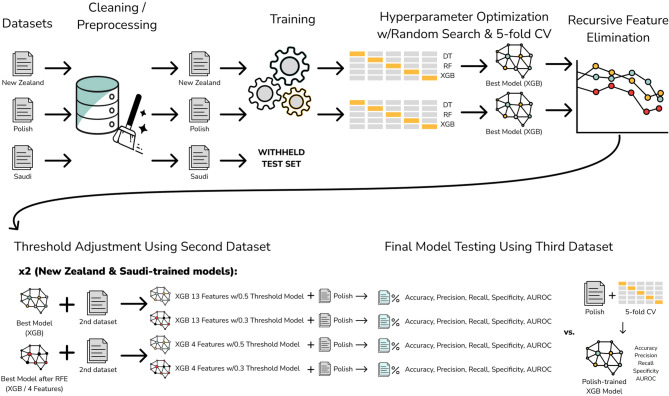 Figure 1
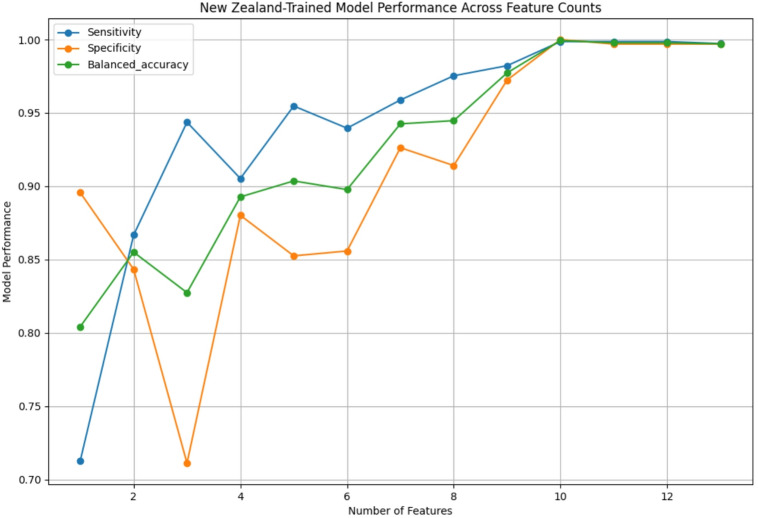 Figure 2
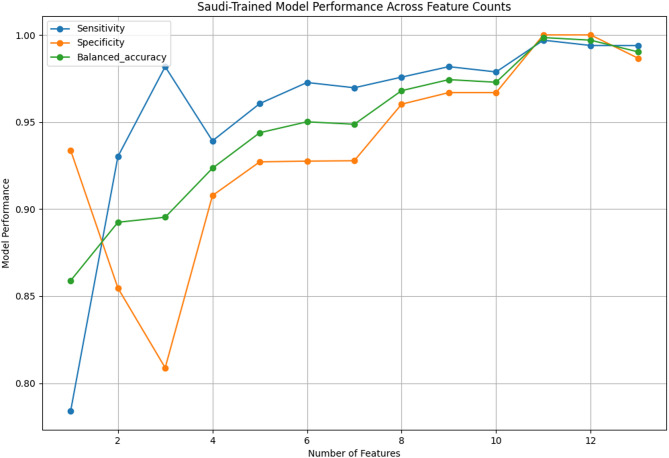 Figure 3
Peer Reviews
No public reviews on file for this paper yet. If you reviewed it on a platform where reviews are public (OpenReview, ICLR, NeurIPS, ICML), you can paste yours below so the community can read it here.
Videos
No videos yet. Explain this paper in a talk, walkthrough, or lecture? Add one.
Taxonomy
TopicsAutism Spectrum Disorder Research · Genomics and Rare Diseases · Genetics and Neurodevelopmental Disorders