Profiling associations of interactive ligand–receptors (HLA class I and KIR gene products) with the progression to type 1 diabetes among seroconverted participants
Lue Ping Zhao, George K. Papadopoulos, Benjamin J. McFarland, Jay S. Skyler, Hemang M. Parikh, William W. Kwok, Terry P. Lybrand, George P. Bondinas, Antonis K. Moustakas, Ruihan Wang, Chul-Woo Pyo, Wyatt C. Nelson, Daniel E. Geraghty, Åke Lernmark

TL;DR
This study explores how interactions between HLA class I and KIR genes affect the progression of type 1 diabetes.
Contribution
The study identifies specific ligand–receptor interactions that modestly influence type 1 diabetes progression and suggests a new pathogenic mechanism.
Findings
Nine HLA-A and 14 HLA-B ligands with corresponding KIR receptors showed modest associations with diabetes progression.
Structural analysis suggests electrostatic and van der Waals interactions stabilize these ligand–receptor complexes.
These interactions may alter type 1 diabetes progression through the C-terminus of HLA-I antigen-binding grooves.
Abstract
The aim of this work was to explore associations between type 1 diabetes progression from stages 1 or 2 to stage 3 and interacting ligand–receptor complexes of HLA class I (HLA-I) and KIR gene products. Applying next-generation sequencing technology to genotype HLA-I genes (HLA-A, -B, -C) and KIR genes (KIR2DL1, KIR2DL2, KIR2DL3, KIR2DL4, KIR2DL5, KIR2DS1, KIR2DS2, KIR2DS3, KIR2DS4, KIR2DS5, KIR3DL1, KIR3DL3, KIR3DS1, KIR2DP1, KIR3DP1) from 1215 participants in the Diabetes Prevention Trial-Type 1 (DPT-1) and the Diabetes Prevention Trial (TN07), we systematically explored associations of HLA-I–KIR ligand–receptor interactions (LRIs) with disease progression via a Cox regression model. We investigated the structural properties of identified LRI complexes. KIR and HLA-I genes had no or sporadic associations with disease progression. Out of all possible LRIs, nine HLA-A Ligands and 14…
Genes, proteins, chemicals, diseases, species, mutations and cell lines named across the full text — each resolved to its canonical identifier and authoritative record.
Click any figure to enlarge with its caption.
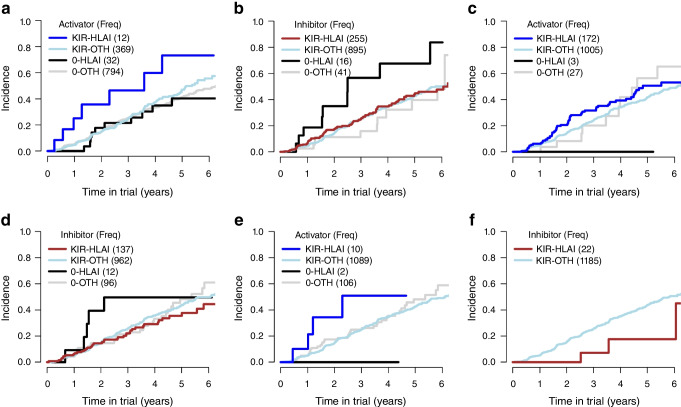 Figure 1
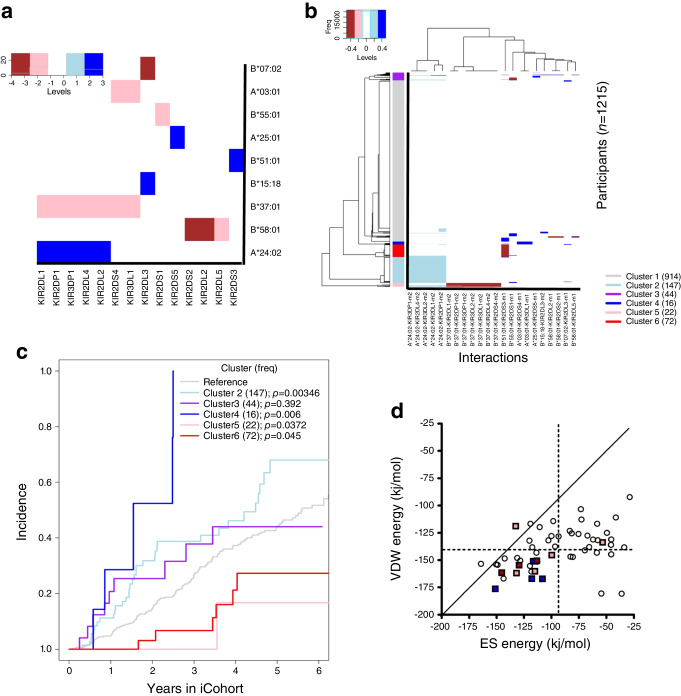 Figure 2
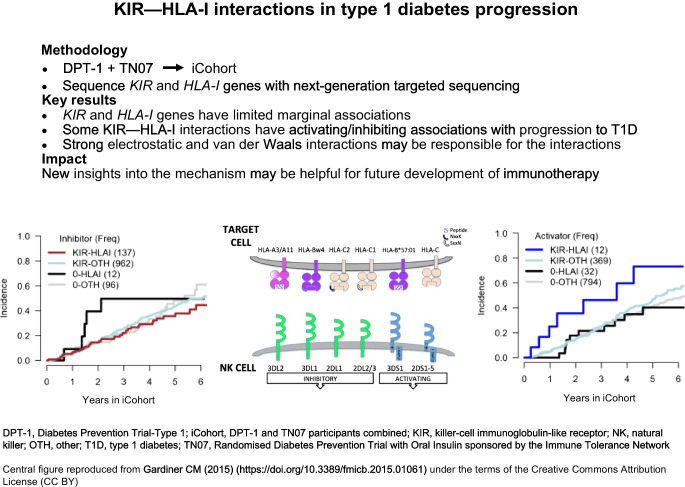 Figure 3
 Figure 4
Peer Reviews
No public reviews on file for this paper yet. If you reviewed it on a platform where reviews are public (OpenReview, ICLR, NeurIPS, ICML), you can paste yours below so the community can read it here.
Videos
No videos yet. Explain this paper in a talk, walkthrough, or lecture? Add one.
Taxonomy
TopicsDiabetes and associated disorders · Immune Cell Function and Interaction · T-cell and B-cell Immunology