Initiation of antipsychotic medication among refugees, non-refugee migrants, second-generation migrants, and Swedish-born adults with incident non-affective psychotic disorders
Daniela Mellin, Ellenor Mittendorfer-Rutz, Christopher J. de Montgomery, Alexis E. Cullen, Heidi Taipale

TL;DR
The study found that migrants in Sweden with non-affective psychosis were more likely to start with long-acting antipsychotics, possibly due to concerns about medication adherence.
Contribution
This is the first study to compare antipsychotic initiation patterns across different migrant groups and Swedish-born individuals with non-affective psychosis.
Findings
Refugees had lower initial antipsychotic use compared to other groups, but this difference disappeared after adjusting for sociodemographic and clinical factors.
Migrants were more likely to start with long-acting injectable and first-generation antipsychotics compared to Swedish-born individuals.
Younger age, higher education, and inpatient care were associated with antipsychotic initiation in both refugees and Swedish-born individuals.
Abstract
It is not known if there are differences in antipsychotic initiation between migrants and native-born individuals diagnosed with non-affective psychotic disorder. This study aimed to determine (1) potential differences in initiation rate and type of first antipsychotic medication between refugees, non-refugee migrants, second-generation migrants, and Swedish-born young adults with incident non-affective psychosis and (2) which sociodemographic and clinical factors are associated with initiation. This register-based cohort included 12,960 adults aged 18–35 years, residing in Sweden during 2007–2018, with an incident diagnosis of a non-affective psychotic disorder in inpatient or specialised outpatient care. Sociodemographic and clinical factors associated with antipsychotic initiation were determined using modified Poisson regression models yielding Relative Risk, RRs, and 95%…
Genes, proteins, chemicals, diseases, species, mutations and cell lines named across the full text — each resolved to its canonical identifier and authoritative record.
Click any figure to enlarge with its caption.
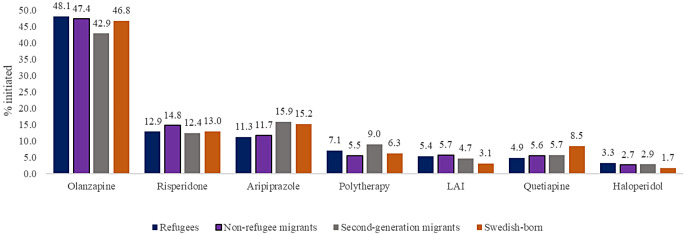 Figure 1
Peer Reviews
No public reviews on file for this paper yet. If you reviewed it on a platform where reviews are public (OpenReview, ICLR, NeurIPS, ICML), you can paste yours below so the community can read it here.
Videos
No videos yet. Explain this paper in a talk, walkthrough, or lecture? Add one.
Taxonomy
TopicsSchizophrenia research and treatment · Migration, Health and Trauma · Multiple Sclerosis Research Studies