Clustered Regularly Interspaced Short Palindromic Repeats (CRISPR)-Cas Unleashed: Transforming Gene Editing With Breakthroughs, Applications, and Ethical Dilemmas
Balasundari Ramesh, Adegbenro O Fakoya

TL;DR
CRISPR-Cas technology allows precise gene editing and has promising applications in treating genetic diseases, but raises ethical concerns.
Contribution
The paper provides an overview of CRISPR enzymes, their applications, and ethical implications.
Findings
CRISPR-Cas9 has been approved for treating sickle cell disease.
CRISPR holds promise for addressing various genetic disorders and diseases.
Ethical dilemmas accompany the rapid advancement of CRISPR technology.
Abstract
The most significant breakthrough in gene editing is the advent of the clustered regularly interspaced short palindromic repeats (CRISPR)-Cas system. This innovative technology enables scientists to insert or delete genes using specific enzymes, facilitating modifications to genomes that can influence an organism's phenotype. The Cas9 enzyme is the most widely used within the CRISPR framework and has already received approval for treating sickle cell disease, with many other applications likely to follow. As this rapidly evolving field continues to advance, it holds great promise for addressing genetic disorders and diseases. This article will explore the various enzymes available in the CRISPR system, the range of diseases and conditions that could be treated using this technology, alternative gene therapy methods, and the ethical considerations surrounding its use.
Genes, proteins, chemicals, diseases, species, mutations and cell lines named across the full text — each resolved to its canonical identifier and authoritative record.
Click any figure to enlarge with its caption.
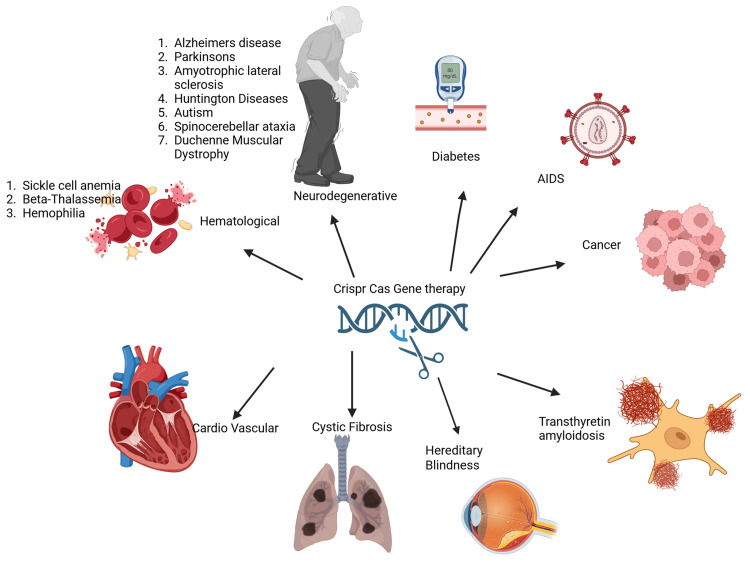 Figure 1
Peer Reviews
No public reviews on file for this paper yet. If you reviewed it on a platform where reviews are public (OpenReview, ICLR, NeurIPS, ICML), you can paste yours below so the community can read it here.
Videos
No videos yet. Explain this paper in a talk, walkthrough, or lecture? Add one.
Taxonomy
TopicsCRISPR and Genetic Engineering · Hemoglobinopathies and Related Disorders · Biotechnology and Related Fields