Evaluation of a Digital, Self-Administered, Cognitive Test Battery in Older Adult Patients Undergoing Abdominal Surgery: Nonrandomized Feasibility Trial
Anahita Amirpour, Markus Saarijärvi, Jeanette Eckerblad, Gabriela Markovic, Anders Thorell, Ulrica Nilsson, Lina Bergman

TL;DR
A digital cognitive test was tested in older adults before abdominal surgery and found to be feasible and easy to use, though recruitment challenges remain.
Contribution
This study introduces a digital, self-administered cognitive test battery as a feasible alternative for assessing neurocognitive function in older surgical patients.
Findings
The digital test battery demonstrated high usability and acceptability among older adult patients.
No cases of delayed neurocognitive recovery or major neurocognitive disorder were observed post-surgery.
Qualitative feedback from patients and nurses highlighted the test's importance and ease of use.
Abstract
Older adults undergoing surgeries face increased risks of postoperative neurocognitive disorders, which impair cognitive functions. Analog neurocognitive tests are commonly used, but digital tests offer faster, more accessible assessments. The primary aim of this study was to evaluate the feasibility of a digital cognitive test battery in older adults undergoing abdominal surgery. Feasibility included estimation of recruitment and retention rates, acceptability, perceived value, and usability of the test. The secondary aim was to explore outcome trajectories of cognition, depression, functional status, and quality of recovery. This nonrandomized feasibility study measured recruitment and retention rates using patient logs and expanded on these findings in semistructured interviews with nurses. Acceptability, perceived value, and usability were explored through interviews with patients…
Genes, proteins, chemicals, diseases, species, mutations and cell lines named across the full text — each resolved to its canonical identifier and authoritative record.
Click any figure to enlarge with its caption.
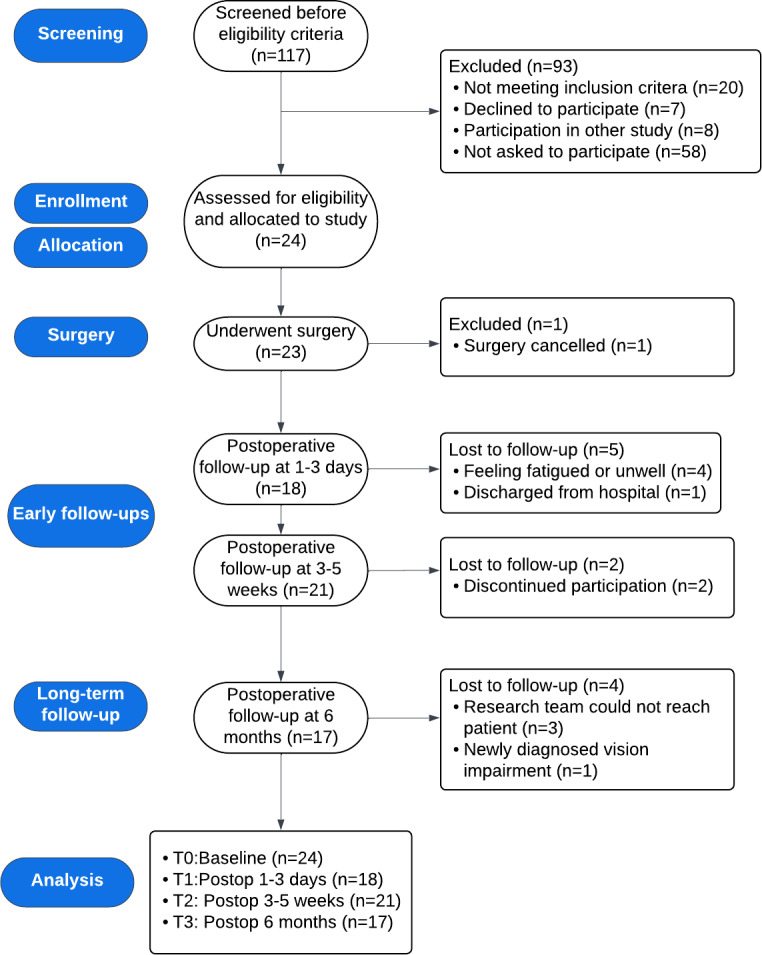 Figure 1
Peer Reviews
No public reviews on file for this paper yet. If you reviewed it on a platform where reviews are public (OpenReview, ICLR, NeurIPS, ICML), you can paste yours below so the community can read it here.
Videos
No videos yet. Explain this paper in a talk, walkthrough, or lecture? Add one.
Taxonomy
TopicsIntensive Care Unit Cognitive Disorders · Sepsis Diagnosis and Treatment · Anesthesia and Sedative Agents