A qualitative analysis of women’s reproductive agency and postpartum family planning in Maharashtra, India
Nandita Bhan, Edwin Elizabeth Thomas, Gennifer Kully, Mohan Ghule, Anita Raj, Lotus McDougal, Abhishek Singh, Sarah Averbach

TL;DR
This study explores why postpartum family planning is underused in rural India, highlighting issues like poor access, lack of women's agency, and community myths.
Contribution
The study introduces a thematic framework based on ecological systems theory to understand barriers to postpartum family planning in rural Maharashtra.
Findings
Marginalized communities face disproportionate barriers in accessing postpartum family planning services.
Women often require husband approval to use contraception, limiting their reproductive agency.
Health services are perceived as low-quality due to lack of information on contraceptive side effects.
Abstract
Despite the benefits of healthy birth spacing for mothers and infants, the use of postpartum family planning (PPFP) by women in India remains low. We qualitatively examined barriers to PPFP access and use to understand the intersections between women’s reproductive agency, fertility and contraceptive norms, and community interactions with health providers in rural Maharashtra, India. We conducted 62 qualitative in-depth interviews with postpartum women, husbands and mothers-in-law of postpartum women, frontline health workers (FLWs) and key community stakeholders in rural Maharashtra from March to May 2022. Semi-structured interview guides included probes related to knowledge of and access to PPFP services, contraceptive decision-making dynamics, interactions with health providers, community norms related to fertility and family planning, and existing and aspirational models for PPFP…
Genes, proteins, chemicals, diseases, species, mutations and cell lines named across the full text — each resolved to its canonical identifier and authoritative record.
Click any figure to enlarge with its caption.
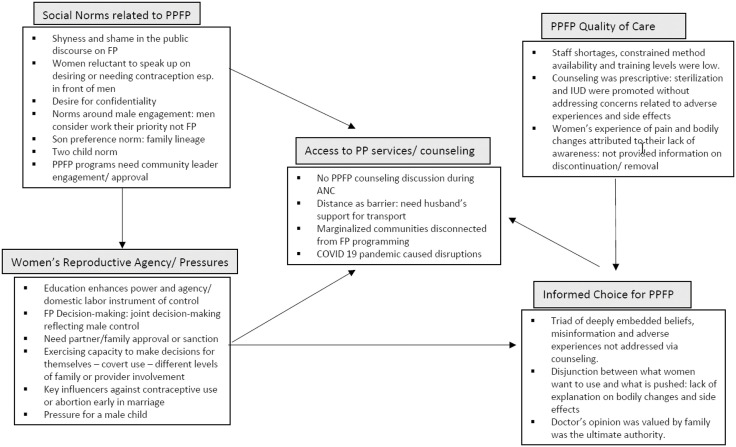 Figure 1
Peer Reviews
No public reviews on file for this paper yet. If you reviewed it on a platform where reviews are public (OpenReview, ICLR, NeurIPS, ICML), you can paste yours below so the community can read it here.
Videos
No videos yet. Explain this paper in a talk, walkthrough, or lecture? Add one.
Taxonomy
TopicsGlobal Maternal and Child Health · Reproductive Health and Contraception · Demographic Trends and Gender Preferences