Exploring healthcare staff experiences with a hybrid paper/digital health management information system and their perspectives on digitalization as an alternative – A Tanzanian qualitative case study on perinatal data
Mary Cronin, Lucy Munishi, Gaudensia A. Olomi, Modesta Mitao, Blandina T. Mmbaga, Jackline Somi, Jairy Khanga, Ali S. Khashan, Francis M. Pima, Simon Woodworth, Hamufare Dumisani Mugauri, Hamufare Dumisani Mugauri, Hamufare Dumisani Mugauri

TL;DR
This study explores healthcare workers' experiences with a mixed paper and digital health system in Tanzania and their views on switching to a fully digital system for better perinatal data management.
Contribution
The study provides new insights into the practical challenges and benefits of transitioning from hybrid to fully digital health systems in low-resource settings.
Findings
Hybrid systems cause inefficiencies in manual data entry, leading to data accuracy and retrieval issues.
Healthcare staff strongly support a fully digital system to improve data accuracy and reduce workload.
Successful digital transition requires training, integrated systems, and reliable infrastructure.
Abstract
Quality health data is essential to improve delivery and outcomes of healthcare. This study explores the experiences of healthcare staff in Kilimanjaro, Tanzania, using a hybrid paper and digital Health Management Information System, and their perspectives on transitioning to a fully digital system. It aims to understand current practices of perinatal data collection and utilisation and gather recommendations regarding the possible introduction of a fully digital HMIS (DHMIS). A case study design was employed; individual semi-structured interviews were undertaken with staff from four professions directly involved in data generation and use (n = 29), working in a range of healthcare settings. Thematic analysis was conducted using NVivo 12 software; it identified findings under four major themes, along with a series of recommendations on the implementation of the DHMIS. We found that…
Genes, proteins, chemicals, diseases, species, mutations and cell lines named across the full text — each resolved to its canonical identifier and authoritative record.
Click any figure to enlarge with its caption.
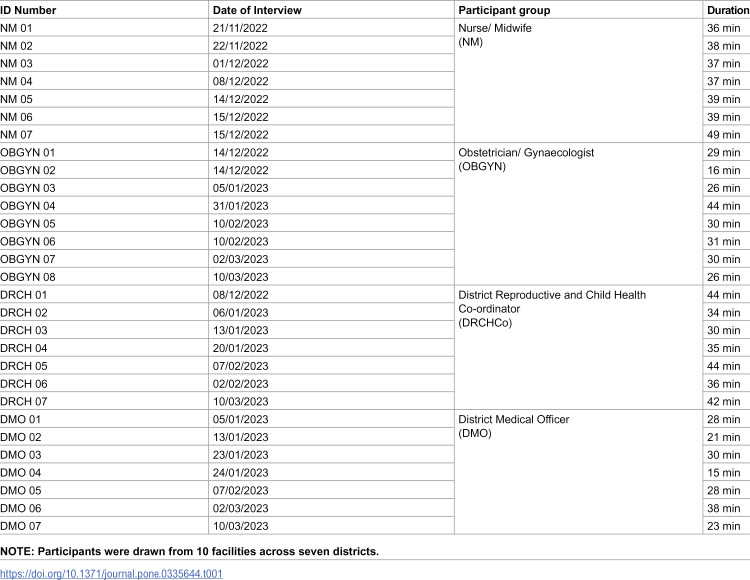 Figure 1
Peer Reviews
No public reviews on file for this paper yet. If you reviewed it on a platform where reviews are public (OpenReview, ICLR, NeurIPS, ICML), you can paste yours below so the community can read it here.
Videos
No videos yet. Explain this paper in a talk, walkthrough, or lecture? Add one.
Taxonomy
TopicsMobile Health and mHealth Applications · Electronic Health Records Systems · ICT in Developing Communities