Geometric modelling of 3D pore space using curve skeleton: Application to computational microbiology of soil organic matter mineralization
Zakaria Belghali, Olivier Monga, Mouad Klai, El Hassan Abdelwahed, Lucie Druoton, Valérie Pot, Philippe C. Baveye

TL;DR
This paper introduces a new method for modeling soil pore spaces using curve skeletons to improve computational simulations of microbial processes in soil.
Contribution
The novel approach uses curve skeletons to partition pore space into connected subsets for graph-based simulations.
Findings
Using curve skeletons reduces computational costs compared to traditional voxel-based methods.
The method allows for accurate simulation of microbial mineralization and diffusion processes.
The approach partitions pore space into connected subsets for graph-based modeling.
Abstract
Recent advances in 3D X-ray Computed Tomography (CT) sensors have stimulated research efforts to unveil the extremely complex micro-scale processes that control the activity of soil microorganisms. Classical methods for the numerical simulation of biological dynamics using meshes of voxels, such as the Lattice Boltzmann Method (LBM), tend to require long computation times. The use of more compact geometrical representations of the pore space can drastically decrease the computational cost of simulations. Recent research has introduced basic analytic volume primitives to define piece-wise approximations of the pore space to simulate drainage, diffusion, and microbial mineralization of organic matter in soils. Such approaches work well but a drawback is that they give rise to significant approximation errors caused by imposing a priori shapes to represent the pores. In the present…
Genes, proteins, chemicals, diseases, species, mutations and cell lines named across the full text — each resolved to its canonical identifier and authoritative record.
Click any figure to enlarge with its caption.
 Figure 1
 Figure 2
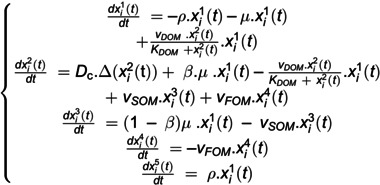 Figure 3
 Figure 4
 Figure 5
 Figure 6
 Figure 7
 Figure 8
 Figure 9
 Figure 10
 Figure 11
 Figure 12
 Figure 13
 Figure 14
 Figure 15
 Figure 16
 Figure 17
 Figure 18
 Figure 19
 Figure 20
 Figure 21
 Figure 22
 Figure 23
 Figure 24
 Figure 25
 Figure 26
 Figure 27
 Figure 28
 Figure 29
 Figure 30
 Figure 31
 Figure 32
 Figure 33
 Figure 34
 Figure 35
 Figure 36
 Figure 37
 Figure 38
 Figure 39
 Figure 40
 Figure 41
 Figure 42
 Figure 43
 Figure 44
 Figure 45
 Figure 46
 Figure 47
 Figure 48
 Figure 49
 Figure 50
Peer Reviews
No public reviews on file for this paper yet. If you reviewed it on a platform where reviews are public (OpenReview, ICLR, NeurIPS, ICML), you can paste yours below so the community can read it here.
Videos
No videos yet. Explain this paper in a talk, walkthrough, or lecture? Add one.
Taxonomy
TopicsLattice Boltzmann Simulation Studies · Enhanced Oil Recovery Techniques · Fecal contamination and water quality