An Unusual Presentation of Orbital Compartment Syndrome: A Case Report
Jillian Rosenblum

TL;DR
A man developed orbital compartment syndrome from pressure on his eye, requiring urgent treatment and highlighting the importance of quick diagnosis.
Contribution
This case report presents a rare and unusual presentation of orbital compartment syndrome caused by external compression.
Findings
Orbital compartment syndrome occurred due to external globe compression in a prone position.
Emergency treatment with lateral canthotomy significantly reduced intraocular pressure.
The patient also developed limb compartment syndrome and required dialysis for worsening renal failure.
Abstract
Orbital compartment syndrome (OCS) is a rare but high-morbidity emergency requiring prompt recognition and management. We present a case of a man who developed OCS from external compression of the globe while lying in a prone position. Initially obtunded and unable to provide any history, the patient exhibited anisocoria, which later progressed to severe chemosis and proptosis. Intraocular pressure reached nearly 100 millimeters of mercury, improving immediately after emergent lateral canthotomy with cantholysis. His course was complicated by ipsilateral limb compartment syndrome and worsening renal failure requiring dialysis. This case highlights the critical role emergency physicians play in the rapid diagnosis and treatment of orbital compartment syndrome.
Genes, proteins, chemicals, diseases, species, mutations and cell lines named across the full text — each resolved to its canonical identifier and authoritative record.
Click any figure to enlarge with its caption.
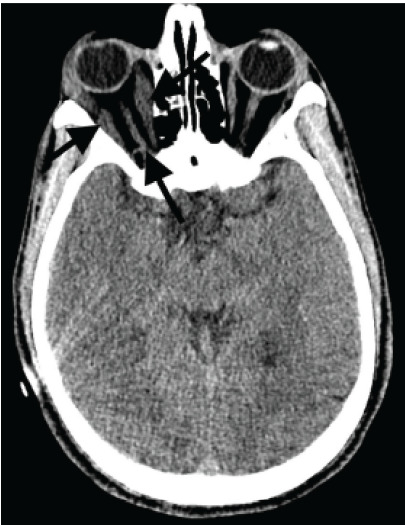 Figure 1
Peer Reviews
No public reviews on file for this paper yet. If you reviewed it on a platform where reviews are public (OpenReview, ICLR, NeurIPS, ICML), you can paste yours below so the community can read it here.
Videos
No videos yet. Explain this paper in a talk, walkthrough, or lecture? Add one.
Taxonomy
TopicsFacial Trauma and Fracture Management · Ophthalmology and Eye Disorders