Bilateral Carotid Artery Dissection After a Fall: A Case of Horner Syndrome Revealed on Examination
Eli Spevack, Zachary M Weisner, Evgenia Nokovich, Michelle Joyner, Lauren Exley

TL;DR
A 53-year-old woman developed bilateral carotid artery dissection after a fall, presenting with Horner syndrome, highlighting the importance of considering rare vascular injuries in trauma cases.
Contribution
This case report adds to the limited literature on bilateral traumatic carotid artery dissection with a delayed and asymmetric clinical presentation.
Findings
Bilateral internal carotid artery dissections were diagnosed using CT angiography and cerebral angiography.
Horner syndrome was a subtle but key clinical indicator of traumatic carotid artery dissection.
The patient was successfully treated with stent placement and anticoagulation therapy.
Abstract
Carotid artery dissections are uncommon but critical vascular injuries. They involve a tear to the intima, the innermost layer of the arterial wall, leading to formation of a false lumen. This false lumen can disrupt blood flow, weaken the wall, and lead to thrombus or rupture of the artery. Carotid artery dissections can occur spontaneously or in the setting of trauma. Traumatic carotid artery dissections (TCAD) are rare and occasionally present with third-order Horner syndrome, characterized by ipsilateral ptosis, miosis, and anhidrosis. The presence of subtle physical exam signs like Horner syndrome reinforces the importance of maintaining a high index of suspicion and obtaining vascular imaging in trauma-related cases. While there have been case reports of bilateral TCAD, these have been rarely reported in the literature. We present a case involving a 53-year-old female with no…
Genes, proteins, chemicals, diseases, species, mutations and cell lines named across the full text — each resolved to its canonical identifier and authoritative record.
Click any figure to enlarge with its caption.
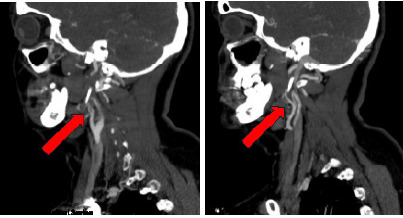 Figure 1
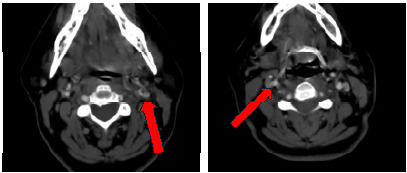 Figure 2
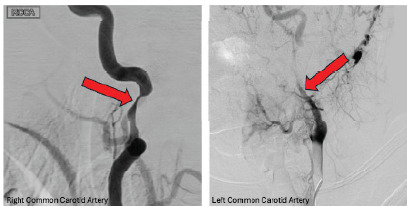 Figure 3
Peer Reviews
No public reviews on file for this paper yet. If you reviewed it on a platform where reviews are public (OpenReview, ICLR, NeurIPS, ICML), you can paste yours below so the community can read it here.
Videos
No videos yet. Explain this paper in a talk, walkthrough, or lecture? Add one.
Taxonomy
TopicsSympathectomy and Hyperhidrosis Treatments · Intracranial Aneurysms: Treatment and Complications · Cerebrovascular and Carotid Artery Diseases