Nonlinear associations of nighttime sleep and protective napping with depressive symptoms: a cross-sectional analysis from the China Family Panel Studies
Yanliqing Song, Yue Liu, Li Liu

TL;DR
This study finds that 7-9 hours of nighttime sleep and 30-90 minute naps are linked to fewer depressive symptoms in Chinese residents, with effects varying by age and health.
Contribution
The study identifies optimal sleep durations and reveals subgroup-specific effects of sleep on depression in a large Chinese population.
Findings
Nighttime sleep shows a U-shaped relationship with depression, with 8.5 hours being optimal.
Napping for 30–90 minutes is associated with lower depression risk without a nonlinear pattern.
Protective effects of sleep are stronger in young adults, while chronic disease and education influence depression in older adults.
Abstract
This study aims to explore the relationship between nap duration, nighttime sleep, and depression among Chinese residents and determine recommended sleep durations to provide scientific evidence for the prevention and control of depression. Based on the 2020 China Family Panel Studies, demographic data, health, and lifestyle information was obtained from the study subjects. A total of 6,795 valid samples were included. Logistic regression, restricted cubic splines, and stratified linear regression analyses were used to examine the associations between sleep behaviors and depression, including subgroup analyses by health status and age categories. A U-shaped dose–response relationship was observed between nighttime sleep and depressive symptoms (P-nonlinear < 0.001), with the lowest likelihood of depression occurring around 8.5 hours of sleep. A nap duration of 30–90 minutes was…
Genes, proteins, chemicals, diseases, species, mutations and cell lines named across the full text — each resolved to its canonical identifier and authoritative record.
Click any figure to enlarge with its caption.
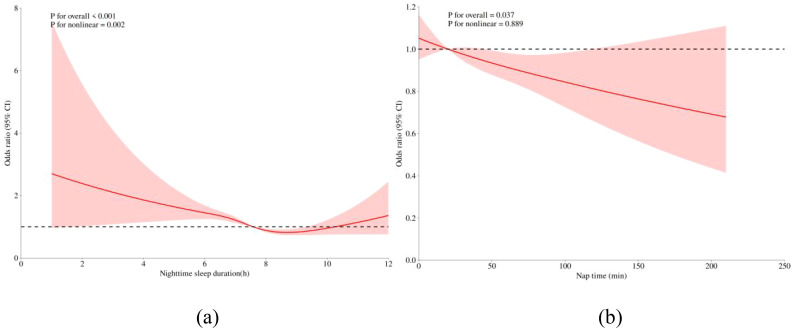 Figure 1
Peer Reviews
No public reviews on file for this paper yet. If you reviewed it on a platform where reviews are public (OpenReview, ICLR, NeurIPS, ICML), you can paste yours below so the community can read it here.
Videos
No videos yet. Explain this paper in a talk, walkthrough, or lecture? Add one.
Taxonomy
TopicsSleep and related disorders · Sleep and Work-Related Fatigue · Youth Substance Use and School Attendance