Cognitive domain-specific impairments and associated risk factors in type 2 diabetes mellitus: a cross-sectional observational study based on neuropsychological assessment from Xiamen, China
Xueling Xiao, Luling Chen, Jingqi Liu, Jiayan Cai, Manxiang Deng

TL;DR
This study finds that type 2 diabetes patients in Xiamen, China, often experience cognitive impairments, especially in executive function, and identifies age and high lipoprotein(a) as risk factors.
Contribution
The study provides new insights into cognitive impairments in T2DM patients from a subtropical Chinese region and identifies lipoprotein(a) as a novel risk factor.
Findings
Executive function was the most commonly affected cognitive domain in T2DM patients with cognitive impairment.
Older age and higher lipoprotein(a) levels were independently associated with cognitive impairment in T2DM patients.
Routine cognitive screening is recommended for older T2DM patients and those with vascular risk factors.
Abstract
Type 2 diabetes mellitus (T2DM) is associated with an increased risk of cognitive impairment, yet limited research has been conducted in subtropical regions of China. To examine the characteristics of cognitive impairment and identify the potential risk factors in patients with T2DM in Xiamen. This cross-sectional observational study included 84 patients with T2DM from Zhongshan Hospital Xiamen University. Patients were grouped based on their Montreal Cognitive Assessment (MoCA) scores into a cognitively impaired group (T2DM-CI group, n = 52) and a cognitively normal group (T2DM-NCI group, n = 32). Multivariate logistic regression was used to identify independent risk factors. Among the 52 patients in the T2DM-CI group, the most commonly affected cognitive domains were executive function (82.7%), language (75.0%), memory (61.5%), and attention (48.1%), with 59.6% exhibiting…
Genes, proteins, chemicals, diseases, species, mutations and cell lines named across the full text — each resolved to its canonical identifier and authoritative record.
Click any figure to enlarge with its caption.
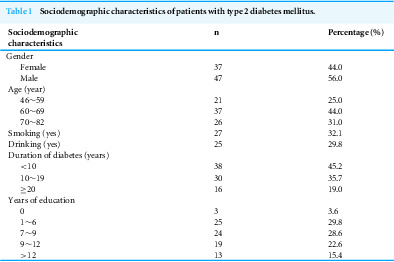 Figure 1
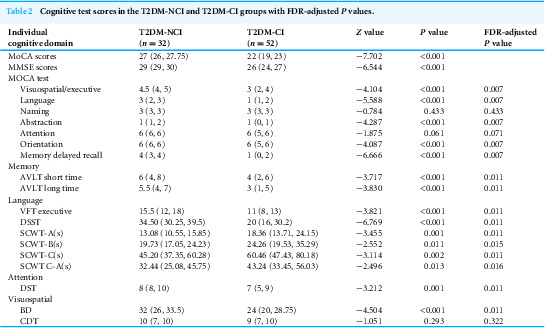 Figure 2
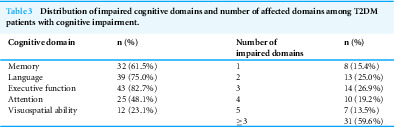 Figure 3
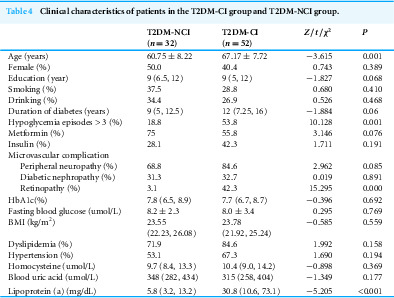 Figure 4
Peer Reviews
No public reviews on file for this paper yet. If you reviewed it on a platform where reviews are public (OpenReview, ICLR, NeurIPS, ICML), you can paste yours below so the community can read it here.
Videos
No videos yet. Explain this paper in a talk, walkthrough, or lecture? Add one.
Taxonomy
TopicsDementia and Cognitive Impairment Research · Neurological Disease Mechanisms and Treatments · Alzheimer's disease research and treatments