Dorobaea linearifolia (Asteraceae, Senecioneae), a distinctive new species of the subtropical montane forests of central Peru

Abstract
Genes, proteins, chemicals, diseases, species, mutations and cell lines named across the full text — each resolved to its canonical identifier and authoritative record.
Click any figure to enlarge with its caption.
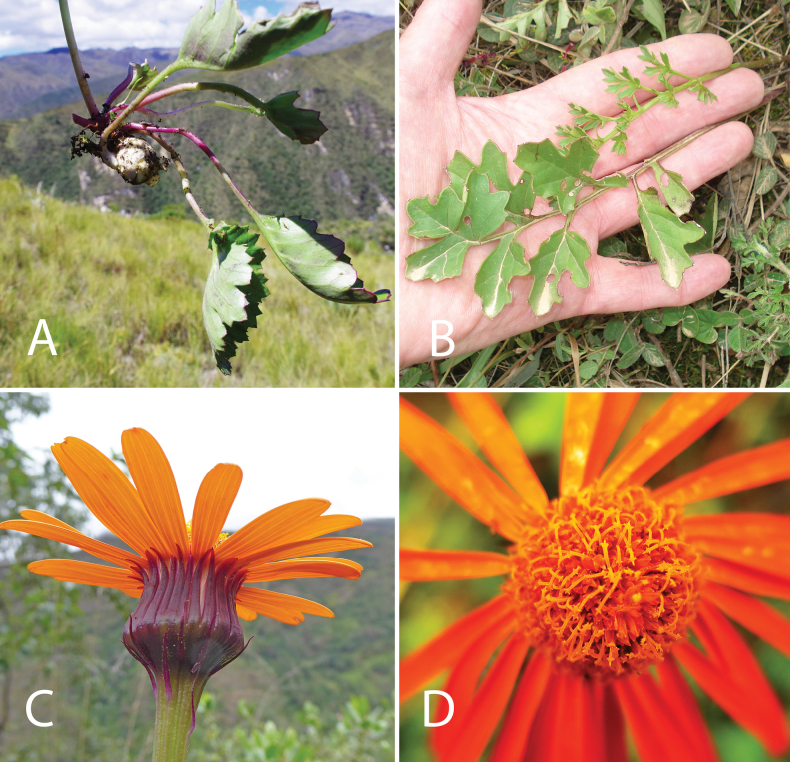 Figure 1
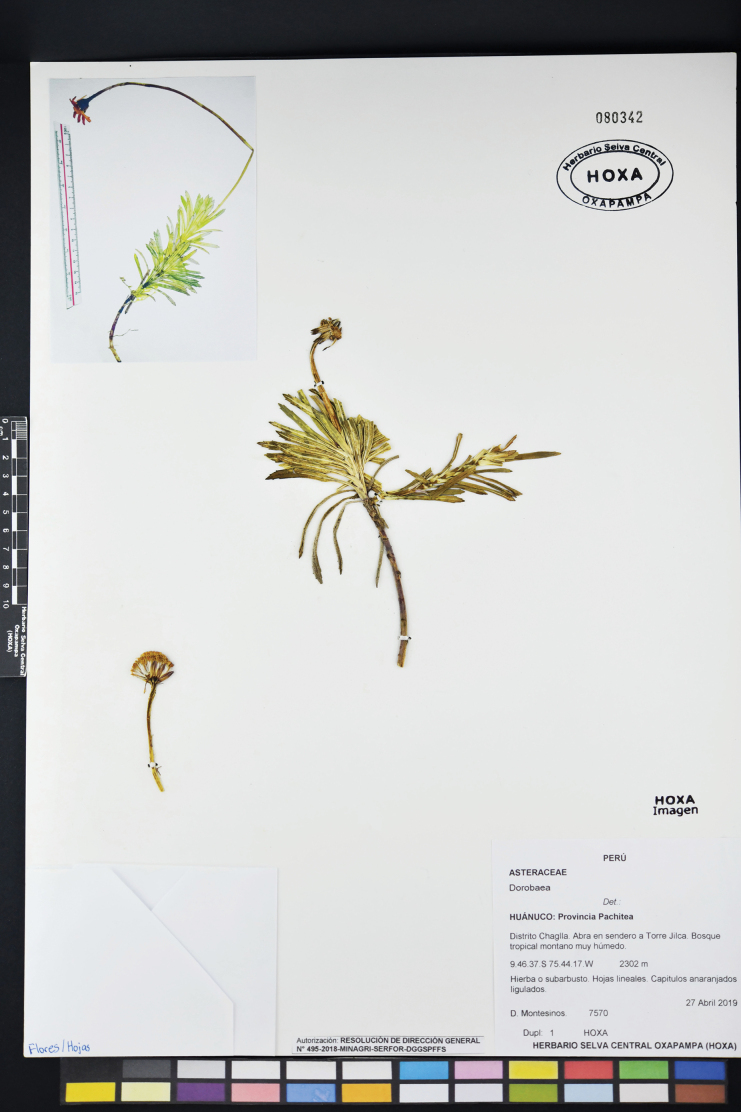 Figure 2
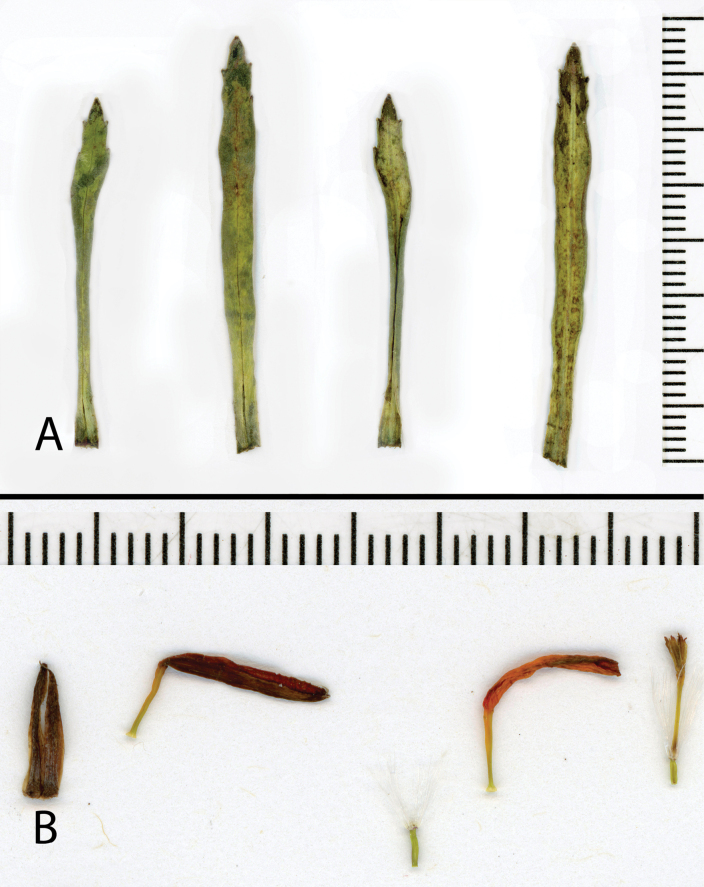 Figure 3
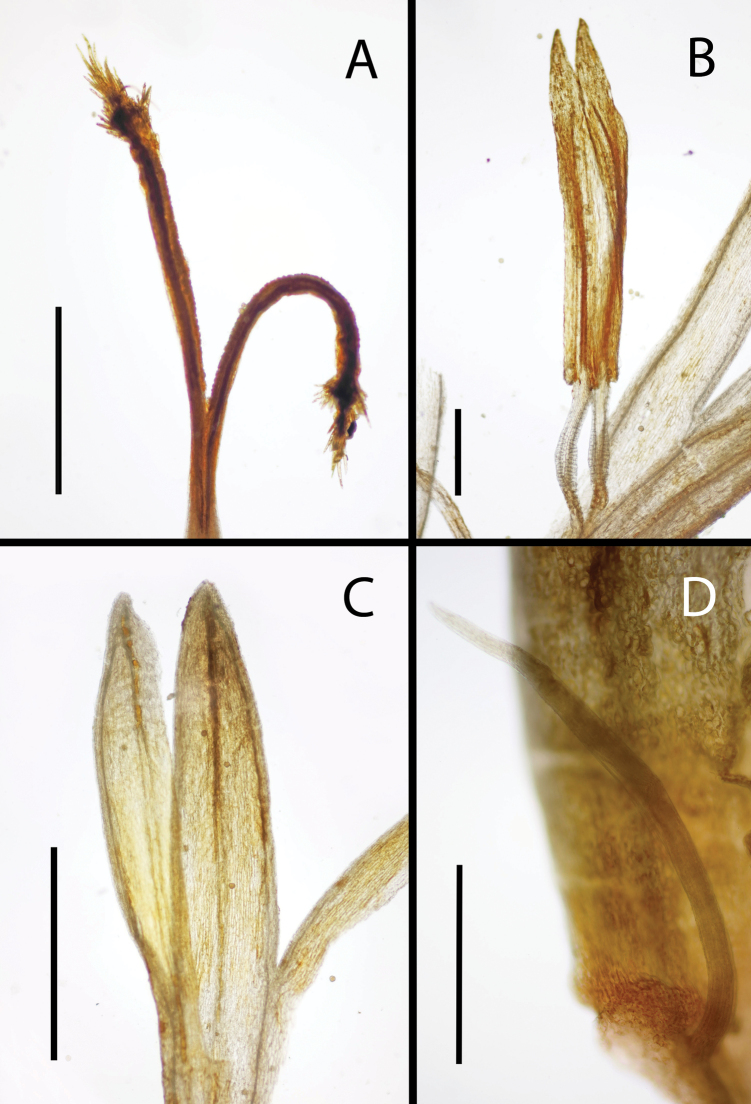 Figure 4
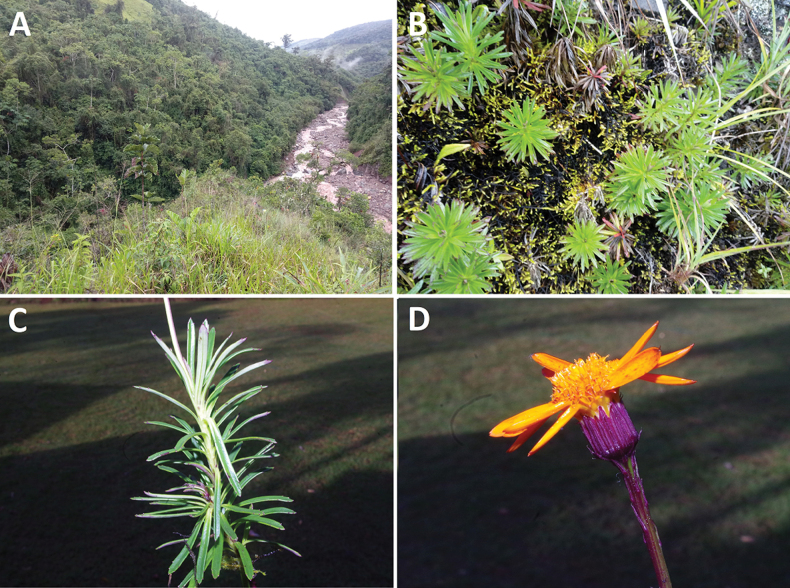 Figure 5
| 1a | Leaf lamina short, linear to oblanceolate, densely clustered along stems with spiraled arrangement; leaves briefly dentate; stems glabrous |
|
| 1b | Leaves elongate, broad in outline, mostly basal |
|
| 2a | Leaf lamina lanceolate to narrowly elliptic, lobes obtuse; ray limbs yellow |
|
| 2b | Leaf lamina ovate, elliptic-oblong, orbiculate or runcinate; ray limbs orange or yellow |
|
| 3a | Leaf lamina deeply lobed almost to the rachis; lobes rounded; margin serrate |
|
| 3b | Leaf lamina ovate to ovate-elliptic, shallowly lobed with obtuse lobes; basal rosettes present, leaves broad and rigid; ray limbs orange |
|
| Character |
|
|
|
|
|---|---|---|---|---|
| Habitat & ecology | Humid montane forest, 2300 m, forest edges and ravines | Dry Andean valleys, 2000–4260 m | Dry hills, 2000–4150 m | Cloud forest, 2400–3680 m |
| Geographic distribution | Eastern slopes of Huánuco, Central Peru | Colombia, Ecuador and North Peru | South Ecuador | North Peru (Amazonas) |
| Distinctive features | Narrowly linear leaves, densely spiraled phyllotaxis, glabrous stems | Strongly dissected leaves with rounded lobes | Deeply dissected leaves with serrate edges | Broad leaves with rigid texture and basal rosettes |
| Leaf arrangement | Caulescent, densely spiralled in lower half of stem | Radical, long-petiolate | Radical, long-petiolate | Rosulate |
| Leaf form | Linear to narrowly oblanceolate | Deeply pinnatipartite with 15–17 lobes | Deeply pinnatipartite with serrate lobes | Ovate to ovate-elliptic, shallowly lobed |
| Leaf size (cm) | 3–4.5 × 0.1–0.4 | ca. 5 × 1.2 | ca. 4 × 1.5 | 4–8 × 2–4 |
| Leaf base | Slightly broadened, not clasping | Adnate-sessile | Adnate-sessile | Cordate or truncate |
| Leaf margin | Entire to slightly serrulate near apex | Crenate-lobed | Sharply serrate-incised | Shallowly lobed, obtuse lobes |
| Leaf indumentum | Glabrous to sparsely hairy at base | Glabrous | Glabrous | Glabrous or minutely hairy on upper ribs |
| Involucre size (mm) | 12–14 long, involucre 10–12 wide | ~15 involucre | ~15 involucre | 14–15 involucre |
| Ray florets (number and color) | 11–14, orange, narrowly oblanceolate | ~22, ligulate, yellow | 22–24, ligulate, orange | ~22, ligulate, yellow |
Peer Reviews
No public reviews on file for this paper yet. If you reviewed it on a platform where reviews are public (OpenReview, ICLR, NeurIPS, ICML), you can paste yours below so the community can read it here.
Videos
No videos yet. Explain this paper in a talk, walkthrough, or lecture? Add one.
Taxonomy
TopicsSesquiterpenes and Asteraceae Studies · Plant Diversity and Evolution · Fern and Epiphyte Biology
Introduction
Dorobaea Cass. (Cassini 1827) (Asteraceae, Senecioneae, Senecioninae), is a paucispeciose genus known from mid to high elevations in the Andes of Colombia, Ecuador, and Peru. Nordenstam (1978: fig. 24) resurrected then monotypic Dorobaea from Senecio L. citing its subglabrous scapose usually rosulate habit and convex-tipped penicillate-appendiculate styles as supporting its distinctiveness, and by balusterform anther collars placed both genera within subtribe Senecioninae. Nordenstam and Pruski (1995) raised to three the number of species recognized in Dorobaea by including two further subglabrous rosulate scapose herbaceous former members of Senecio. Here, based on herbaceous subscapose habit, subglabrous vestiture, and convex-tipped penicillate-appendiculate styles, we describe in Dorobaea the new cauline-leaved D. linearifolia Montesinos & Pruski from Andean Peru, and briefly distinguish Dorobaea from the regional genera that Nordenstam et al. (2009) placed in the same clade. The new species is characterized by radiate capitula, narrowly tubular-funnelform (limb not campanulate as in Senecio) disc floret corollas with relatively long tubes, disk style branches papillose, and usually has pinnatifid leaves in basal rosettes, having a small number of stem leaves near the base. Although, the leaves are typically obviously pinnatifid, there is an occasional tendency toward few-lobed leaves, namely especially Dorobaea callacallensis. (Cuatrec.) B.Nord. & Pruski (Nordenstam and Pruski 1995). The long naked peduncles of the monocephalous capitulescences of Dorobaea are typically bracteate-leaved. The ray florets of Dorobaea are usually yellow, but D. laciniata B. Nord. & Pruski (Nordenstam and Pruski 1995) may have yellow or orange ray corollas. While the corolla variation is striking to human eyes, the actual color spectrum variation to pollinators is slight. We do not currently consider ray color to be specifically diagnostic, but it should be noted that Dorobaea linearifolia appears to be consistently orange-rayed. While D. linearifolia has the essential genus floral microcharacters as well as the long monocephalous naked capitulescences typical of the genus, it obviously differs from the three other species by its simple (vs. pinnatifid) leaves that are proximal-cauline (vs. basically in basal rosettes or nearly so). The growth habit is fairly a different form from the other species of Dorobaea, and it seems unlikely that the plants described here are merely aberrant plants of admittedly variable D. callacallensis. Dorobaea linearifolia is thus described here, and this description is supplemented by photographs of the florets and leaves from the fragmentary holotype specimen. As expanded, Dorobaea remains similar to Talamancalia H.Rob. & Cuatrec. (Robinson and Cuatrecasas 1994) and Lomanthus B.Nord. & Pelser (Nordenstam et al. 2009), both of which have similar appendiculate disc styles.
According to Pelser et al. (2007), Dorobaea is included in a strongly supported molecular subclade together with Charadranaetes Janovec & H.Rob. (Janovec and Robinson 1997), Garcibarrigoa Cuatrec. (Cuatrecasas 1986), Jessea H.Rob. & Cuatrec. (Robinson and Cuatrecasas 1994), Pseudogynoxys (Greenm.) Cabrera (Cabrera 1950) and Talamancalia H.Rob. & Cuatrec., based on Hind (2022) studies. Further phylogenetic information is yet unknown for these genera.
Charadranaetes Janovec & H.Rob. and Jessea are Central American endemics (Pruski and Robinson 2018), as well as other relatives Rockhausenia (Hind 2022) and Werneria (Kunth 1820) s. str. have connate (vs. free) phyllaries, each of these four genera thereby differing from Dorobaea. North Peruvian Angeldiazia M.O.Dillon & Zapata (Dillon and Zapata Cruz 2010) is ecalyculate and disciform-capitulate (Dillon and Sagástegui Alva 1999), north Peruvian Caxamarca M.O.Dillon & Sagást. (Dillon and Sagástegui Alva 1999) has fistulose stems and lacks penicillate-appendiculate styles (Dillon and Zapata Cruz 2010), and Bolivia Chaetacalia Pruski (Pruski 2021) has disciform capitula, caudate anthers, and abaxial-distally papillose apically penicillate-appendiculate style branches (Pruski 2021), all three genera thereby distinguished from Dorobaea. Colombia-centered Garcibarrigoa is a shrub with broadly auriculate-based leaves (Cuatrecasas 1986), and Pseudogynoxys is a vine with triangular-cellular-appendiculate-styles (Pruski 1996), and although both genera are orange-flowered recalling Dorobaea, they are distinct generically from Dorobaea. Basically, no genera of the Dorobaea clade seems confusable with our expanded concept of Dorobaea.
Our concept of Dorobaea includes four species, and we characterize the members of the genus as being perennial subglabrous low herbs with basal or mostly proximally disposed leaves and by scapose or subscapose erect long-pedunculate monocephalous calyculate radiate moderately large capitula. The scapes or peduncles of Dorobaea are sparsely narrowly bracteolate, with their bracts merging distally into the few to several linear divided calycules which is characteristic of the genus. The ray corollas of Dorobaea are usually yellow, but D. laciniata has either yellow or orange ray corollas (Fig. 1C, D), and D. linearifolia appears to consistently have orange ray corollas (Fig. 3B). While the corolla variation is striking to human eyes, the actual color spectrum variation to pollinators is slight and we do not take ray color as specifically diagnostic. The ray florets of Dorobaea linearifolia have styles lacking elongate subapical spreading papillae but often have several staminodia (Fig. 4D). Elsewhere in Senecioneae rays with staminodia are rarely encountered. The disk corollas of Dorobaea are gradually funnelform with tubes about as long as the limb, the disk corolla limbs have five moderately long lobes, each with a medial resin duct (Fig. 4C). The anthers of Dorobaea are ecaudate (Fig. 4B), and the disk style branches are gradually papillose-apiculate with subapical spreading lateral papillae (Fig. 4A).
Select characters of rosulate species of Dorobaea in Amazonas and Ancash, northern Peru. A. Dorobaea callacallensis (Cuatrec.) B.Nord. & Pruski, caudex and lobed leaves of basal rosette; B. D. laciniata B.Nord. & Pruski, two pinnatisect leaves of same caudex, the longer leaf with the broader segments is an outer leaf of the rosette, the inner and the shorter leaf with narrow segments is an inner younger rosette leaf; collections of the non-published superlaciniata variant of Bertil Nordenstam have only narrow-segmented leaves; C. D. laciniata, capitulum showing the many purple phyllaries involucre, Dorobaeas with similar urceolate capitula match the urceolata variant of Bertil Nordenstam; D. D. laciniata, capitulum in high-contrast showing the penicillate-appendiculate yellow style branches. (A. D. callacallensis (Cuatr.) B.Nord. & Pruski, Leymebamba, unvouchered, photograph by Daniel Montesinos; B. D. laciniata B.Nord. & Pruski, Chachapoyas, Pruski & Ortiz 4997, photograph by John Pruski, showing the superlaciniata variant of Bertil Nordenstam and the typical leaf on a single caudex; C. D. laciniata, Huacchis in Huánuco, Montesinos 5509, photograph by Daniel Montesinos; D. D. laciniata, Molinopampa, Pruski & Ortiz 4978, photograph by Rosa Ortiz).
This study contributes to the understanding of species diversity and endemism within Andean Senecioneae and underscores the value of continued botanical exploration in poorly surveyed montane ecosystems of central Peru.
Methods
This study was conducted between 2018 and 2025 in the central Andes of Peru, focusing on montane Asteraceae of the tribe Senecioneae. Dorobaea linearifolia was discovered in a single population in humid montane forests of Huánuco, near the Pasco border. Additional surveys explored nearby areas to assess distribution and habitat. The recent field surveys done in the area did not lead to finding the novelty due to deforestation as also noted by Montesinos-Tubée (2025). Specimens were collected following standard floristic protocols, prioritizing reproductive material, and later processed according to herbarium practices. Comparative morphological analyses were based on fresh and dried material, using an Olympus SZX10 stereomicroscope. Relevant Dorobaea and related Senecioneae were studied through type material, protologues, and herbarium specimens from B, CPUN, HOXA, HSP, HUT, K, MO, PRC and USM (abbreviations according to Thiers 2025, continuously updated). Diagnostic features were recorded via macrophotography, supporting the recognition of D. linearifolia as a distinct species.
Results
Dorobaea
linearifolia
Taxon classificationPlantaeAsteralesAsteraceae
Montesinos & Pruski sp. nov.
177A1C84-61A9-56DD-B754-A8256862271C
urn:lsid:ipni.org:names:77371259-1
Type.
Peru • Dept. Huánuco, Prov. Pachitea, Dist. Chaglla, Locality: Path by the pass between Monopampa and Torre Jirca, 2302 m, 09°46'37"S, 75°44'17"W, 27 Apr 2019, D. Montesinos 7570 (Holotype: HOXA-080342!; isotype: MO-5452663!). Figs 2, 3A, B, 4A–D, 5A–D.
Dorobaea linearifolia (Montesinos 7570, Holotype HOXA-080342).
Diagnosis.
Dorobaea linearifolia is distinguished by narrowly linear to narrowly oblanceolate leaves (3–4.5 × 0.1–0.4 cm) densely spiraled on the lower half of the caulescent stem, with entire to slightly serrulate margins and glabrous to sparsely hairy bases. It produces a solitary terminal capitulum with a 12–14 mm involucre and 11–14 narrow, orange ray florets with red edges. These features distinctly separate it from D. callacallensis, D. laciniata, and D. pimpinellifolia, which have broader, lobed or rosulate leaves and single-headed inflorescences.
Dorobaea linearifolia. A. Leaves, the two on left showing adaxial surface, the two on the right showing abaxial surface; B. Phyllaries, ray corolla, ray ovary, ray corolla, disk florets (from left to right). All from the isotype: Montesinos 7570 [MO-5452663]).
Select microcharacters of Dorobaea linearifolia. A. Disk style branches showing convex apex with lateral and also the gradually elongated apical papillae; the distal abaxial surface of the branch is smooth; B. Two anthers (center of image; the dissected corolla is towards the lower right and lower left) showing long-triangular apical appendage and narrowly balusterform collars; C. Dissected disk floret showing parts of three corolla lobes, each with a medial resin duct; D. Staminode of a ray floret (adaxial view), curving from lower right to upper left; the staminode shows no development of a filament collar. Scale bars: 1 mm (A, C); 0.5 mm (B, D) (from an unmounted duplicate of Montesinos 7570).
A. Subtropical montane forest of Torre Jirca (2302 m) where the new species was found; B. Sprouts of leafy stems seen vertically; C. Stems densely covered by leaves; D. Capitulescence.
Description.
Simple-stemmed caulescent-leaved perennial herbs, 20–70 cm tall, growing in small groups of up to 20 stems/plants, possibly from the same underground caudex system, individual stems leafy from base to mid-stem; stems erect or ascending, densely spiral-leaved in proximal half, herbage glabrous or nearly so. Rootstock rhizomatous, more or less fibrous, taproot nearly 2 mm diam., pale white with reddish surface in the upper section, rootlets white, fleshy, more or less equal in diam. (0.4–0.6 mm) and covered with thin hairs of about 0.1–0.35 mm long. Leaves sessile and slightly broadened at base, 30–75 per stem, not obviously clasping, moderately dense-clustered in proximal half of stem and much longer than the very short internodes; blade 3–4. 5 × 0.1–0.4 cm, linear to more frequently very narrowly oblanceolate, usually slightly broader at base and apex but extended middle portion of the blade with margins revolute, thus appearing narrower at midblade, with 1–2 pairs of remote leaves per side in apical ca. 0.6 cm of blade, midrib very narrow, impressed adaxially, broad, flat, and not at all prominent abaxially, secondary veins not seen and presumably basically obsolete, base slightly broadened (ca. 2 mm wide) and flat towards stem, margins revolute or at least drying so, entire except at the 1–2-serrulate apex, serrulations to 0.5 mm deep, forward-directed, apex acute, surfaces pale greyish-green on the underside, dark green and shiny in the upperside, glabrous throughout except at the base of young leaves (basal and single trichomes 0.1–0.3 mm long). Cauline leaves, alternate, sessile; blade, linear-oblong, pale purple to purple, purple-coloured, surface glabrous, and apex aristulate, margins with scattered trichomes of about 0.1–0.3 mm long, mostly located at the base of the upperside of young bracteoles adhered to the involucre. Capitulescence of a single terminal capitulum per stem, peduncle erect or ascending, to about 20 cm long, green but sometimes tingled with purple. Peduncles glabrous except by the scattered presence of trichomes of about 0.1–0.3 mm long, surface varying in colour from light green to purple to yellowish red with age. Capitula radiate, 12–14 mm long, calyculate; involucre 10–12 mm diam., campanulate, the florets held about half again above involucre tips; phyllaries uniseriate, 11–13, 7.5–8.5 × ca. 1 mm, lanceolate, purplish, glabrous, apex acuminate; calycular bracts few, linear, 3–4 mm long, usually less than 1/2 the length of the involucre; Capitulum c. 8–10 mm in diam.; receptacle (clinanthium) epaleate, slightly convex, ca. 1 mm high, 3–4 mm in diam.. Ray florets 11–14, pistillate; corolla glabrous, tube ca. 5.5 mm long, yellow-green, limb orange, spreading laterally from involucre, 9–10 × 1.5–2 mm, narrowly oblanceolate, 4-nerved, minutely 3-denticulate; ray limb margins narrowly dark red coloured and scarcely covered with thin trichomes of less than 0.1 mm long. Disc florets ca. 60–80, bisexual; corolla 7–8 mm long, narrowly funnelform, limb (yellowish-)orange, tube yellow-green, glabrous throughout, tube and throat not very distinct from each other, lobes ca. 1–2 mm long, lanceolate, erect; anthers pale, ca. 1.8 mm long, endothecial tissue radial, collar balusterform; styles appendiculate, branches recurved, ca. 1 mm long, stigmatic surface 2-banded and fertile to branch apex, dark orange, apical and apical-lateral papillae, 0.1–0.2 mm long, sterile. Pollen grains white, orbicular, 0.06–0.07 mm diam., surface is covered with spinules, typically with entire distal ends and acute apices. Cypselae 2–3.2 mm long, green to pale-brown, 10-nerved, carpopodium 0.1–0.2 mm long; pappus consists of numerous white capillary bristles that vary in texture from smooth to scabridulous, typically measuring 6–8 mm in length, covered with fine, thin, and minute setulose (hair-like) outgrowths along their surface, in disc florets, the pappus bristles are relatively shorter, extending only to about the middle of the corolla throat
Key to the species of Dorobaea (developed from Nordenstam and Pruski 1995)
**: **
Discussion
Dorobaea linearifolia is distinct from its congeners (Table 1) by its habitat and morphology: it occupies humid montane forests at ~2300 m in Central Peru, unlike D. pimpinellifolia and D. laciniata which are found in drier Andean valleys and hills between 2000–4260 m and 2000–4150 m respectively, and D. callacallensis inhabiting cloud forests at 2400–3680 m. Morphologically, D. linearifolia is a small perennial herb (20–70 cm) with stems bearing densely spiraled, narrowly linear to narrowly oblanceolate leaves measuring 3–4.5 × 0.1–0.4 cm with mostly entire margins, versus the large, strongly dissected, petiolate leaves of D. pimpinellifolia (~5 × 1.2 cm), deeply pinnatipartite leaves with serrate lobes in D. laciniata, and broad, ovate-elliptic, shallowly lobed leaves (4–8 × 2–4 cm) in D. callacallensis, which has a rosette leaf arrangement rather than caulescent. The involucre of D. linearifolia measures 12–14 mm long and 10–12 mm wide with 11–14 narrow, orange ray florets with red edges, compared to larger involucres (~14–15 mm) bearing ~22–24 broader ray florets in yellow or orange in the other species. These differences in leaf size and shape, leaf arrangement, and capitulum structure, combined with its specific ecological niche, clearly separate D. linearifolia from D. pimpinellifolia, D. laciniata, and D. callacallensis within the genus. D. linearifolia is distinct from the genus Talamancalia species in several key aspects. It is a small perennial herb (20–70 cm) with simple, upright stems from a rhizomatous base, while Talamancalia consists of large, branching shrubs up to 2 m tall. The leaves of D. linearifolia are narrow, smooth, sessile, and entire with rolled edges, unlike the ovate, lobed, often hairy, petiolate leaves with clasping bases typical of Talamancalia. Its solitary terminal flower head has fewer, smooth phyllaries and narrow, orange ray florets with red edges, whereas Talamancalia has loose clusters of many heads with more phyllaries in multiple series and broader, short ray florets without papillae. Microscopically, Dorobaea fruits (cypselae) are smooth to slightly hairy with a rough pappus, contrasting with the bumpy, mucilaginous fruits and easily deciduous four-row pappus of Talamancalia.
Table 1.: Diagnostic morphological differences between Dorobaea linearifolia and related species.
Until now, Dorobaea was thought to exclusively be a genus of rosulate herbs (Fig. 1A, B), but some lower elevational collections Dorobaea have both basal and stem leaves present, and here we describe low-elevational proximally cauline-leaved Dorobaea linearifolia. The leaves in three species of Dorobaea are few and rosulate, in two species of Dorobaea are petiolate with long pinnatipartite blades, in D. callacallensis leaf blades few-lobed and ovate, and in D. linearifolia the leaves are densely inserted sessile and linear to narrowly oblanceolate. Dorobaea linearifolia is a subglabrous subscapose radiate-capitulate herb and does not violate the macromorphologically. Moreover, D. linearifolia is seen to have microcharacters (Fig. 4) in corollas form and nervation, anthers, and styles that prove to be consistent with its placement in Dorobaea. Dorobaea linearifolia is thus described here, and this description is supplemented by photographs of the florets and leaves from the fragmentary holotype specimen.
Distribution ecology
Dorobaea linearifolia is a montane species endemic to a narrow region of Central Peru, known from the Chaglla District, Huánuco Region, at ~2300 m elevation. It inhabits the humid upper montane forests of the upper humid montane ecoregion forests, particularly rocky, mossy slopes, ravines, and road edges with high precipitation (>3000 mm annually). The species prefers partially open, minimally disturbed forest margins and flowers in April–May, likely relying on insect pollination. Despite some tolerance for marginal habitats, recent surveys failed to locate additional populations, highlighting its restricted range and the urgency for further exploration and ecological study in the region.
Few regional genera of Senecioneae are as distinctive as herbaceous subglabrous subscapose Dorobaea, yet a few narrow-leaved regional species do loosely recall D. linearifolia. The synonymies of these narrow leaved plants thus required checking for potential obscured earlier names for D. linearifolia, but we have found none. For example, several regional Senecioneae species are narrow-leaved, but none of them or any of their synonyms match D. linearifolia.
Preliminary conservation status
Following IUCN Red List criteria (IUCN 2025), Dorobaea linearifolia qualifies as Endangered (EN) under criterion B1ab(iii), due to its restricted range (EOO < 2,500 km^2^), being known from a single population confined to subtropical montane forests (~2,300 m) at the Huánuco–Pasco border. The habitat of Dorobaea species is highly fragmented and threatened by ongoing deforestation, slash-and-burn agriculture, grazing, road building, slope burning, and climate variability, all contributing to continuing decline in habitat quality and extent. Recent surveys failed to find additional populations, indicating a probable decline in occupancy and abundance (Montesinos-Tubée 2025). Most of the known habitat lies outside protected areas, underscoring the urgent need for habitat monitoring, formal protection, and conservation interventions.
Supplementary Material
XML Treatment for Dorobaea linearifolia
The reference list from the paper itself. Each links out to its DOI / PubMed record.
- 1Cabrera AL (1950) Notes on the Brazilian Senecioneae.Brittonia 7(2): 53–74. 10.2307/2804930 · doi ↗
- 2Cassini AD (1827) Sénécionées. In: Cuvier F (Ed.) Dictionnaire des Sciences Naturelles, 48: 459.
- 3Cuatrecasas J (1986) Dos géneros nuevos de Compositae de Colombia. Caldasia 15(71/75): 1–14. https://www.jstor.org/stable/i 40134924
- 4Dillon MO Sagástegui Alva A (1999) Caxamarca, a new monotypic genus of Senecioneae (Asteraceae) from northern Peru.Novon 9: 156–161. 10.2307/3391792 · doi ↗
- 5Dillon MO Zapata Cruz M (2010) Angeldiazia weigendii (Asteraceae, Senecioneae), a new genus and species from northern Peru.Arnaldoa 17(1): 19–24. https://biostor.org/reference/140042
- 6Hind DJN (2022) A new genus, Rockhausenia (Compositae: Senecioneae: Senecioninae).Kew Bulletin 77(3): 691–714. 10.1007/s 12225-022-10040-5 · doi ↗
- 7IUCN (2025) The IUCN Red List of Threatened Species. International Union for Conservation of Nature, International Union for Conservation of Nature, Natural Resources. Species Survival Commission, & IUCN Species Survival Commission. IUCN Red List categories and criteria. Version 2025-1. https://www.iucnredlist.org. [Accessed on 1st June 2025]
- 8Janovec JP Robinson H (1997) Charadranaetes, a new genus of the Senecioneae (Asteraceae) from Costa Rica.Novon 7(2): 162–168. 10.2307/3392189 · doi ↗