Unusual Localized Pre-orgasmic Sensory Phenomenon Following Meralgia Paresthetica Recovery: A Case Report
P. L. van Soest, T Karakose

TL;DR
A man experienced a unique pleasurable sensation on his thigh before orgasm after recovering from a nerve condition, suggesting unusual nerve changes.
Contribution
Reports a novel positive sensory phenomenon following recovery from meralgia paresthetica, suggesting possible neuroplastic changes.
Findings
A 79-year-old man developed a localized pleasurable tingling sensation on his thigh before orgasm after MP recovery.
The sensation could be triggered by light touch and was described as emotionally restorative.
Neurological exams and lab tests were normal, ruling out other causes.
Abstract
Meralgia paresthetica (MP) is a relatively uncommon neuropathy caused by compression or injury of the lateral femoral cutaneous nerve (LFCN), which provides sensory innervation to the anterolateral thigh. While sensory symptoms during active MP are well described, long-term alterations in sensation following recovery have rarely been reported. Here, we present the case of a 79-year-old man who developed a highly localized, reproducible, and intensely pleasurable tingling sensation over the external aspect of his left thigh following full resolution of MP. Remarkably, this sensation emerged consistently within two seconds prior to orgasm during sexual activity, without direct genital involvement. The sensation was perceived as emotionally restorative and stronger than the orgasm itself. In some cases, it could also be triggered by light touch to the affected area. Neurological…
Genes, proteins, chemicals, diseases, species, mutations and cell lines named across the full text — each resolved to its canonical identifier and authoritative record.
Click any figure to enlarge with its caption.
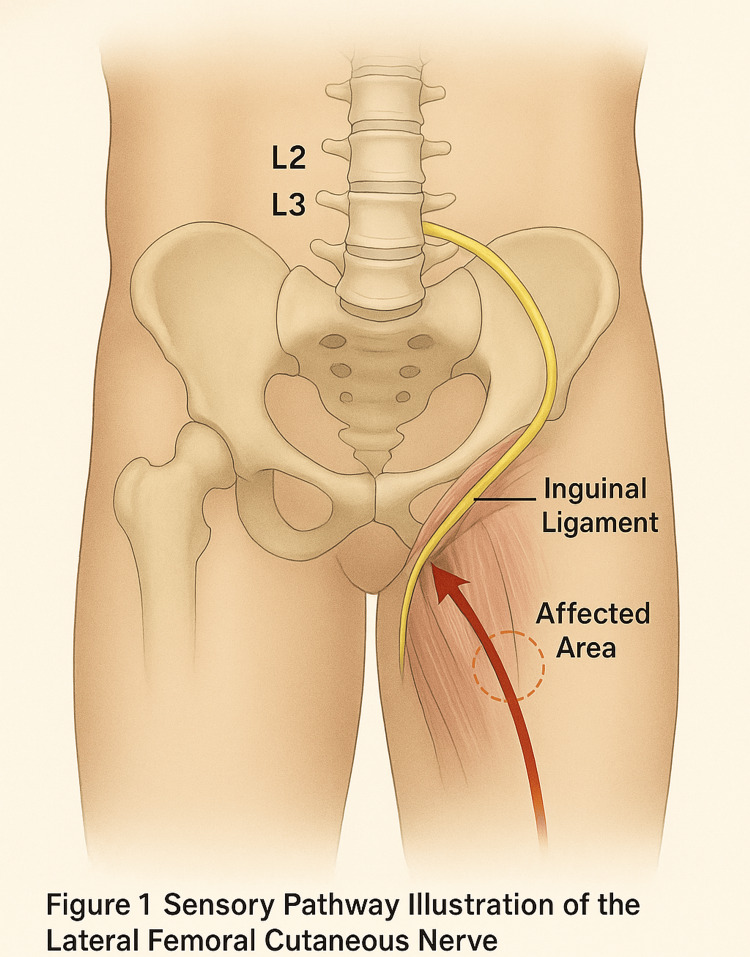 Figure 1
| Parameter Obtained Value | Obtained Value | Reference Range |
| Complete Blood Count | Normal | Within normal limits |
| Blood Glucose | 5.2 mmol/L | 3.9-5.8 mmol/L |
| Inflammatory Markers | Normal | Within normal limits |
| Urinalysis | Normal | No abnormalities |
Peer Reviews
No public reviews on file for this paper yet. If you reviewed it on a platform where reviews are public (OpenReview, ICLR, NeurIPS, ICML), you can paste yours below so the community can read it here.
Videos
No videos yet. Explain this paper in a talk, walkthrough, or lecture? Add one.
Taxonomy
TopicsPain Management and Treatment · Pain Mechanisms and Treatments · Myofascial pain diagnosis and treatment
Introduction
Meralgia paresthetica (MP) is a mononeuropathy of the lateral femoral cutaneous nerve (LFCN), typically presenting as burning pain, paresthesia, or numbness over the anterolateral thigh [1,2]. The causes of this condition include obesity, tight garments, trauma, and iatrogenic injury. While MP is well documented during its symptomatic phase, persistent sensory phenomena following its complete resolution are rarely discussed [3]. Here, we report a case of a highly localized, pre-orgasmic sensory phenomenon following recovery from MP. The phenomenon was reproducible, pleasurable, and confined to the original dermatomal distribution of the LFCN.
Case presentation
A 79-year-old man with a past diagnosis of MP presented with a complete resolution of paresthesia and burning over the left lateral thigh. The earlier episode of MP had occurred approximately 10 years prior and resolved spontaneously over a period of six months. No injury, mass lesion, or specific treatment was involved, and no imaging or nerve conduction studies were conducted at that time. Several months after resolution, the patient noted a new, striking sensation of intense pleasure emerging just prior to orgasm. This sensation lasted approximately two seconds, was localized to the upper lateral thigh, and occurred only after direct genital stimulation leading to orgasm. The patient described the experience as emotionally restorative and subjectively more intense than the orgasm itself, though not distressing, but even satisfying. Physical and neurological examinations revealed normal strength, reflexes, and sensation outside the previously affected dermatome. The abnormal sensory perception followed the path of the LFCN. No signs of radiculopathy or polyneuropathy were present. Routine lab investigations showed no abnormalities (Table 1). No imaging or nerve conduction studies were performed during the current episode, and a urological consultation found no pathology.
As shown in Figure 1, the unusual pre-orgasmic sensation followed the sensory distribution of the LFCN on the outer thigh. The stimulus pathway did not extend into genital regions or involve the vagus nerve. The genital orgasmic response remained intact and separate.
Sensory Pathway Illustration of the Lateral Femoral Cutaneus NerveIllustration generated using DALL·E 3 engine (OpenAI, San Francisco, CA) for anatomical accuracy. No patient data were used.As shown in the figure, the unusual pre-orgasmic sensation followed the sensory distribution of the lateral femoral cutaneous nerve (LFCN) on the outer thigh. The stimulus pathway did not extend into genital regions or involve the vagus nerve. The genital orgasmic response remained intact and separate.
Discussion
This case underscores the possibility that neural regeneration or maladaptive neuroplasticity following peripheral nerve injury can lead to unanticipated sensory experiences. While pain and dysesthesia are common sequelae of nerve damage, positive sensory phenomena such as pleasure are underrecognized. We hypothesize mechanisms such as ephaptic transmission, cross-talk between sensory and autonomic fibers, or central cortical remapping may underlie this phenomenon [4-6]. The consistent temporal association with orgasm raises questions about interactions between somatic and autonomic centers. Misrouting of afferent signals from the LFCN to limbic or hypothalamic areas could also be considered. However, autonomic involvement - such as via the vagus nerve - was not clinically evident.
Clinical evaluation and diagnostic certainty
Although this case is based on a self-experienced phenomenon, the diagnosis of MP was made and documented by a licensed physician (co-author Dr. T. Karakose) based on typical symptoms, anatomical distribution, and clinical course. During the current episode, no imaging or electrophysiological tests were performed. A referral to a urologist ruled out testicular or genitourinary causes, and no signs of referred pain from the pelvic region were identified. The unusual post-recovery sensory phenomenon was reproducible, anatomically consistent with the original LFCN distribution, and temporally linked to orgasm, making alternative explanations unlikely. This case satisfies the standard criteria for a credible case report of an unusual neurophysiological phenomenon. This report supports growing recognition of positive sensory manifestations following neural injury, akin to phenomena seen in phantom limb pleasure or synesthesia. Further neuroimaging and neurophysiological studies are warranted.
Conclusions
Recovery from MP can, in rare instances, be associated with unusual but benign sensory phenomena. This case of a reproducible pre-orgasmic sensation confined to the LFCN dermatome highlights the need for awareness of such outcomes in clinical neurology. A multidisciplinary approach may help elucidate the mechanisms behind such rare sensory experiences.
The reference list from the paper itself. Each links out to its DOI / PubMed record.
- 1Meralgia paresthetica: diagnosis and management strategies Pain Med Harney D Patijn J 669677820071802804510.1111/j.1526-4637.2006.00227.x · doi ↗ · pubmed ↗
- 2Meralgia paresthetica: diagnosis and treatment J Am Acad Orthop Surg Grossman MG Ducey SA Nadler SS Levy AS 336344920011157591310.5435/00124635-200109000-00007 · doi ↗ · pubmed ↗
- 3Meralgia paresthetica following spine surgery Surg Neurol Nouraei SA Anand B Spink G Papadopoulos SM 179181672007
- 4Functional and chemical anatomy of the afferent vagal system Auton Neurosci Berthoud HR Neuhuber WL 1178520001118901510.1016/S 1566-0702(00)00215-0 · doi ↗ · pubmed ↗
- 5Phantom limb pain: a case of maladaptive CNS plasticity?Nat Rev Neurosci Flor H Nikolajsen L Jensen TS 873881720061705381110.1038/nrn 1991 · doi ↗ · pubmed ↗
- 6Brain (re)organisation following amputation: Implications for phantom limb pain Neuroimage Makin TR Flor H 11694321820203242870610.1016/j.neuroimage.2020.116943 PMC 7422832 · doi ↗ · pubmed ↗