Application of gallbladder-cholangial plastic stent with a retraction thread in the treatment of acute calculous cholecystitis: the first clinical practice
Rongjuan Zhu, Jiyu Zhang, Qingfen Zheng, Jie Liu, Bin Hai, Dan Liu, Bingrong Liu

Abstract
Click any figure to enlarge with its caption.
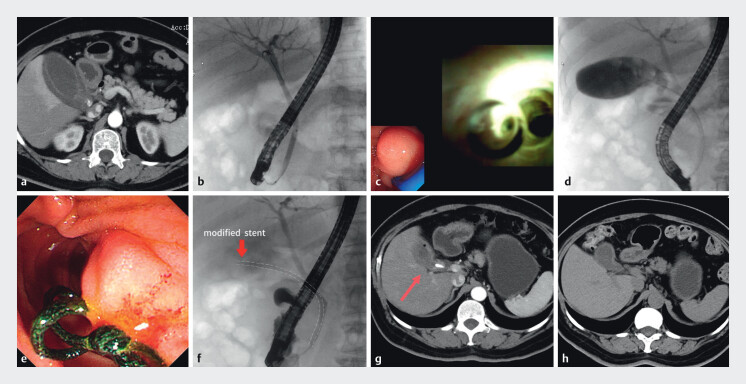 Fig. 1
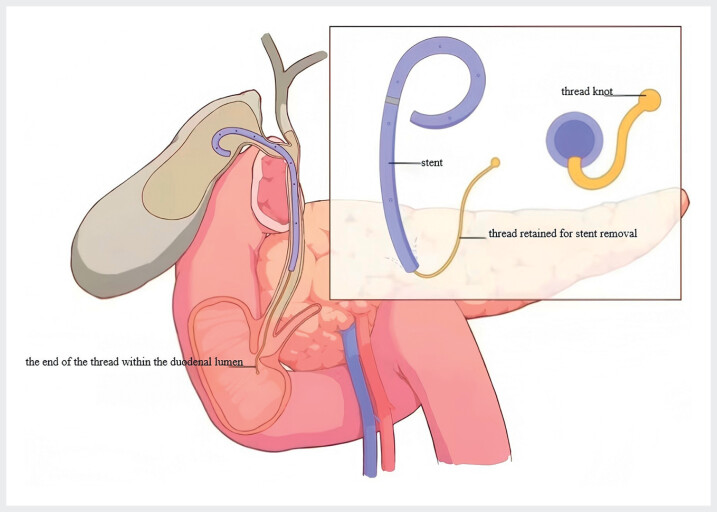 Fig. 2
- —The Key R&D Program of Henan Province
- —Henan Key Medical Laboratory: innovative technology for minimally invasive treatment of digestive endoscope
- —Natural Science Foundation of Henan Province
Peer Reviews
No public reviews on file for this paper yet. If you reviewed it on a platform where reviews are public (OpenReview, ICLR, NeurIPS, ICML), you can paste yours below so the community can read it here.
Videos
No videos yet. Explain this paper in a talk, walkthrough, or lecture? Add one.
Taxonomy
TopicsGallbladder and Bile Duct Disorders · Medical Device Sterilization and Disinfection · Cholangiocarcinoma and Gallbladder Cancer Studies
A 55-year-old female was admitted to our hospital with intermittent abdominal pain for 8 months and aggravated for 1 day. Physical examination revealed a positive Murphy sign. CT scan indicated acute calculus cholecystitis ( Fig. 1 a ). The patient strongly desired gallbladder preservation. Considering the patient’s severe cholecystitis and increased risks of cholecystolithotomy, we concluded that controlling inflammation and relieving biliary obstruction should be the initial priorities. Therefore, we decided to perform cystic duct stent placement. ERCP showed no dilation of the common bile duct and non-visualization of the gallbladder ( Fig. 1 b ). Successful gallbladder cannulation and cholangiography were performed with a cholangioscope, which revealed multiple gallstones ( Fig. 1 c, d ). To protect gallbladder physiological function (maintaining hepatobiliary circulation, gallbladder storage, and bile excretion) and ensure controlled stent retrieval, we placed an improved new type of gallbladder-cholangial plastic stent (8.5-Fr 8 cm) with a retraction thread. Firstly, the side wings of the stent were removed, and a thread about 8 cm long was threaded at the distal end of the stent ( Fig. 2 ). The stent was then deployed into the biliary tract ( Video 1 , Fig. 1 e, f ). Postoperatively, the patient’s abdominal pain was relieved immediately and discharged. After 3 months, a CT scan revealed complete resolution of gallbladder wall edema, and the stent remained in situ ( Fig. 1 g ). Subsequent natural orifice transluminal endoscopic surgery, gallbladder-preserving cholecystolithotomy, and stent removal were performed successfully 1 . At 18-month follow-up, the patient was well ( Fig. 1 h ).
a The CT scan indicated a thickened and markedly edematous gallbladder wall. b ERCP showed no dilation of the common bile duct and non-visualization of the gallbladder. c Under direct visualization with the cholangioscope, the cystic duct was identified. d The cholecystography revealed multiple gallstones. e The end of the thread remained within the duodenal lumen. f The stent was then deployed into the biliary tract. g After 3 months, the CT scan showed complete resolution of gallbladder wall edema, and the stent remained in situ. h At 1-month follow-up, the CT scan showed complete clearance of gallstones without cholecystitis.
The proximal end of the stent was placed into the gallbladder cavity, with the distal end in the common bile duct, while the end of the thread remained within the duodenal lumen to ensure the stent could be removed.
Application of gallbladder-cholangial plastic stent with a retraction thread in the treatment of acute calculous cholecystitis.Video 1
For patients with acute calculous cholecystitis who request gallbladder preservation, cystic duct stent placement is effective to relieve biliary obstruction and alleviate gallbladder inflammation 2 3]. The application of a gallbladder-cholangial plastic stent with a retraction thread serves as a bridging therapy. It rapidly relieves biliary obstruction, protects gallbladder physiological function, and ensures easy stent removal. This approach paves the way for definitive surgery, whether gallbladder preservation or cholecystectomy.
Endoscopy_UCTN_Code_TTT_1AR_2AH
The reference list from the paper itself. Each links out to its DOI / PubMed record.
- 1Ullah S Yang BH Liu D Are laparoscopic cholecystectomy and natural orifice transluminal endoscopic surgery gallbladder preserving cholecystolithotomy truly comparable? A propensity matched study World J Gastrointest Surg 20221447048110.4240/wjgs.v 14.i 5.47035734621 PMC 9160690 · doi ↗ · pubmed ↗
- 2Higa JT Irani SS Endoscopic Methods for Gallbladder Drainage Curr Treat Options Gastroenterol 20191735736610.1007/s 11938-019-00243-431317444 · doi ↗ · pubmed ↗
- 3Higa JT Sahar N Kozarek RAEUS-guided gallbladder drainage with a lumen-apposing metal stent versus endoscopic transpapillary gallbladder drainage for the treatment of acute cholecystitis (with videos)Gastrointest Endosc 20199048349231054909 10.1016/j.gie.2019.04.238 · doi ↗ · pubmed ↗