Successful endoscopic retrograde appendicitis therapy for acute appendicitis using a multi-side-hole conical cap
Lu Qiao, Longbao Yang, Juhui Zhao, Cui Fu, Shangxuan Cai, Shiyang Ma

Abstract
Click any figure to enlarge with its caption.
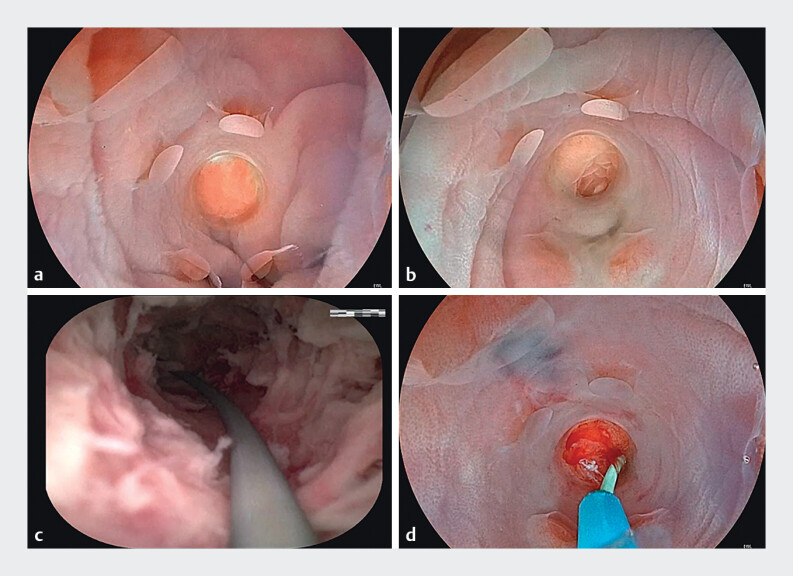 Fig. 1
Peer Reviews
No public reviews on file for this paper yet. If you reviewed it on a platform where reviews are public (OpenReview, ICLR, NeurIPS, ICML), you can paste yours below so the community can read it here.
Videos
No videos yet. Explain this paper in a talk, walkthrough, or lecture? Add one.
Taxonomy
TopicsAppendicitis Diagnosis and Management · Minimally Invasive Surgical Techniques · Intestinal and Peritoneal Adhesions
Endoscopic retrograde appendicitis therapy (ERAT), a novel minimally invasive technique, has gained attention for treating acute simple appendicitis 1 . However, cannulation in ERAT is challenging, particularly in cases of appendiceal orifice stenosis secondary to acute inflammation 2 . This case report describes our innovation of a multi-side-hole conical cap to address this challenge. A 53-year-old woman presented with right lower quadrant abdominal pain for 1 day. Physical examination revealed significant tenderness in the right lower quadrant. Blood tests showed leukocytosis (13 × 10 ^9^ /L), and an abdominal ultrasound indicated appendicitis. After emergency admission and bowel preparation, ERAT was performed. During the colonoscopy, a large amount of fecal residue can be seen remaining in the intestinal cavity. Using the multi-side-hole conical cap ( Fig. 1 a ), we successfully cleared the fecal residues entered the appendiceal cavity ( Fig. 1 b ). The cholangioscopy showed white pus in the appendiceal cavity, which was irrigated with metronidazole-saline solution ( Fig. 1 c ). Finally, a 7 Fr × 5 cm pancreatic stent (Cook, Ireland, SPSOF-7-5) was deployed ( Fig. 1 d , Video 1 ). Within 24 hours postoperatively, the patient’s abdominal pain significantly subsided and was discharged. At the 2-month follow-up, the patient reported no specific discomfort. Emergency bowel preparation might be inadequate with more fecal residues. In this situation, we innovated a multi-side-hole conical cap to aspirate and flush away these fecal residues. This cap, based on the original conical cap, features two rows of circular holes to enhance suction during cholangioscopy (Micro-Tech, China, CDS22001) insertion. Compared to standard conical caps, it removes most fecal residues and flushes out those trapped within the cap, facilitating smoother entry into the cecum and appendiceal cavity. In conclusion, the multi-side-hole conical cap is a promising tool for improving the success rate of ERAT in acute appendicitis patients, especially in patients with poor intestinal preparation. Further studies are needed to validate its efficacy and safety.
Process of ERAT with multi-side-hole conical cap. a A multi-side-hole conical cap was installed on the front end of the colonoscope. b The colonoscope was successfully passed to the appendiceal orifice. c A pus-filled infection was seen inside the appendiceal lumen and a guidewire was placed. d A stent was placed under guidewire guidance.
Using a multi-side-hole conical cap during ERAT facilitates easier removal of fecal debris, resulting in a clearer visual field-especially in patients with suboptimal bowel preparation.Video 1
Endoscopy_UCTN_Code_TTT_1AQ_2AJ
The reference list from the paper itself. Each links out to its DOI / PubMed record.
- 1Yang B Kong L Ullah S Endoscopic retrograde appendicitis therapy versus laparoscopic appendectomy for uncomplicated acute appendicitis Endoscopy 20225474775410.1055/a-1737-638135021234 PMC 9329065 · doi ↗ · pubmed ↗
- 2Liu BR Top tips for endoscopic retrograde appendicitis therapy (with video)Gastrointestinal Endoscopy 20249962562810.1016/j.gie.2023.12.01938103748 · doi ↗ · pubmed ↗