The relationship between home modifications and frailty among older adults: a scoping review protocol
Julius Ernst, Elisabeth Zwinge, Maximilian König, Mi-So Shim, Mi-So Shim, Mi-So Shim

TL;DR
This scoping review protocol explores how home modifications affect frailty in older adults to improve living conditions and reduce healthcare burdens.
Contribution
The study introduces a structured approach to map evidence on home modifications and frailty in older adults.
Findings
Home modifications may delay frailty onset or progression in older adults.
A person-environment misfit could accelerate physical decline in aging populations.
The review will highlight evidence gaps to guide future interventions.
Abstract
The rapid aging of populations worldwide presents significant challenges to healthcare and social systems. Frailty—a multidimensional geriatric syndrome marked by physical weakness, exhausted reserve capacities across all organ systems, and increased susceptibility to adverse events—is prevalent among older adults. Ensuring an optimal fit between individuals and their living environment is vital for preserving independence and reducing the burden on both professional healthcare services and informal care. A supportive home environment may help delay the onset or progression of frailty, while a person-environment misfit is likely to accelerate physical decline. Home modifications may play a critical role in this regard. This scoping review seeks to identify, synthesize and map the current evidence on the associations between accessible housing, home modifications, and frailty in…
Genes, proteins, chemicals, diseases, species, mutations and cell lines named across the full text — each resolved to its canonical identifier and authoritative record.
Click any figure to enlarge with its caption.
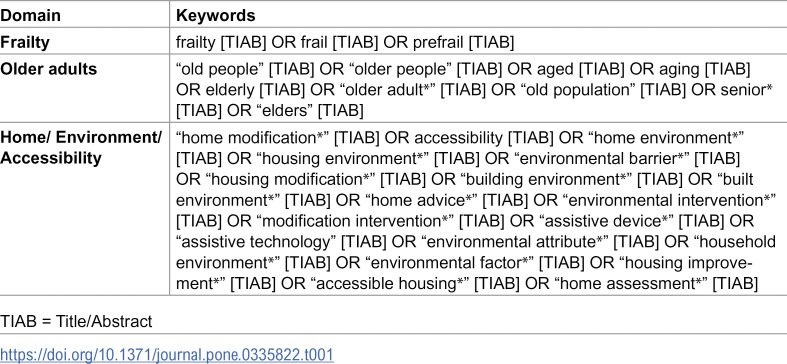 Figure 1
- —Ministry of Social Affairs, Health and Sport of Mecklenburg-Vorpommern
Peer Reviews
No public reviews on file for this paper yet. If you reviewed it on a platform where reviews are public (OpenReview, ICLR, NeurIPS, ICML), you can paste yours below so the community can read it here.
Videos
No videos yet. Explain this paper in a talk, walkthrough, or lecture? Add one.
Taxonomy
TopicsFrailty in Older Adults · Geriatric Care and Nursing Homes · Pressure Ulcer Prevention and Management
Background and rationale
Demographic trends indicate a rapidly aging global population, posing profound implications for healthcare and social support systems [1]. Aging increases the risk of age-related diseases and functional decline, notably the development of frailty [2]. Frailty, a multifactorial geriatric syndrome characterized by diminished physiological reserves and increased vulnerability to stressors, is strongly associated with adverse outcomes including falls, hospitalizations, care dependency, and mortality [2,3]. Importantly, the development of frailty is currently understood as a dynamic and potentially reversible process, shaped by intrinsic and extrinsic factors and can be positively influenced by targeted measures [4,5].
Although research on frailty has emphasized individual-level risk factors such as multimorbidity, inactivity, and nutritional deficits, the significance of environmental determinants is increasingly recognized [6–10]. Environmental gerontology explores person-environment interactions, positing that person–environment fit is critical to successful aging [11–14]; a misalignment between an individual’s abilities and their living environment can exacerbate functional decline and dependency [9,15]. In addition to objective housing conditions, subjective aspects, such as emotional ties to the place of residence are important in the analysis and design of age-appropriate living spaces [16]. It has been shown that accessible layouts, as well as home modification interventions for older adults, encompassing both structural and functional adaptations to the home environment, such as grab bars, non-slip flooring, and appropriate lighting, can reduce barriers in the home environment, enhance safety and well-being, reduce fall risk, reduce functional difficulties, improve participation and perceptions of safety and exertion, prevent and delay care dependence, reduce care home admissions, as well as hospital admissions, and potentially delay the onset and progression of frailty [9,10,13,17–25]. For example, the evaluation of the Care & Repair Cymru program in Wales showed that such interventions have a protective effect on nursing home admissions, particularly in moderately to severely frail people [17]. In Japan, a retrospective cohort study demonstrated an association between home adaptations and delayed decline in care needs [25]. It also has been shown that home modifications reduce difficulties experienced by older people in everyday activities – and that this effect lasts up to six months after installation [19]. Long-term data also showed that every additional month of waiting for a housing adaptation is associated with more difficulties in dealing with everyday tasks, which underlines the importance of rapid implementation [19]. Others point to the importance of social and subjective elements, such as emotional attachment to one’s home, perceived safety, and social interaction [6–8,26,27]. A unifying understanding of the complex interplay of home and health in older adults is still lacking [18,21,22,28]. Frailty in particular, has so far been investigated less frequently as an outcome compared to other endpoints, such as falls, and has not yet been the focus of a systematic review. This is despite growing evidence that both objective and subjective aspects of the home environment are predictors of frailty in older people [6,20,29]. Although the link between housing accessibility, home adaptations, and frailty appears intuitive, the current evidence base is markedly heterogeneous, with significant variation in study designs, intervention approaches, and frailty assessment methods. It is also fragmented, and a comprehensive overview is lacking.
Therefore, a scoping review is well-suited to chart the literature, identify research gaps, and help shape future research directions and policy measures. This is especially important because both more observational and interventional research approaches, including randomized controlled trials, are needed in this area. Understanding the relationship between housing characteristics, home modifications and frailty is critical for designing effective programs that support aging in place and reduce the healthcare burden associated with frailty [27]. Given the growing challenge of caring for an increasing number of frail older adults with functional limitations amid a shrinking working-age population, efforts to prevent frailty and to support the autonomy and quality of life of older people have become a public health priority. In this context, the findings are expected to inform public health policies and guidelines on housing accessibility and environmental adaptations for older adults.
Objectives
This scoping review aims to identify, describe, map, and synthesize existing research on the – presumably bidirectional – relationship between housing accessibility, home modifications and frailty among community-dwelling adults aged ≥65 years. Specifically, we will:
Examine types of home modification interventions, study populations, outcome measures, and study designs.Explore evidence on the impact of accessible housing and home modifications on the onset, progression, or reversal of frailty.
The findings of this scoping review aim to provide a basis for future research and contribute to practical recommendations in the field of housing modification.
Methods and analysis
Design and framework
We will conduct this scoping review following Arksey and O’Malley’s framework and guidance from the JBI (Joanna Briggs Institute) and the PRISMA-ScR checklist in S1 File [30–32]. The project has been preregistered on the Open Science Framework (OSF) to ensure transparency and reproducibility (osf.io/6xajk). Any amendments to the protocol will be documented there.
Search strategy
An initial exploratory search in PubMed identified relevant studies on the topic, from which key terms and keywords were extracted. These informed the development of a comprehensive search strategy aimed at capturing the breadth of relevant literature (Table 1). Using this refined strategy, a second, systematic search will be conducted in PubMed, Embase, the Cochrane Library, and CINAHL. Additionally, the top 250 hits from Google Scholar will be screened for relevance to capture grey literature. References of included studies will be hand-searched to ensure completeness.
Table 1: Preliminary version of the search strategy (PubMed).
Study selection
Rayyan [33] will be used to manage references, remove duplicates, and support blind screening by two independent reviewers. First, titles and abstracts will be screened against eligibility criteria. Next, full texts will be assessed, with disagreements resolved by discussion. Reasons for excluding studies after full-text review will be documented and reported in the final scoping review. The selection process will be documented in a PRISMA-ScR flowchart.
Eligibility criteria
Studies will be included if they:
include community-dwelling adults aged ≥65 (Population),examine home modifications and/or accessibility as exposures, interventions, or contextual factors (Concept), andexplore frailty prevention, delay, or management as an outcome (Context),
according to the PCC (Population, Concept, Context) framework [34]. Only English-language studies published up to September 2025 will be included.
Data extraction
Data will be extracted independently by two reviewers using a piloted extraction form. Extracted information will include study design, setting, characteristics of the studied population, definitions and measures of frailty (including the assessment tools used), assessments of environmental accessibility or types of home modifications and interventions to improve accessibility, as well as the key findings. The data extraction form will initially be tested on 10 studies and, if necessary, adapted to ensure clarity and completeness in an iterative process. The methodological quality and potential risk of bias of the included studies will also be checked using the JBI criteria.
Data synthesis
Extracted data will be collated in Excel. Tables and figures will be used to map the evidence, highlight key themes, and identify gaps in the literature. A narrative summary will then integrate and interpret the findings, providing an overview of patterns and relationships between housing accessibility, home modifications, and frailty among community-dwelling older adults.
Ethics and Dissemination
No ethical approval is required as this review uses only published literature. Findings will be disseminated in peer-reviewed journals and presented at conferences.
Patient and Public Involvement
Neither patients nor members of the public will be involved in the design or conduct of this review.
Expected Limitations
This scoping review may face several limitations. We anticipate high heterogeneity among included studies with respect to study design, types of home/environmental assessments and housing modification interventions, and methods used to assess frailty, which may limit the comparability and synthesis of findings.
Supporting information
S1 FilePRISMA Checklist.(PDF)
The reference list from the paper itself. Each links out to its DOI / PubMed record.
- 1The Lancet Public Health. Ageing: a 21st century public health challenge?. Lancet Public Health. 2017;2(7):e 297. doi: 10.1016/S 2468-2667(17)30125-1 29253452 · doi ↗ · pubmed ↗
- 2Clegg A, Young J, Iliffe S, Rikkert MO, Rockwood K. Frailty in elderly people. Lancet. 2013;381(9868):752–62. doi: 10.1016/S 0140-6736(12)62167-9 23395245 PMC 4098658 · doi ↗ · pubmed ↗
- 3Fried LP, Tangen CM, Walston J, Newman AB, Hirsch C, Gottdiener J, et al. Frailty in older adults: evidence for a phenotype. J Gerontol A Biol Sci Med Sci. 2001;56(3):M 146-56. doi: 10.1093/gerona/56.3.m 146 11253156 · doi ↗ · pubmed ↗
- 4Dent E, Martin FC, Bergman H, Woo J, Romero-Ortuno R, Walston JD. Management of frailty: opportunities, challenges, and future directions. Lancet. 2019;394(10206):1376–86. doi: 10.1016/S 0140-6736(19)31785-4 31609229 · doi ↗ · pubmed ↗
- 5Puts MTE, Toubasi S, Andrew MK, Ashe MC, Ploeg J, Atkinson E, et al. Interventions to prevent or reduce the level of frailty in community-dwelling older adults: a scoping review of the literature and international policies. Age Ageing. 2017;46(3):383–92. doi: 10.1093/ageing/afw 247 28064173 PMC 5405756 · doi ↗ · pubmed ↗
- 6Caldwell JT, Lee H, Cagney KA. Disablement in Context: Neighborhood Characteristics and Their Association With Frailty Onset Among Older Adults. J Gerontol B Psychol Sci Soc Sci. 2019;74(7):e 40–9. doi: 10.1093/geronb/gbx 123 31529128 PMC 6748803 · doi ↗ · pubmed ↗
- 7Ye B, Gao J, Fu H. Associations between lifestyle, physical and social environments and frailty among Chinese older people: a multilevel analysis. BMC Geriatr. 2018;18(1):314. doi: 10.1186/s 12877-018-0982-1 30547760 PMC 6295038 · doi ↗ · pubmed ↗
- 8Uemura K, Kamitani T, Yamada M. Frailty and Environmental Attributes in Older Adults: Insight from an Ecological Model. Phys Ther Res. 2023;26(3):71–7. doi: 10.1298/ptr.R 0027 38125292 PMC 10730123 · doi ↗ · pubmed ↗