Dataset of internal temperature and gas pressure in cylindrical lithium-ion cells during thermal runaway
Begum Gulsoy, Calum Briggs, Quang Ngo, Mona, Faraji Niri, James Marco

TL;DR
This paper presents a dataset capturing internal temperature and gas pressure in lithium-ion cells during thermal runaway, offering insights into battery failure stages and safety.
Contribution
The paper introduces a novel methodology for real-time monitoring of internal temperature and gas pressure in cylindrical lithium-ion cells during thermal runaway.
Findings
The dataset characterizes three stages of thermal runaway: pre-vent, soft-vent, and flame generation/explosion.
Previously unmeasured battery parameters improve understanding of battery safety and vent system design.
The data supports the development of models for early failure detection and mitigation strategies.
Abstract
This experimental dataset relates to the research “Real-time simultaneous monitoring of internal temperature and gas pressure in cylindrical cells during thermal runaway” [1]. This study introduces, for the first time, a novel methodology that enables simultaneous real-time monitoring of internal temperature and gas pressure in 21,700 format cylindrical cells. The datasets are from three thermal runaway tests conducted on three instrumented cells, each equipped with an embedded thermocouple and gas pressure adaptor to allow access to internal gasses. Measurements collected during the experiments include cell voltage, internal gas pressure, surface temperatures measured 10 mm from both the negative and positive terminals, surface and internal temperatures at the axial midpoint of the cell, and vent temperatures recorded at 5 mm and 10 mm from the vent cap on the positive terminal. In all…
Genes, proteins, chemicals, diseases, species, mutations and cell lines named across the full text — each resolved to its canonical identifier and authoritative record.
Click any figure to enlarge with its caption.
 Figure 1
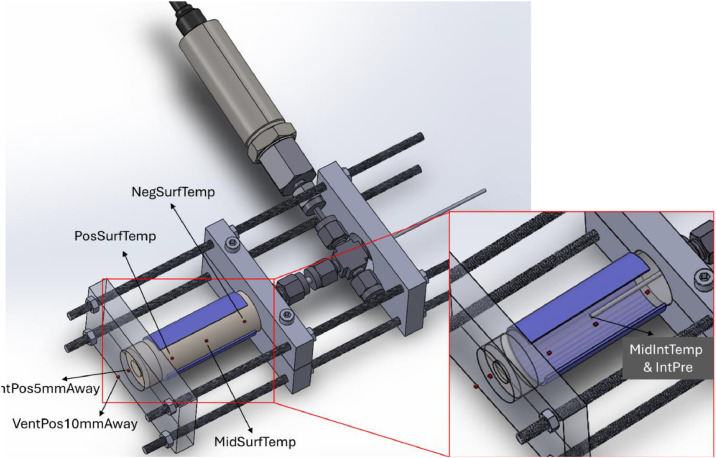 Figure 2
Peer Reviews
No public reviews on file for this paper yet. If you reviewed it on a platform where reviews are public (OpenReview, ICLR, NeurIPS, ICML), you can paste yours below so the community can read it here.
Videos
No videos yet. Explain this paper in a talk, walkthrough, or lecture? Add one.
Taxonomy
TopicsAdvanced Battery Technologies Research
Specifications TableSubjectEngineering & Materials scienceSpecific subject areaSafety characterisation of cylindrical lithium-ion batteries by monitoring internal temperature and gas pressure simultaneously during a thermal runaway event.Type of dataProcessedTable (.mat format)Data collectionMeasurements collected during three thermal runaway tests include cell voltage, internal gas pressure, surface temperatures measured 10 mm from both the negative and positive terminals, as well as surface and internal temperatures at the axial midpoint of the cell. Vent temperatures are recorded at 5 mm and 10 mm from the vent cap on the positive terminal. These parameters were monitored throughout the three key stages of thermal runaway: pre-vent, soft-vent, and flame generation/explosion. All parameters recorded simultaneously using a National Instruments data acquisition system (cDAQ-9178). Voltage-related measurements were logged using an NI 9213 module at a sampling rate of 1 kHz, while temperature-related measurements were recorded using an NI 9220 module at 10 Hz.Data source locationInstitution: Warwick Manufacturing Group (WMG), Energy Innovation Centre, University of WarwickCity: CoventryCountry: United KingdomGPS coordinates for collected samples/data: 52.38363378953185, −1.5615186436655097.Data accessibilityRepository name: Mendeley DataData identification number: 10.17632/rgfhdhcd9k.2Direct URL to data: https://data.mendeley.com/datasets/rgfhdhcd9k/1Related research articleGulsoy, B., Chen, H., Briggs, C., Vincent, T.A., Sansom, J.E. and Marco, J., 2024. Real-time simultaneous monitoring of internal temperature and gas pressure in cylindrical cells during thermal runaway. Journal of Power Sources, 617, p.235147.https://doi.org/10.1016/j.jpowsour.2024.235147 .
Value of the Data
1
- •This dataset provides unique, high-resolution measurements of internal cell temperature and gas pressure during thermal runaway, offering rare insights into the failure dynamics of lithium-ion batteries.
- •The data captures critical stages of cell failure including pre-vent, soft-vent, and flame/explosion events, enabling a deeper understanding of gas accumulation and heat generation mechanisms.
- •The findings support the design of predictive models and diagnostic tools for thermal runaway, which are essential for battery management system (BMS) development.
- •Battery manufacturers can leverage this information to enhance cell design, optimize venting systems, and select safer electrode materials, contributing to the next generation of safer, high-performance energy storage systems.
Background
2
Lithium-ion batteries are widely used for energy storage and conversion in applications such as consumer electronics, electric vehicles, and emerging aerospace applications. As battery technology advances, new cathode and anode materials are being explored, including nickel- or manganese-rich cathodes and silicon-carbon composite anodes. While these materials offer improved performance, they also introduce increased thermal instability, which raises the risk of safety issues like thermal runaway. This has led to a growing need to better understand the thermal runaway mechanism to develop early detection systems and improve overall battery safety [[1], [2], [3]]. A novel method has been developed to characterise thermal runaway events by simultaneously monitoring internal cell temperature and gas pressure during key failure stages: pre-vent, soft-vent, and flame generation or explosion. The resulting dataset provides important insights into gas accumulation and temperature rise during cell failure. These findings support the development of diagnostic tools and predictive models, and improved battery design and venting systems [1].
Data Description
3
The experimental dataset comprises three thermal runaway tests conducted on instrumented Sony VTC6A cells. The dataset was processed and saved in MATLAB data (.mat) format. Fig. 1 shows the structured dataset.Fig. 1. Structured dataset in .mat format.Fig 1:
The dataset includes measurements of cell voltage, internal gas pressure, surface temperatures measured 10 mm from both the negative and positive terminals, surface and internal temperatures at the axial midpoint of the cell, and vent temperatures recorded at 5 mm and 10 mm from the vent cap on the positive terminal, as detailed in Table 1. All parameters except IntPre collected directly from the data logger. IntPre was measured as a voltage signal and converted to pressure in bar using a transfer function derived from calibration of the pressure sensor.Table 1. Parameters measured during thermal runaway testing.Table 1:Column NumberParametersUnitDetails1TestID−Test ID assigned to each test cell2ExpTimesecondsDuration of test measured in seconds, starting from the beginning of experiment. This time variable is used for IntPre and CellVoltage.3IntPrebarInternal gas pressure measured during testing4CellVoltagevoltCell voltage measured during testing5ExpTimeTempsecondsDuration of test measured in seconds for temperature-rated measurements, starting from the beginning of the experiment6MidIntTemp°CInternal cell temperature at the axial midpoint of the cell7MidSurfTemp°CSurface cell temperature at the axial midpoint of the cell8NegSurfTemp°CSurface cell temperature measured at a point 10 mm away from the negative terminal9PosSurfTemp°CSurface cell temperature measured at a point 10 mm away from the positive terminal10VentPos5mmAway°CVent temperature measured 5 mm away from the vent cap at the positive terminal11VentPos10mmAway°CVent temperature measured 10 mm away from the vent cap at the positive terminal
Experimental Design, Materials and Methods
4
Cell information
4.1
The Sony VTC6A is a cylindrical lithium-ion cell in the 21,700-format, featuring a rated capacity of 4 Ah. It has a nominal voltage of 3.6 V and an average mass of approximately 67.37 ± 0.5 g The cell has a charge cut-off voltage of 4.25 V and a discharge cut-off voltage of 2.5 V. Its operating temperature ranges are 0 °C to +60 °C for charging and −20 °C to +60 °C for discharging. The cell utilizes a Lithium Nickel Cobalt Aluminium Oxides (NCA) cathode, a Graphite–Silicon Oxide (SiOx) composite anode. The electrolyte consists of lithium hexafluorophosphate (LiPF₆) salt dissolved in a mixture of dimethyl carbonate (DMC) and ethylene carbonate (EC) organic solvents. As part of their safety mechanism, the cells are equipped with a negative-end vent in addition to the conventional top venting disk [1].
Cell preparation
4.2
All cells were instrumented with embedded thermocouples and pressure transducers using the methodology described in our previous publications [2,3]. Prior to testing, all cells were charged to their upper voltage limit to achieve 100 % SOC using a CC—CV charging protocol. During the CC phase, a current of 1C was applied, followed by a CV phase at a voltage of 4.25 V, that continued until the current reduced to C/20. This ensured consistent SOC conditioning across all test samples.
Thermal runaway tests
4.3
Thermal runaway tests were initiated by an external heating method. A flexible heating pad (50 mm x 50 mm) was placed on the cell surface, and a constant heating power of 40 W was applied via an external power supply until the onset of thermal runaway. All instrumented cells were secured with a bespoke test fixture (Fig. 2). Experiments were conducted within a dedicated abuse testing facility, where the ambient temperature ranged between 15 °C and 20 °C. Further details of the test setup are provided in [1] and are therefore not repeated here.Fig. 2. Schematic of the instrumented cell mounted on a bespoke test fixture, showing the locations of temperature and internal gas measurements.Fig 2:
All test parameters were recorded simultaneously using a National Instruments data acquisition system (cDAQ-9178). Voltage-related measurements, including ExpTime, IntPre, and CellVoltage, were logged using an NI 9213 module at a sample rate of 1 kHz, while temperature-related measurements (ExpTimeTemp, MidIntTemp, MidSurfTemp, NegSurfTemp, PosSurfTemp, VentPos5mmAway, and VentPos10mmAway) were recorded using an NI 9220 module at a sampling rate of 10 Hz. Fig. 2 shows the locations of the measurements corresponding to the parameters discussed.
Limitations
Not applicable.
Ethics Statement
The proposed data does not involve any human subjects, animal experiments, or data collected from social media platforms. The authors confirm that this work meets the ethical requirements of the journal.
Credit Author Statement
B. Gulsoy: Conceptualization, Methodology, Formal analysis, Investigation, Writing - Original Draft. C. Briggs: Methodology, Investigation. Q. Ngo: Data Processing, Formal analysis. M.F. Niri: Data Processing, Writing - Review & Editing. J. Marco: Funding acquisition, Supervision, Resources, Writing - Review & Editing.
The reference list from the paper itself. Each links out to its DOI / PubMed record.
- 1Gulsoy B.Chen H.Briggs C.Vincent T.A.Sansom J.E.Marco J.Real-time simultaneous monitoring of internal temperature and gas pressure in cylindrical cells during thermal runaway J. Power Sources 6172024235147
- 2Gulsoy B.Vincent T.A.Sansom J.E.H.Marco J.In-situ temperature monitoring of a lithium-ion battery using an embedded thermocouple for smart battery applications J. Energy Storage 54202210526010.1016/j.est.2022.105260 · doi ↗
- 3Gulsoy B.Vincent T.A.Briggs C.Sansom J.E.Marco J.In-situ measurement of internal gas pressure within cylindrical lithium-ion cells J. Power. Sources 2023570