Adequacy of Operative Notes for Orthopaedic Procedures: A Quality Improvement Project
Atizaz A Jan, Hassan Imtiaz, Talha Ahmed, Omran Alkhatib, Adam Khan Rahim, Georgios Kouklidis

TL;DR
This study shows that simple interventions like typed notes and checklists can improve the quality of surgical documentation.
Contribution
The study demonstrates that low-cost interventions can significantly improve operative note quality in orthopaedic procedures.
Findings
Typed notes increased from 30% to 65% after interventions.
Documentation of closure technique and signature completion reached 100% post-intervention.
Modest improvements were seen in operative diagnosis and findings documentation.
Abstract
Introduction: High-quality operative documentation is fundamental to safe patient care, supporting communication, guiding postoperative management, and serving as a medico-legal record. Despite its importance, variability in the quality and completeness of operative notes remains common. Methods: A closed-loop audit was performed at University Hospital Crosshouse, United Kingdom. The first cycle reviewed 82 operative notes, assessing compliance with set standards. Interventions included encouragement to use typed instead of written operation notes, display of posters in theatres, and introduction of a structured post-operative checklist. A second cycle reviewed 84 notes post-intervention. Results between audit cycles were compared and analysed using chi-squared tests to evaluate the statistical significance of improvements. Results: In Cycle 1, typed notes accounted for 25 (30%), with…
Genes, proteins, chemicals, diseases, species, mutations and cell lines named across the full text — each resolved to its canonical identifier and authoritative record.
Click any figure to enlarge with its caption.
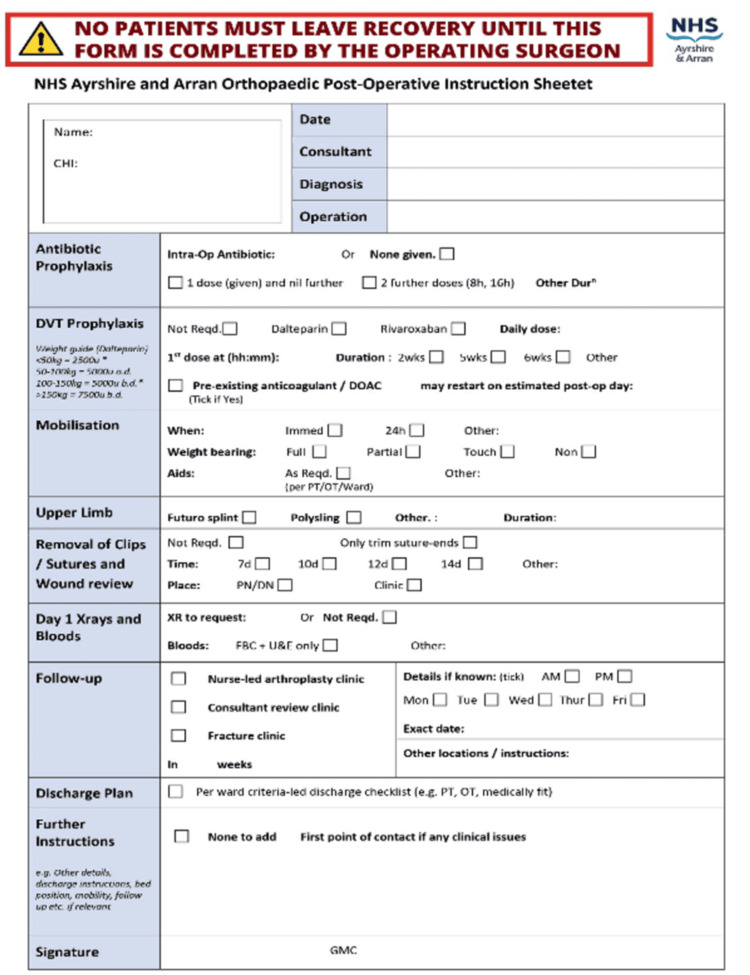 Figure 1
| Parameter | Cycle 1 (n=82) | Cycle 2 (n=84) | Change (%) | Chi-squared value(χ²) | p-value** | Statistically Significant(Yes/No) |
| Typed notes | 25 (30%) | 55 (65%) | +35 | 20.345 | <0.001 | Yes |
| Date | 82 (100%) | 84 (100%) | 0 | - | - | - |
| Time | 10 (12%) | 9 (11%) | −1 | 0.090 | 0.764 | No |
| Trauma or elective procedure | 22 (27%) | 20 (24%) | −3 | 0.200 | 0.655 | No |
| Name of surgeon, assistant, and anaesthetist | 82 (100%) | 84 (100%) | 0 | - | - | - |
| Operative diagnosis | 53 (65%) | 62 (74%) | +9 | 1.388 | 0.239 | No |
| Name of Procedure | 82 (100%) | 84 (100%) | 0 | - | - | - |
| Operative findings | 60 (73%) | 68 (81%) | +8 | 1.068 | 0.301 | No |
| Prosthesis identification* | 60/69 (87%) | 47/54 (87%) | 0 | 0.000 | 1.000 | No |
| Estimated blood loss | 5 (6%) | 2 (2%) | −4 | 1.693 | 0.193 | No |
| Closure technique | 73 (89%) | 84 (100%) | +11 | 4.291 | 0.038 | Yes |
| Detailed post-operative instructions | 78 (95%) | 82 (98%) | +3 | 0.743 | 0.389 | No |
| Signature | 78 (95%) | 84 (100%) | +5 | 4.199 | 0.040 | Yes |
Peer Reviews
No public reviews on file for this paper yet. If you reviewed it on a platform where reviews are public (OpenReview, ICLR, NeurIPS, ICML), you can paste yours below so the community can read it here.
Videos
No videos yet. Explain this paper in a talk, walkthrough, or lecture? Add one.
Taxonomy
TopicsDigital Imaging in Medicine · Breast Implant and Reconstruction · Anatomy and Medical Technology
Introduction
High-quality operative documentation underpins surgical practice. Operative notes ensure continuity of care, guide postoperative management, and serve as vital medico-legal records. Deficient documentation has been linked to communication failures, adverse outcomes, and litigation risk [1,2].
The General Medical Council (GMC), through Good Medical Practice, requires doctors to record work clearly, accurately, and contemporaneously [3]. The Royal College of Surgeons of England (RCS Eng) builds on this with Good Surgical Practice, outlining a checklist of essential operative note items, including operative diagnosis, complications, prophylaxis, tissue removed, prostheses, and closure technique [4]. These standards provide an evidence-based framework to reduce omissions and variability.
Despite clear guidance, audits across surgical specialties consistently demonstrate incomplete and inconsistent operative notes [5-7]. Barriers include time pressures, reliance on freehand documentation, lack of awareness of standards, and absence of structured templates [8,9]. To address these, quality improvement measures, such as standardised proformas, electronic note systems, and checklists, have been shown to significantly improve compliance [10-13].
Given the central role of documentation in safe care, regular auditing is recommended [14]. We report a closed-loop audit assessing orthopaedic operative notes against GMC and RCS Eng standards, evaluating the impact of targeted interventions.
Materials and methods
This prospective closed-loop audit was undertaken at the Trauma & Orthopaedics department, University Hospital Crosshouse, NHS Ayrshire and Arran. The first cycle was conducted between 01/09/2024 and 15/09/2024, while the subsequent cycle was conducted between 15/10/2024 and 30/10/2024. Following the first cycle, gaps were identified in practice. To address these, posters (Appendix 1) highlighting key details to be documented on operative notes were displayed in operating theatres. Additionally, a post-operative checklist was introduced, which was mandatory to be completed prior to the patient leaving the theatre recovery (Appendix 2), with the aim to ensure that important post-operative instructions are not missed when a patient leaves of theatre. The orthopaedic team was encouraged to rely more on typed rather than hand-written operative notes, and preferably use templated notes (if available), which cover all relevant aspects of the procedure, to ensure better documentation.
Consecutive operative notes were analysed for the given timeframes. Data were collected from Electronic Patient Records (EPR) and inpatient paper records for assessment of operation notes. All orthopaedic surgery cases (including both emergency and elective procedures) were evaluated during the specified time frames for each audit cycle. Surgeries done under local anesthetic or non-orthopaedic surgeries were excluded.
Audit standards were derived from the GMC's guidance on Good Medical Practice [3] and the RCS's Good Surgical Practice [4] guidelines for documentation on operative notes. Based on these guidelines, the documentation of the following parameters was evaluated for each operative note: date and time, elective or trauma procedure, name of operating surgeon with assistant and anesthetist, name of procedure, indication for procedure/diagnosis, intra-operative findings, identification of prosthesis used (where applicable), estimated blood loss, post-operative instructions including follow-up plans, and signature by operating surgeon. Target compliance to documentation for each parameter was mutually agreed among orthopaedic team members and set at 100%.
Data were collected and stored in Microsoft Excel (Microsoft® Corp., Redmond, WA), and analysed using JASP software (version 0.18.3). Patient identifiers were removed from the datasheet prior to final analysis. Chi-square test was employed to statistically compare the results of the first and second loop results, with a p-value of less than 0.05 being set as a mark of significance.
Results
A total of 82 operative notes were reviewed during the first audit cycle. Documentation was complete for key identifiers, such as the date, name of surgeon, assistant, anaesthetist, and procedure, in 100% of cases. Typed notes accounted for 25 (30%) of all entries, with the majority remaining handwritten. Operative diagnosis was documented in 53 notes (65%), while operative findings were recorded in 60 (73%). Among the 69 cases involving prosthesis use, identification details were specified in 60 (87%). Estimated blood loss was documented in only five notes (6%). Closure technique was described in 73 (89%) cases, detailed postoperative instructions were provided in 78 (95%), and the surgeon's signature was present in 78 (95%) of the notes. Documentation of time and whether the procedure was elective or trauma-related remained suboptimal at 12% and 27%, respectively. Overall, while core identifying information was consistently recorded, several key clinical and procedural elements demonstrated room for improvement, particularly in operative findings, prosthesis identification, and estimated blood loss.
Following the implementation of interventions, including a theatre poster displaying the documentation standards, encouragement to use typed operation note templates, and introduction of a post-operative checklist, 84 operation notes were assessed in the second audit cycle. Typed documentation increased markedly to 55 notes (65%), representing a statistically significant improvement compared with Cycle 1 (p<0.001). Closure technique documentation improved to 100% (84/84), also showing a significant increase (p=0.038). Similarly, signature completion rose to 100% (p=0.040). Operative diagnosis and findings improved modestly to 74% and 81%, respectively, though these changes were not statistically significant (p>0.05). Prosthesis identification among the 54 applicable cases remained stable at 87%. Estimated blood loss documentation fell slightly to 2% (p=0.19), while postoperative instruction documentation increased marginally to 98% (p=0.39). The date, surgeon details, and procedure name continued to achieve 100% compliance in both cycles. Overall, the second audit cycle demonstrated substantial gains in legibility through typed notes and in completeness for closure technique and signature, while other parameters showed positive but non-significant improvements. The results of both audit cycles, along with statistical analysis, are presented in Table 1.
Discussion
This closed-loop audit demonstrates that straightforward, low-resource interventions can produce measurable improvements in the quality of operative documentation in orthopaedic practice. The most striking change was the shift from handwritten to typed notes (30%-65%), a statistically significant improvement. This is consistent with prior work showing that typed or electronic operation notes improve legibility and completeness and reduce missing data compared with freehand notes [11,12]. The conversion to typed notes likely addresses two common root problems: poor legibility and potential omissions due to time pressure or handwriting deterioration. It has the secondary benefit of facilitating future integration into electronic proformas and mandatory fields that prompt clinicians.
Documentation of the closure technique and signature also improved significantly after the intervention. Both of these items are critical for postoperative care, accountability, and medicolegal safety; similar gains in these domains have been reported after the introduction of checklists and proformas in other surgical settings [1,10]. The mandatory postoperative checklist used in our intervention likely reinforced completion of closure and signatory fields prior to leaving recovery, explaining the observed improvement.
Several other domains showed improvement that did not reach statistical significance: operative diagnosis, operative findings, and detailed postoperative instructions. Prosthesis identification (87% in both cycles) remained high and unchanged when assessed among the subset of cases where a prosthesis was used. These findings align with the pattern reported in systematic reviews and audits that find the largest improvements occur in items that are explicitly prompted by templates or checklists, whereas more narrative items (findings, diagnosis detail) improve less unless templates include dedicated prompts or mandatory fields [13,15].
Estimated blood loss documentation decreased, but this change was not statistically significant (p=0.193). Low baseline rates of documentation for such parameters can reflect variability in perceived clinical relevance for routine orthopaedic procedures; embedding these fields into electronic templates has been shown elsewhere to increase capture rates [16].
Our results mirror prior literature showing the effectiveness of simple interventions (proformas, checklists, education, and electronic templates) in improving operation note quality [1,10,15,16]. The audit also highlights an important practical point: items already at or near 100% compliance (e.g., date, surgeon name, procedure name) are less amenable to further change, and efforts may be better directed at items with lower baseline capture or those that will impact patient safety. Introducing typed or electronic, templated notes with mandatory fields for key safety items is a logical next step and is supported by health informatics studies showing better compliance and legibility with electronic operation notes [17].
Limitations include the single-centre nature of the audit and modest sample sizes, which reduce power to detect small differences for parameters with intermediate baseline compliance. Additionally, the time frame between audit cycles was only a month, and it is possible that a much delayed re-audit could have resulted in larger improvements and produced a more reliable indication of the sustainability of implemented changes following the first audit cycle.
Conclusions
This audit demonstrates that simple, low-cost interventions can lead to meaningful improvements in the quality of operative documentation. The introduction of theatre posters, a typed template, and a postoperative checklist significantly increased the proportion of typed notes and achieved full compliance in closure technique and signature documentation. These results confirm that targeted educational and process-based measures can effectively enhance adherence to GMC and RCS documentation standards, improving both legibility and completeness of operative notes.
Although some parameters, such as operative findings and estimated blood loss, showed limited or no improvement, the overall trend indicates greater consistency and awareness among operating surgeons. Sustained improvement will likely depend on embedding these interventions into routine practice. Future work should focus on implementing electronic operation note systems with mandatory data fields, regular re-audits, and feedback to ensure continued compliance and standardisation. By promoting structured, legible, and comprehensive documentation, such measures will strengthen patient safety, clinical communication, and medico-legal protection within surgical practice.
The reference list from the paper itself. Each links out to its DOI / PubMed record.
- 1Improving the standard of operation notes in orthopaedic and trauma surgery: the value of a proforma Injury Al Hussainy H Ali F Jones S Mc Gregor-Riley JC Sukumar S 110211063520041548849910.1016/j.injury.2003.10.016 · doi ↗ · pubmed ↗
- 2Improving operation notes to meet British Orthopaedic Association guidelines Ann R Coll Surg Engl Morgan D Fisher N Ahmad A Alam F 2172199120091910282510.1308/003588409 X 359367 PMC 2765008 · doi ↗ · pubmed ↗
- 3Good medical practice 11 2025 2024 https://www.gmc-uk.org/professional-standards/the-professional-standards/good-medical-practice
- 4Good surgical practice 11 2025 2025 https://www.rcseng.ac.uk/standards-and-research/good-surgical-practice/
- 5Improving the standard of orthopaedic operation documentation using typed proforma operation notes: a completed audit loop Cureus Coughlan F Ellanti P Moriarty A Mc Auley N Hogan N 09201710.7759/cureus.1084 PMC 538484628405534 · doi ↗ · pubmed ↗
- 6Usefulness of Royal College of Surgeons of England operation note guidelines to neurosurgical practice: a closed loop audit Br J Neurosurg Bradley R Bremner M Mc Kinley A Lammy S 4184233520213293060810.1080/02688697.2020.1817858 · doi ↗ · pubmed ↗
- 7A clinical audit of orthopaedic operation note documentation and digitalization of the operative note template: a quality improvement project Cureus Nasim O Durrani A Eskander B Pantelias C Gallagher K 014202210.7759/cureus.33171 PMC 980534036601195 · doi ↗ · pubmed ↗
- 8Surgical checklists: the human factor Patient Saf Surg O'Connor P Reddin C O'Sullivan M O'Duffy F Keogh I 14720132367266510.1186/1754-9493-7-14PMC 3669630 · doi ↗ · pubmed ↗