A novel absorbable string-loop suturing device for closing a large colonic defect spanning anastomosis after endoscopic submucosal dissection
Shibo Song, Xiaolong Rao, Yunlong Cai, Xinyue Guo, Long Rong

Abstract
Genes, proteins, chemicals, diseases, species, mutations and cell lines named across the full text — each resolved to its canonical identifier and authoritative record.
Click any figure to enlarge with its caption.
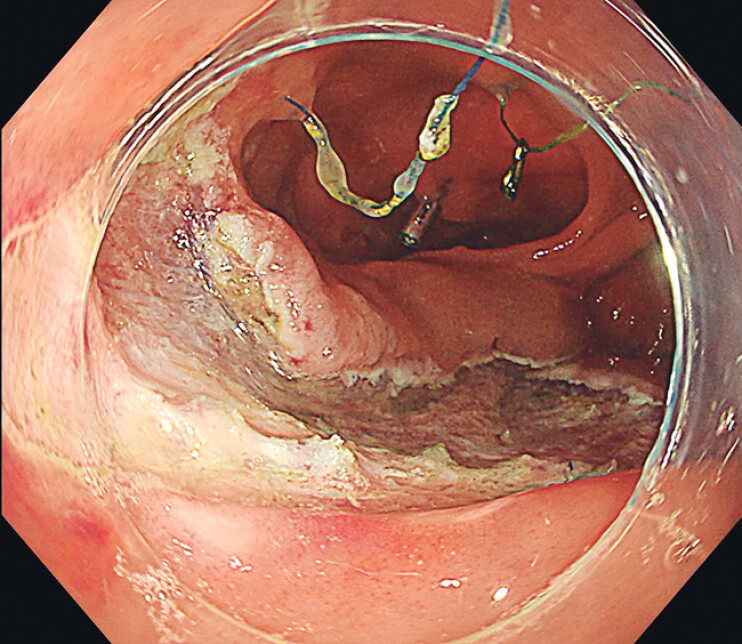 Fig. 1
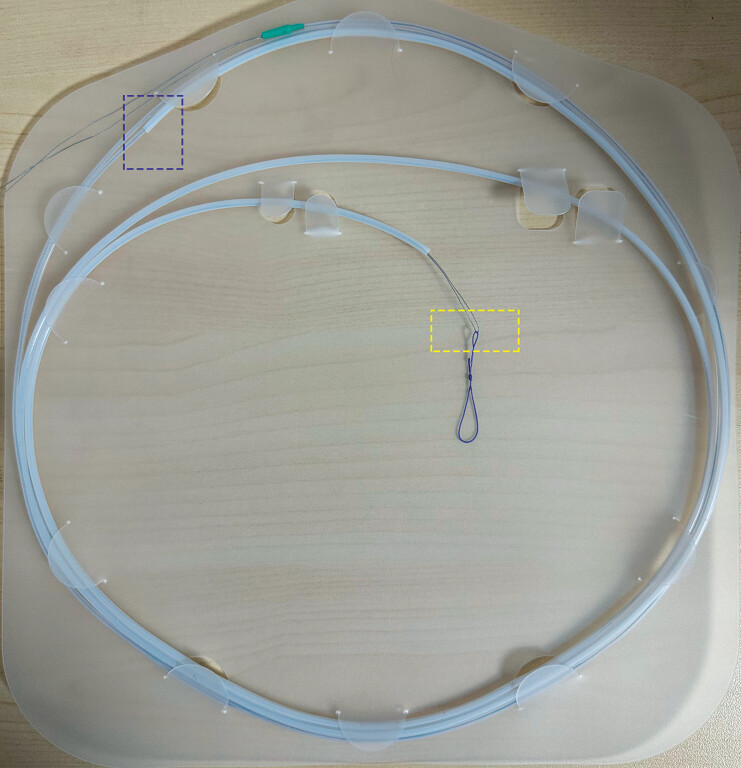 Fig. 2
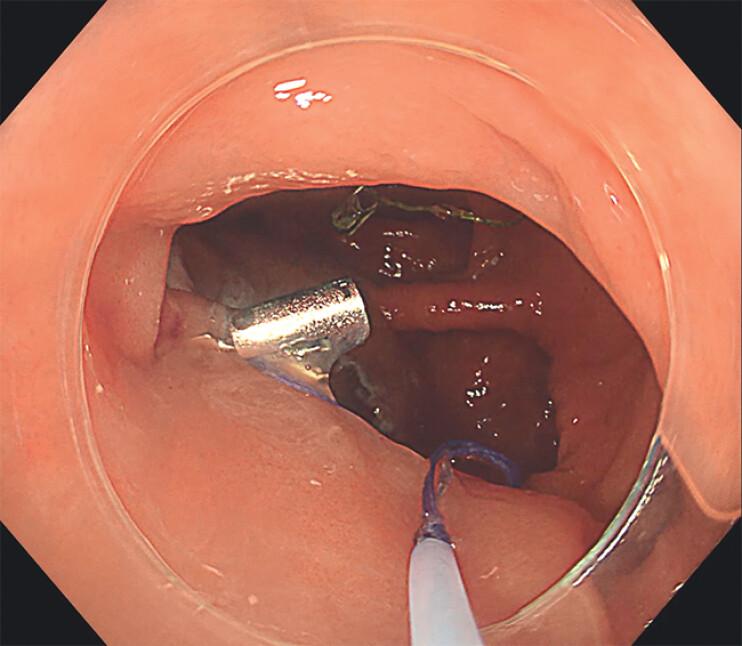 Fig. 3
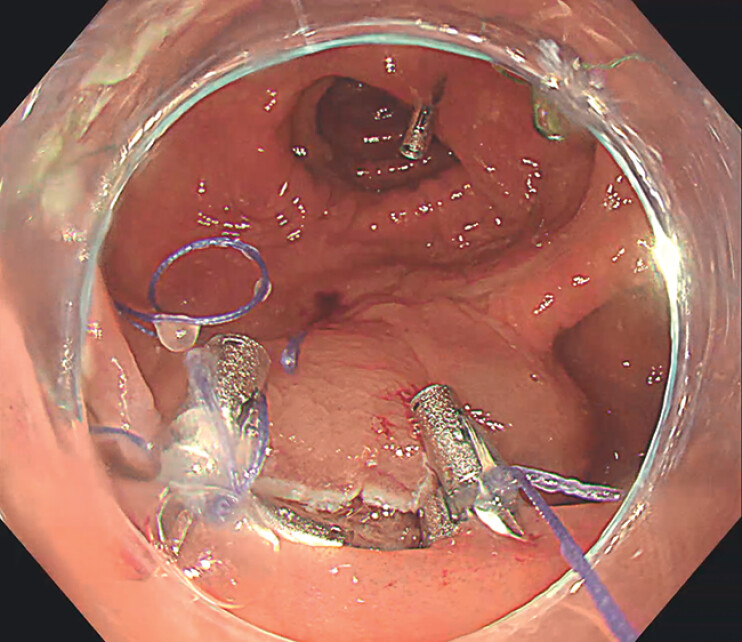 Fig. 4
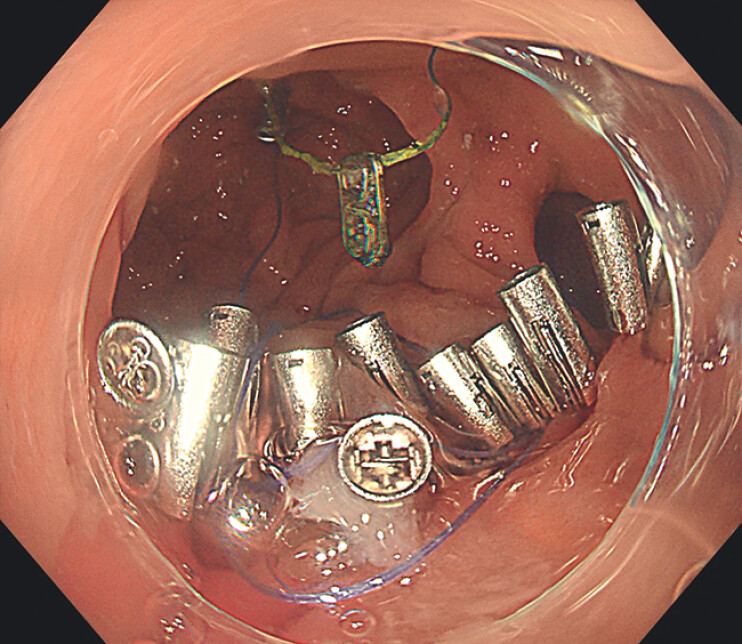 Fig. 5
- —National High Level Hospital Clinical Research Funding (Scientific and Technological Achievements Transformation Incubation Guidance Fund Project of Peking University First Hospital)
- —National High Level Hospital Clinical Research Funding (Scientific Research Seed Fund of Peking University First Hospital)
Peer Reviews
No public reviews on file for this paper yet. If you reviewed it on a platform where reviews are public (OpenReview, ICLR, NeurIPS, ICML), you can paste yours below so the community can read it here.
Videos
No videos yet. Explain this paper in a talk, walkthrough, or lecture? Add one.
Taxonomy
TopicsGastric Cancer Management and Outcomes · Enhanced Recovery After Surgery · Esophageal Cancer Research and Treatment
We present a novel absorbable string-loop suturing device for closing a colonic defect after endoscopic submucosal dissection (ESD). An 84-year-old female underwent ESD for a 4.0 cm × 3.0 cm lesion spanning the colonic anastomosis, leaving a large defect ( Fig. 1 ). Video 1 demonstrates the resection and suturing process. The string-loop device comprises two sheaths, a traction thread, and a closure loop with a pretied sliding knot made of absorbable thread (R216; Jinhuan, Shanghai, China) ( Fig. 2 ). During the procedure, the outer sheath was withdrawn while a metal clip grasped the closure loop through the biopsy channel and affixed it to one edge of the defect. Afterward, only the traction thread remained in the channel, with both sheaths external, allowing unobstructed passage of a second clip to fix the loop to the opposite edge. The traction thread was pulled while both sheaths advanced, and the inner sheath was used to advance the sliding knot ( Fig. 3 ), tightening it to approximate the wound edges ( Fig. 4 ). Finally, the traction thread was pulled to detach it from the closure loop, and additional clips were applied to completely close the defect ( Fig. 5 ). The 68-minute procedure used two string-loop devices and 17 clips – 47 minutes for resection and 21 for closure. The patient resumed liquids on postoperative day 3 and was discharged the next day without complications. Histology confirmed complete resection of high-grade intraepithelial neoplasia.
A defect spanning the anastomosis after endoscopic submucosal dissection.
A large defect spanning the anastomosis after endoscopic submucosal dissection is completely closed using a novel absorbable string-loop suturing device.Video 1
Prototype of the string-loop suturing device. Notes: The suturing device consists of three key components: 1) a purple absorbable closure loop with a pre-tied sliding knot, 2) a gray traction thread, and 3) two transparent nested polytetrafluoroethylene sheaths. Critical structural relationships are highlighted with color-coded dashed boxes: yellow marks the junction between the closure loop and traction thread, while blue indicates the overlap region of the sheaths.
The sliding knot being advanced by the inner sheath.
The defect was drawn together into a linear form by two string-loop suturing devices.
The defect completely closed with the assistance of additional clips.
Unlike nylon loop devices, which are not designed for defect closure, the string-loop device is smaller, cost-effective, and specifically designed for this purpose. The traction thread can be removed directly without scissors after tightening. Before removal, it can provide external traction without obstructing the endoscopic channel. The soft, absorbable string-loop facilitates easy clip fixation and naturally degrades within 2–3 months, promoting the clips’ detachment as the defect heals.
Endoscopy_UCTN_Code_TTT_1AQ_2AK