Evaluation of in vitro efficacy of aztreonam-nacubactam and cefepime-nacubactam against clinical isolates of Stenotrophomonas maltophilia
Wataru Aoki, Yoshifumi Uwamino, Hiroaki Kubota, Yuka Kamoshita, Rika Inose, Mika Nagata, Ho Namkoong, Hiromichi Matsushita

TL;DR
This study tested how well two antibiotic combinations work against a type of bacteria called Stenotrophomonas maltophilia, finding that both combinations reduced bacterial growth in the lab.
Contribution
The study demonstrates that combining β-lactam antibiotics with nacubactam can effectively reduce MICs against S. maltophilia, even when one antibiotic is a substrate for bacterial enzymes.
Findings
Aztreonam-nacubactam significantly reduced minimum inhibitory concentrations (MICs) against S. maltophilia isolates.
Cefepime-nacubactam also remarkably decreased MICs despite cefepime being a substrate for L1 β-lactamase.
The results suggest β-lactam–NAC combinations may be promising alternatives for treating S. maltophilia infections.
Abstract
We evaluated the in vitro activity of aztreonam-nacubactam (ATM-NAC) and cefepime-nacubactam (FEP-NAC) against 53 clinical isolates of Stenotrophomonas maltophilia from blood cultures. Minimum inhibitory concentrations (MICs) were determined via broth microdilution. While ATM-NAC showed more significant MIC reduction, FEP-NAC also remarkably decreased MICs, despite cefepime being a substrate for L1 β-lactamase. These findings suggest the potential of β-lactam–NAC combinations as promising alternatives, warranting further in vivo studies to confirm clinical applicability.
Genes, proteins, chemicals, diseases, species, mutations and cell lines named across the full text — each resolved to its canonical identifier and authoritative record.
Click any figure to enlarge with its caption.
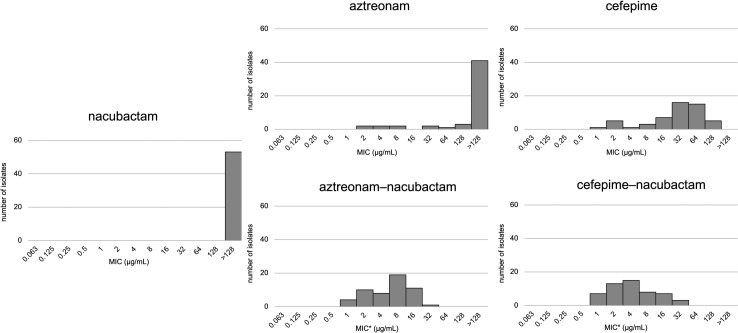 Fig 1
Fig 1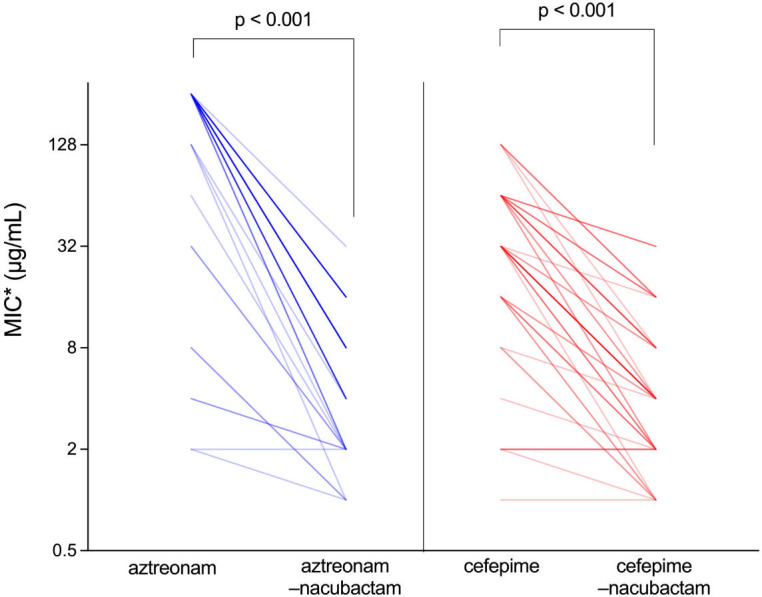 Fig 2
Fig 2- —Japan Science and Technology Agencyhttp://dx.doi.org/10.13039/501100002241
Peer Reviews
No public reviews on file for this paper yet. If you reviewed it on a platform where reviews are public (OpenReview, ICLR, NeurIPS, ICML), you can paste yours below so the community can read it here.
Videos
No videos yet. Explain this paper in a talk, walkthrough, or lecture? Add one.
Taxonomy
TopicsInfections and bacterial resistance · Antibiotic Resistance in Bacteria · Mycobacterium research and diagnosis
INTRODUCTION
Diazabicyclooctanes (DBOs) are non-β-lactam β-lactamase inhibitors that can inhibit class A and C β-lactamases, and some class D enzymes (1). Recently, DBOs such as avibactam (AVI) and relebactam have been combined with β-lactam antibiotics (e.g., ceftazidime and imipenem) to treat infections caused by drug-resistant gram-negative bacteria. However, a known limitation of DBOs is their inability to inhibit metallo-β-lactamases (MBLs), classified as class B enzymes.
Newly developed DBOs such as nacubactam (NAC, RG6080/OP0595; Roche, Fedora, Meiji) and zidebactam (ZID, WCK5107; Wockhardt) have demonstrated high affinity for penicillin-binding protein 2 (PBP2) in gram-negative bacilli, showing intrinsic antibacterial activity. When combined with β-lactam antibiotics that target PBP3, these agents exert an “enhancer effect,” improving activity even against MBL-producing organisms (2, 3).
Stenotrophomonas maltophilia harbors both L1 β-lactamase (an MBL) and L2 β-lactamase (class A), which confer resistance to most conventional β-lactams, including carbapenems. Historically, treatment options have been limited to trimethoprim-sulfamethoxazole, levofloxacin, or tetracyclines. More recently, cefiderocol (FDC), a siderophore cephalosporin with demonstrated activity against S. maltophilia, has become available (4). Additionally, aztreonam (ATM)—a monobactam not hydrolyzed by MBLs—combined with AVI has emerged as a promising therapeutic option. This combination is recommended in the Infectious Diseases Society of America guidelines (5).
We previously reported that the ATM-AVI combination and FDC showed strong in vitro activity against S. maltophilia blood culture isolates from a university hospital in Tokyo (6, 7). Although AVI does not enhance ATM’s activity via PBP binding, NAC may potentiate ATM’s effect through PBP2 binding and an enhancer mechanism. Similarly, combinations of cefepime (FEP) with ZID have demonstrated activity despite FEP being a substrate for the L1 enzyme (8). However, no study to date has evaluated the in vitro activity of ATM or FEP in combination with NAC against S. maltophilia.
In this study, we assessed the in vitro activity of ATM-NAC and FEP-NAC against 53 previously collected blood culture isolates of S. maltophilia from Keio University Hospital (Tokyo, Japan) between January 2012 and December 2024. Patient background and identification methods were previously described (6). Whole-genome sequencing data from our prior study (7) were used to determine sequence types using MLST 2.0 (9), assess clonality with Snippy v3.2 (https://github.com/tseemann/snippy) and Gubbins v2.3.4 (10), and detect blaL1 and blaL2 genes by BLAST v2.12.0+ with the BLASTN algorithm (11), referencing EF126059 and EF126086, respectively.
Minimum inhibitory concentrations (MICs) were determined by broth microdilution using CAMHB in accordance with CLSI M100 35th edition guidelines (12), over a concentration range of 0.063–128 µg/mL. NAC was combined with ATM or FEP at a 1:1 ratio per CLSI guidance. Quality control for NAC used Escherichia coli ATCC 25922 and Pseudomonas aeruginosa ATCC 27853; other agents were tested with Klebsiella pneumoniae ATCC 700603.
MIC_50_ and MIC_90_ values were calculated for each agent and combination. Statistical analysis of MIC differences (with/without NAC) was performed using the Wilcoxon signed-rank test after log transformation. Statistical analyses were conducted using JMP Student Edition 18. MICs > 128 µg/mL were treated as 256 µg/mL for statistical purposes.
The isolates showed diverse sequence types and were polyclonal in phylogenetic analysis. All but three strains harbored both blaL1 and blaL2 (Fig. S1; Table S1). MIC_50_ and MIC_90_ for NAC and ATM alone were both >128 µg/mL, while for FEP alone were 32 and 64 µg/mL, respectively.
With NAC, MIC_50_/MIC_90_ values were reduced to 8/16 µg/mL for ATM-NAC and 4/16 µg/mL for FEP-NAC. ATM-NAC showed slightly higher MICs than FEP-NAC (P = 0.018) (Fig. 1). Both combinations significantly reduced MICs compared to monotherapy (P < 0.001) (Fig. 2). Median fold reduction was 32-fold (interquartile range [IQR]: 16–32) for ATM and 8-fold (IQR: 4–8) for FEP, with greater reduction for ATM (P < 0.001).
*Distribution of MIC values for aztreonam, cefepime, nacubactam alone, and their respective combinations. The distribution of minimum inhibitory concentrations (MICs) for aztreonam, cefepime, and nacubactam as monotherapies, as well as for the combinations of aztreonam–nacubactam and cefepime–nacubactam, is demonstrated. For the β-lactam and nacubactam combinations, the two agents were used at a 1:1 ratio, and the MIC values are represented based on the β-lactam concentration.
The effect of nacubactam combination on MIC reduction. The in vitro reduction in minimum inhibitory concentrations (MICs) of aztreonam and cefepime after the addition of an equivalent amount of nacubactam is demonstrated. The thickness of the lines corresponds to the number of overlapping isolates.
To our knowledge, this is the first study assessing ATM-NAC and FEP-NAC against S. maltophilia. Although ATM-NAC showed MIC reductions, MIC_50_/MIC_90_ values for ATM-AVI were slightly lower than those for ATM-NAC. FDC demonstrated even lower MIC_50_/MIC_90_ values (Table S2). Interestingly, despite FEP being a known substrate of L1 β-lactamase, FEP-NAC also showed significant MIC reductions, suggesting that NAC may confer an enhancer effect through PBP2 targeting.
Previous studies, such as that by Sadar et al., reported MIC_50_/MIC_90_ values of 4/16 µg/mL for the FEP-ZID combination against S. maltophilia (8), indicating that FEP-NAC and FEP-ZID may have comparable activity. Another relevant combination is FEP-taniborbactam (FEP-TAN). Taniborbactam is a cyclic boronic acid β-lactamase inhibitor with broad-spectrum inhibitory activity against class A, C, and D β-lactamases, as well as subclass B1 MBLs such as NDM and VIM. However, it does not inhibit subclass B3 MBLs, including L1, which is characteristic of S. maltophilia (13, 14). Therefore, the in vitro activity of FEP-TAN against S. maltophilia is thought to derive primarily from inhibition of the L2 β-lactamase (15). According to the report by Gerges et al., the MIC_50_/MIC_90_ values of S. maltophilia isolates recovered from blood cultures of cancer patients for FEP-TAN were 4/8 µg/mL (16). Although not a direct comparison, FEP-NAC demonstrated relatively comparable in vitro activity to FEP-TAN.
Although there is no established breakpoint for FEP-NAC against S. maltophilia, CLSI has proposed a provisional susceptibility breakpoint of 8 µg/mL for Enterobacterales. Based on this threshold, 81.1% of our isolates would be considered susceptible.
Given that ATM and FDC are WHO AWaRe “RESERVE” category antibiotics (https://aware.essentialmeds.org/list), preserving their use is desirable. Developing alternative options using WATCH category agents like FEP, especially in combination with novel DBOs such as NAC, could be valuable. However, as NAC is not yet approved for clinical use, further pharmacokinetic/pharmacodynamic and in vivo efficacy studies are warranted.
In conclusion, both ATM-NAC and FEP-NAC combinations demonstrated promising in vitro activity against clinical blood isolates of S. maltophilia, suggesting their potential as alternative therapeutic options pending further clinical development.
The reference list from the paper itself. Each links out to its DOI / PubMed record.
- 1Shlaes DM. 2013. New β-lactam-β-lactamase inhibitor combinations in clinical development. Ann N Y Acad Sci 1277:105–114. doi:10.1111/nyas.1201023346860 · doi ↗ · pubmed ↗
- 2Livermore D.M, Mushtaq S, Warner M, Woodford N. 2015. Activity of OP 0595/β-lactam combinations against Gram-negative bacteria with extended-spectrum, Amp C and carbapenem-hydrolysing β-lactamases. J Antimicrob Chemother 70:3032–3041. doi:10.1093/jac/dkv 23926311835 · doi ↗ · pubmed ↗
- 3Livermore David M., Mushtaq S, Warner M, Vickers A, Woodford N. 2017. In vitro activity of cefepime/zidebactam (WCK 5222) against Gram-negative bacteria. J Antimicrob Chemother 72:1373–1385. doi:10.1093/jac/dkw 59328158732 · doi ↗ · pubmed ↗
- 4Nakamura R, Oota M, Matsumoto S, Sato T, Yamano Y. 2021. In vitro activity and in vivo efficacy of cefiderocol against Stenotrophomonas maltophilia. Antimicrob Agents Chemother 65:e 01436-20. doi:10.1128/AAC.01436-2033526491 PMC 8097474 · doi ↗ · pubmed ↗
- 5Tamma PD, Heil EL, Justo JA, Mathers AJ, Satlin MJ, Bonomo RA. 2024. Infectious diseases society of America 2024 guidance on the treatment of antimicrobial-resistant Gram-Negative infections. Clin Infect Dis Clin Infect Dis 75:ciae 403. doi:10.1093/cid/ciae 40339108079 · doi ↗ · pubmed ↗
- 6Aoki W, Uwamino Y, Kamoshita Y, Inose R, Nagata M, Hasegawa N, Matsushita H. 2025. In vitro activity of aztreonam-avibactam combination against blood culture isolates of Stenotrophomonas maltophilia in Japan before the launch of ceftazidime-avibactam. Microbiol Spectr 13:e 0331624. doi:10.1128/spectrum.03316-2440084947 PMC 12054054 · doi ↗ · pubmed ↗
- 7Aoki W, Uwamino Y, Niida N, Kubota H, Kamoshita Y, Inose R, Nagata M, Ishihara O, Uno S, Yoshifuji A, Namkoong H, Hasegawa N, Matsushita H. 2025. Cefiderocol susceptibility of Stenotrophomonas maltophilia species complex and carbapenem-resistant Pseudomonas aeruginosa isolates from blood cultures at a university hospital in Tokyo, Japan. J Glob Antimicrob Resist 44:251–255. doi:10.1016/j.jgar.2025.07.00440633765 · doi ↗ · pubmed ↗
- 8Sader HS, Mendes RE, Duncan LR, Carvalhaes CG, Castanheria M. 2022. Antimicrobial activity of cefepime/zidebactam (WCK 5222), a β-lactam/β-lactam enhancer combination, against clinical isolates of Gram-negative bacteria collected worldwide (2018–19). J Antimicrob Chemother 77:2642–2649. doi:10.1093/jac/dkac 23335897129 · doi ↗ · pubmed ↗