Determination of Fusobacterium nucleatum levels in patients with periodontal disease and oral squamous cell carcinoma
Karthik Shunmugavelu, Bala Geetha Shakthi Chakravarthy, Shanmuga Priya

TL;DR
This paper reviews evidence that Fusobacterium nucleatum is more common in periodontal disease and oral cancer, suggesting a possible role in causing these conditions.
Contribution
The paper systematically evaluates F. nucleatum levels in periodontal disease and oral cancer, highlighting its potential pathogenic role.
Findings
Fusobacterium nucleatum is more prevalent in periodontal disease tissues compared to healthy controls.
Fusobacterium nucleatum is more prevalent in oral squamous cell carcinoma tissues compared to healthy controls.
Abstract
Fusobacterium (F.) nucleatum, a Gram-negative anaerobic bacterium, has been implicated in both periodontal disease and oral squamous cell carcinoma (OSCC). This review aims to evaluate the levels of F. nucleatum in patients with periodontal disease and OSCC, exploring its potential role in the pathogenesis. A comprehensive literature search was conducted across multiple databases, identifying studies that measured F. nucleatum levels in periodontal disease and OSCC tissues. A higher prevalence of F. nucleatum exists in both periodontal disease and OSCC tissues compared to healthy controls. It appears that there is a link between infection with F. nucleatum and the development of these oral diseases. Further research is warranted to elucidate the mechanisms underlying this association and to explore potential therapeutic interventions targeting F. nucleatum.
Genes, proteins, chemicals, diseases, species, mutations and cell lines named across the full text — each resolved to its canonical identifier and authoritative record.
Click any figure to enlarge with its caption.
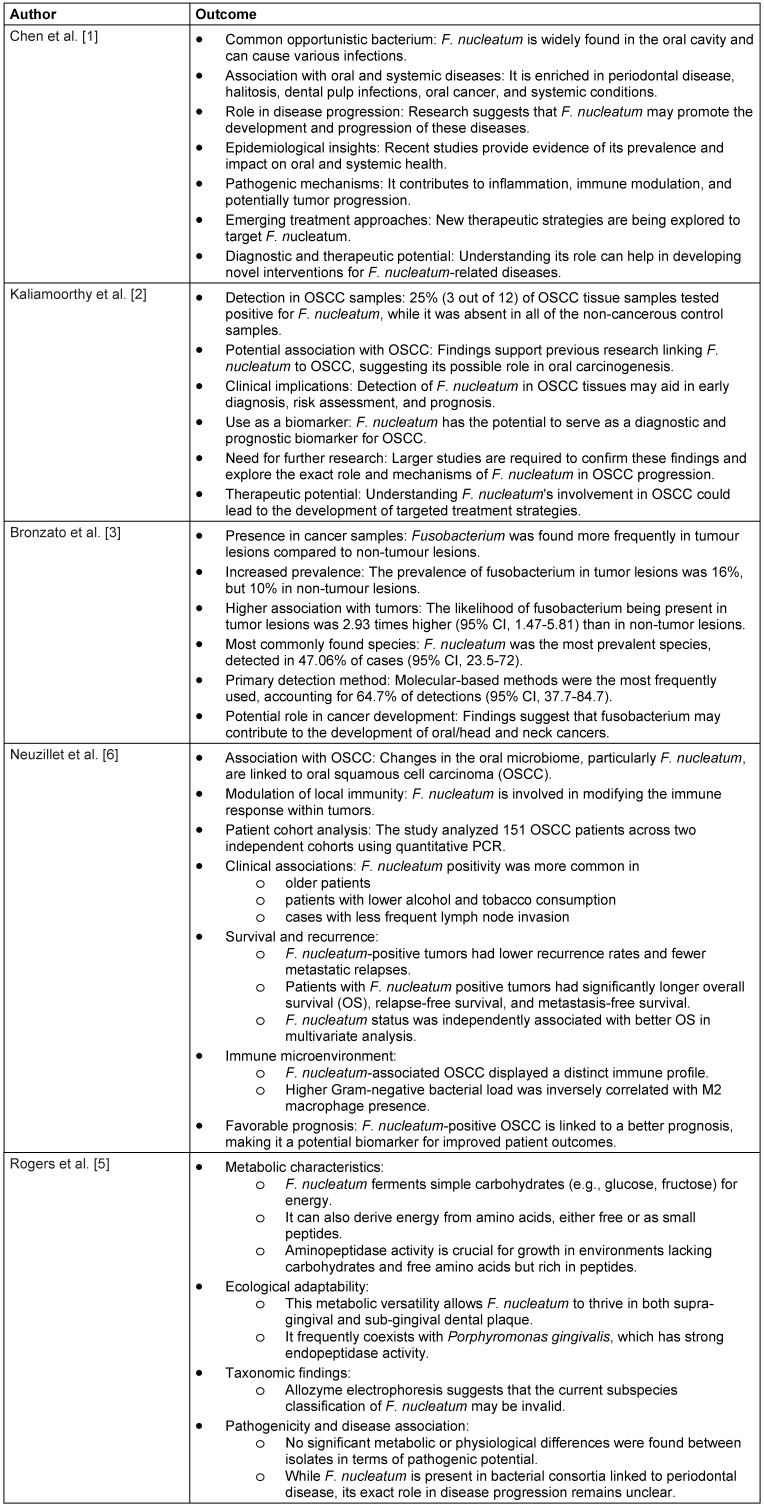 Figure 1
Peer Reviews
No public reviews on file for this paper yet. If you reviewed it on a platform where reviews are public (OpenReview, ICLR, NeurIPS, ICML), you can paste yours below so the community can read it here.
Videos
No videos yet. Explain this paper in a talk, walkthrough, or lecture? Add one.
Taxonomy
TopicsOtolaryngology and Infectious Diseases · Oral microbiology and periodontitis research · Salivary Gland Disorders and Functions
Introduction
Periodontal diseases encompass inflammatory conditions affecting the supporting structures of the teeth, primarily caused by bacterial infections. Fusobacterium (F.) nucleatum, a key periodontal pathogen, has been frequently isolated from periodontal pockets and is known to play a significant role in the progression of periodontal disease. Recent studies have also identified F. nucleatum in various malignancies, including colorectal cancer and oral squamous cell carcinoma (OSCC), suggesting a potential oncogenic role. The review aims to assess the levels of F. nucleatum in patients with periodontal diseases and OSCC, providing insights into its potential involvement in the pathogenesis of these conditions [1], [2].
Methods
A systematic literature search was conducted using databases such as PubMed, Scopus, Web of Science, Embase, and Cochrane, covering studies published up to March 2025. The search strategy used the keywords “Fusobacte**rium nucleatum”, “periodontal disease”, “oral squamous cell carcinoma”, and “oral microbiome”. Inclusion criteria encompassed studies that quantitatively measured F. nucleatum levels in periodontal disease or OSCC tissues. Exclusion criteria involved studies lacking quantitative data or focusing on other Fusobacterium spp. Data extraction was performed independently by two reviewers, and discrepancies were resolved through discussion [3].
Results
The initial search yielded 118 unique records, with 88 full-text articles assessed for eligibility. Seventeen (17) studies met the inclusion criteria, of which we reviewed 5 (Table 1 (Tab. 1)). Although 18 studies initially met the inclusion criteria, we included only 5 in the final review to ensure methodological consistency and data integrity. The excluded studies exhibited significant limitations, including inadequate reporting of quantitative outcomes, inconsistent microbial detection methods (e.g., qPCR vs. 16S rRNA sequencing), and population variability that introduced substantial heterogeneity. Additionally, several studies were assessed as having a high risk of bias, further reducing their suitability for inclusion. By focusing on a smaller subset of high-quality studies, we aimed to enhance the reliability of our findings and align with PRISMA recommendations for transparent and reproducible systematic reviews.
In periodontal diseases, F. nucleatum was more abundant than in healthy controls, with detection rates ranging from 57.1% to 68% in patients with gingivitis and periodontitis, respectively, and 37.8% in healthy individuals. In OSCC tissues, F. nucleatum was present in 16% of tumor lesions compared to 10% in non-tumor lesions, indicating a higher prevalence in cancerous tissues. A pilot case-control study reported a 25% detection rate of F. nucleatum in OSCC tissues, while it was not present in any of the control samples.
Discussion
F. nucleatum is a highly adaptable and opportunistic bacterium widely present in the human oral microbiome. The physiological and metabolic versatility of this organism has been demonstrated in various studies, highlighting its role in different pathological conditions, including periodontal diseases, OSCC, and systemic diseases [4].
The study by Rogers [5] explored the metabolic abilities of F. nucleatum, showing that it can ferment both simple carbohydrates (such as glucose and fructose) and amino acids, either free or in small peptides. This metabolic flexibility allows it to survive in various niches within the oral cavity, including supra- and sub-gingival dental plaque. Aminopeptidase activity was found to be essential for growth in peptide-rich environments, suggesting that this enzymatic function plays a key role in its ecological adaptability. Additionally, the study raised doubts about the validity of the current subspecies classification of F. nucleatum based on allozyme electrophoresis. Although its presence in periodontal disease-associated bacterial consortia is well-documented, its exact contribution to disease progression remains uncertain.
Chen et al. [1] provided a comprehensive overview of F. nucleatum as more than just a periodontal pathogen, highlighting its association with various oral and systemic diseases. The study emphasized that F. nucleatum is enriched in conditions such as halitosis, dental pulp infections, and oral cancer and contributes to inflammation, immune modulation, and potentially tumor progression. The authors discussed emerging therapeutic strategies targeting F. nucleatum and the importance of understanding its pathogenic mechanisms to develop novel diagnostic and therapeutic interventions.
Kaliamoorthy et al. [2] conducted a pilot case-control study investigating the presence of F. nucleatum in OSCC tissue samples. The study detected the bacterium in 25% of OSCC cases, whereas it was absent in non-cancerous controls, reinforcing the hypothesis that F. nucleatum may be involved in oral carcinogenesis. The study suggested its potential use as a biomarker for early diagnosis, risk assessment, and prognosis of OSCC. However, given the limited sample size, the authors emphasized the need for larger-scale studies to confirm these findings and elucidate the underlying mechanisms of its role in cancer progression.
A meta-analysis by Bronzato et al. [3] further supported the link between Fusobacterium and cancer, demonstrating a significantly higher prevalence of Fusobacterium spp. in tumor lesions compared to non-tumor lesions. F. nucleatum was identified as the most prevalent species, detected in nearly 47.06% of cases. The study also highlighted that molecular-based methods were the most reliable for detecting Fusobacterium, accounting for 64.7% of positive cases. These findings suggest a possible role of Fusobacterium in the development of oral and head and neck cancers, warranting further research to determine its precise contribution to tumorigenesis.
Neuzillet et al. [6] provided additional insights into the prognostic value of intratumoral F. nucleatum and its association with immune-related gene expression in OSCC patients. The study analyzed a large cohort of 151 OSCC patients and found that F. nucleatum positivity was associated with a favorable prognosis, including longer overall survival, relapse-free survival, and metastasis-free survival. Additionally, the study revealed a distinct immune microenvironment in F. nucleatum positive OSCC cases, where a higher Gram-negative bacterial load correlated inversely with M2 macrophage presence. These findings suggest that F. nucleatum may influence tumor immunity, which could have implications for immunotherapeutic strategies in OSCC management.
The findings from these studies collectively underscore the complex role of F. nucleatum in oral health and disease. While its metabolic adaptability allows it to colonize diverse environments, its potential pathogenicity in both periodontal and systemic diseases, particularly OSCC, remains an area of active investigation. The emerging evidence linking F. nucleatum to cancer progression and immune modulation highlights the need for further research to determine whether this bacterium serves as a causative agent or merely an opportunistic colonizer. Understanding its interactions with host immunity and other microbial species may open new avenues for targeted therapeutic interventions and improve diagnostic accuracy in oral and systemic diseases.
Conclusion
F. nucleatum is a metabolically versatile bacterium that plays a significant role in both oral and systemic diseases. Its ability to ferment carbohydrates and amino acids allows it to thrive in diverse oral environments, contributing to its presence in both supra- and sub-gingival dental plaque. While traditionally associated with periodontal disease, emerging research highlights its involvement in various pathological conditions, including oral squamous cell carcinoma (OSCC) and other head and neck cancers. Studies have demonstrated its increased prevalence in tumor tissues and its potential as a biomarker for cancer diagnosis and prognosis. Moreover, its impact on immune modulation suggests a possible role in influencing disease progression.
Despite these insights, the exact contribution of F. nucleatum to disease remains unclear. While some studies link its presence to pathogenic outcomes, others suggest a potential association with better survival rates in certain cancers. This paradox underlines the need for further research to delineate its mechanisms of action, interactions within microbial consortia, and potential therapeutic interventions. Understanding the metabolic and physiological characteristics of* F. nucleatum* could pave the way for new diagnostic and treatment strategies, ultimately improving patient outcomes in both oral and systemic health.
Notes
Competing interests
The authors declare that they have no competing inter-ests.
Funding
None.
Authors’ ORCIDs
- Shunmugavelu K: https://orcid.org/0000-0001-7562-8802
- Shakthi Chakravarthy BG: https://orcid.org/0009-0006-0582-1563
The reference list from the paper itself. Each links out to its DOI / PubMed record.
- 1Chen Y Huang Z Tang Z Huang Y Huang M Liu H Ziebolz D Schmalz G Jia B Zhao J More Than Just a Periodontal Pathogen -the Research Progress on Fusobacterium nucleatum Front Cell Infect Microbiol 3Feb 20221281531810.3389/fcimb.2022.81531835186795 PMC 8851061 · doi ↗ · pubmed ↗
- 2Kaliamoorthy S Priya Sayeeram S Sundar Raj S Balakrishnan J Nagarajan M Samidorai A Investigating the Association Between Fusobacterium nucleatum and Oral Squamous Cell Carcinoma: A Pilot Case-Control Study on Tissue Samples Cureus 17Oct 20231510 e 4723810.7759/cureus.4723838022043 PMC 10654264 · doi ↗ · pubmed ↗
- 3Bronzato JD Bomfim RA Edwards DH Crouch D Hector MP Gomes BPFA Detection of Fusobacterium in oral and head and neck cancer samples: A systematic review and meta-analysis Arch Oral Biol Apr 202011210466910.1016/j.archoralbio.2020.10466932028171 · doi ↗ · pubmed ↗
- 4Mc Ilvanna E Linden GJ Craig SG Lundy FT James JA Fusobacterium nucleatum and oral cancer: a critical review BMC Cancer 13Nov 2021211121210.1186/s 12885-021-08903-434774023 PMC 8590362 · doi ↗ · pubmed ↗
- 5Rogers AH Studies on fusobacteria associated with periodontal diseases Aust Dent J Apr 199843210510910.1111/j.1834-7819.1998.tb 06098.x 9612984 · doi ↗ · pubmed ↗
- 6Neuzillet C Marchais M Vacher S Hilmi M Schnitzler A Meseure D Leclere R Lecerf C Dubot C Jeannot E Klijanienko J Mariani O Calugaru V Hoffmann C Lesnik M Badois N Borcoman E Piaggio E Kamal M Le Tourneau C Bieche I Prognostic value of intratumoral Fusobacterium nucleatum and association with immune-related gene expression in oral squamous cell carcinoma patients Sci Rep 12Apr 2021111787010.1038/s 41598-021-86816-933846399 PMC 8041800 · doi ↗ · pubmed ↗