Beyond the PEL surveyance: Genome editing of the OsPEL family enhances photosynthesis efficiency in rice
Christian Damian Lorenzo

Abstract
Genes, proteins, chemicals, diseases, species, mutations and cell lines named across the full text — each resolved to its canonical identifier and authoritative record.
Click any figure to enlarge with its caption.
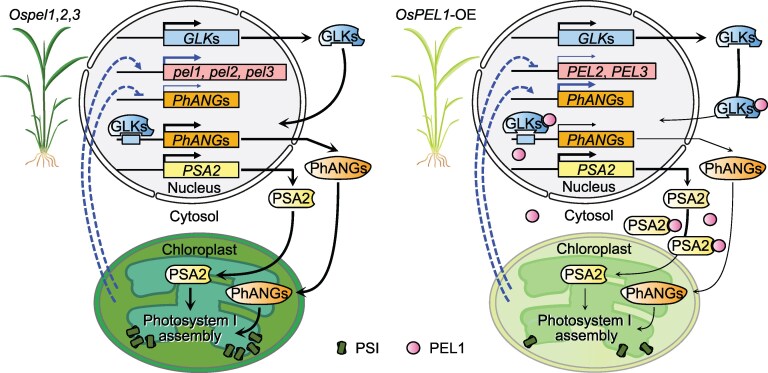 Figure 1
Peer Reviews
No public reviews on file for this paper yet. If you reviewed it on a platform where reviews are public (OpenReview, ICLR, NeurIPS, ICML), you can paste yours below so the community can read it here.
Videos
No videos yet. Explain this paper in a talk, walkthrough, or lecture? Add one.
Taxonomy
TopicsPhotosynthetic Processes and Mechanisms
Photosynthesis is a major target of improvement strategies to boost crop productivity. One strategy focuses on engineering the C4 metabolic pathway, or aspects of it, into C3 crops such as rice (Croce et al. 2024). C4 plants have a specialized photosynthetic metabolism in which CO_2_ is first incorporated into a reduced C4 acid in mesophyll chloroplasts. The C4 acid then moves to the bundle sheath chloroplasts, where it concentrates CO_2_ around Rubisco, the key enzyme involved in CO_2_ fixation. This optimizes carbon fixation by reducing photosynthetic losses due to photorespiration, a process where Rubisco uses O_2_ instead of CO_2_ as its substrate (Mukundan et al. 2024). Unfortunately, engineering the C4 pathway into C3 plants is complex. Overexpression of the transcription factor GOLDEN2-LIKE (GLK) from a C4 crop (maize) in rice (Oryza sativa) results in a pseudo-C4 anatomy with increased chloroplast development (Choi et al. 2024). However, similar approaches modifying the GLK from rice itself had little effect, hinting at a more complex regulation in this crop. Identification of other potential genes to improve photosynthetic efficiency has highlighted the PSEUDO-ETIOLATION IN LIGHT (PEL) family as a promising hub. PEL genes code for microproteins that act as negative regulators of photosynthesis. PEL knockout (KO) mutants exhibit higher chlorophyll levels and increased biomass as compared with wild type (wt) plants (Kim et al. 2023). Mechanistic studies indicate that PEL proteins act through inhibition of the DNA-binding properties of transcription factors (Kim et al. 2023).
Delving deeper into the potential role of PELs as an avenue for photosynthesis improvements, Heebak Choi and collaborators (2025) performed a functional analysis of the PELs in rice. The researchers identified 3 orthologs of Arabidopsis thaliana PELs: O. sativa PEL1 (OsPEL1), OsPEL2, and OsPEL3. Tissue expression studies showed that all OsPELs were highly expressed in young shoots, particularly in mesophyll cells, the main site of carbon fixation in C3 plants. Phenotypical characterization of OsPEL overexpression (OE) lines (OsPEL1OE) revealed pale-green coloration in several tissues and reductions of chlorophyll levels and biomass as compared with wt plants. In generated KO lines, a single OsPEL KO did not cause a distinct phenotype, while triple-KO mutants (Ospel1,2,3) exhibited dark green leaves with increases in chlorophyll levels up to 80%. They also had more developed grana stacks (an increased number of thylakoid membrane layers), higher efficiency of CO_2_ assimilation, and greater plant biomass and grain weight.
The group screened for potential OsPEL protein–protein interactors through a yeast 2-hybrid assay. Among others, they identified OsGLK1, an orthologue to GLK in Arabidopsis, as well as PHOTOSYSTEM I ASSEMBLY 2 (PSA2), a key player in photosystem I development. Both proteins interacted with all 3 OsPELs through a conserved domain of 37 to 39 amino acids. Considering the previous evidence of OsPEL inhibiting DNA binding, the researchers analyzed the subcellular localization and accumulation of OsPEL, OsGLK1, and OsPSA2 in wt, OE, and KO lines. Isolated OsPEL1 and OsGLK1 were localized in the cytoplasm and nucleus, while OsPSA2 was localized in chloroplasts in wt plants. Nevertheless, assays performed in Ospel1,2,3 and the OsPEL1OE revealed that OsGLK1 nuclear distribution increased in the former and decreased in the latter. Such effects were not observed when expressing a OsGLK1 lacking the 37 amino acids needed for interaction. Likewise, PSA2 chloroplast localization was severely disrupted in OsPEL1OE lines. These findings suggest that OsPEL1 acts by sequestering OsGLK1 in the cytoplasm and reducing PSA2 subcellular distribution.
Finally, to better understand the action of OsPELs at the transcriptomic level, bulk RNA sequencing was carried out on OE and KO lines. Interestingly, dark green Ospel1,2,3 plants (due to the unrestricted localization of GLKs) displayed high OsPEL transcript levels, suggesting negative feedback regulation of expression within the OsPEL family, as well as other photosynthesis-associated nuclear genes. Accordingly, pale-green OE lines (caused by the cytoplasmic sequestration of GLKs and PSA2 by OsPELs) showed opposite trends. Altogether, the information points toward a complex regulatory pathway in rice where PELs act as surveyors, fine-tuning chloroplast homeostasis at the transcriptional and protein levels (Fig.). These results reveal insights into the complex regulation mediated by OsPEL genes in rice and how this could be employed to improve photosynthesis.
Recent related articles in The Plant Cell
Pei and collaborators (2025) showed that the transcription factor DEAR1 plays a role regulating chlorophyll biosynthesis and degradation in tomato. Croce and collaborators (2024) performed a case-detailed perspective review on the latest advancements aimed at optimizing photosynthetic efficiency, focusing on potential avenues for improvements and bottlenecks.
The reference list from the paper itself. Each links out to its DOI / PubMed record.
- 1Choi H, Gwak D, Kim S, Yi T, Ha SH. Molecular action of GOLDEN 2-LIKE transcription factor family with diverse interacting promoters and proteins. Physiol Plant. 2024:176(1):e 14164. 10.1111/ppl.14164 · doi ↗
- 2Choi H, Yi TG, Gho Y, Jung KH, Ha SH. Editing of rice PSEUDO-ETIOLATION IN LIGHT micro Protein genes promotes chloroplast development. Plant Cell. 2025:koaf 235. 10.1093/plcell/koaf 23541054818 PMC 12696372 · doi ↗ · pubmed ↗
- 3Croce R, Carmo-Silva E, Cho YB, Ermakova M, Harbinson J, Lawson T, Mc Cormick AJ, Niyogi KK, Ort DR, Patel-Tupper D. Perspectives on improving photosynthesis to increase crop yield. Plant Cell. 2024:36(10):3944–3973. 10.1093/plcell/koae 13238701340 PMC 11449117 · doi ↗ · pubmed ↗
- 4Kim N, Jeong J, Kim J, Oh J, Choi G. Shade represses photosynthetic genes by disrupting the DNA binding of GOLDEN 2-LIKE 1. Plant Physiol. 2023:191(4):2334–2352. 10.1093/plphys/kiad 02936702576 PMC 10069884 · doi ↗ · pubmed ↗
- 5Mukundan NS, Satyamoorthy K, Sankar Babu V. Investigating photosynthetic evolution and the feasibility of inducing C 4 syndrome in C 3 plants. Plant Biotechnol Rep. 2024:18(4):449–463. 10.1007/s 11816-024-00908-2 · doi ↗
- 6Pei Y, He X, Xue Q, Deng H, Xu W, Yang C, Wu M, Wang W, Tang W, Niu W. The bifunctional transcription factor DEAR 1 oppositely regulates chlorophyll biosynthesis and degradation in tomato fruits. Plant Cell. 2025:37(7):koaf 167. 10.1093/plcell/koaf 16740577586 · doi ↗ · pubmed ↗