Exploring factors influencing students’ self-feedback: insights from a structural equation modeling analysis using an extended theory of planned behavior framework
Yongle Yang, Zi Yan, Jinyu Zhu, Wuyuan Guo, Junsheng Wu, Bingjun Huang

TL;DR
This study explores what motivates students to engage in self-feedback using a behavioral model, finding that attitudes and perceived control strongly influence their actions.
Contribution
The study extends the Theory of Planned Behavior to self-feedback and identifies key predictors of students' self-feedback behavior.
Findings
Attitude, subjective norms, and perceived behavior control significantly predict self-feedback intentions.
Perceived behavior control and intention strongly influence actual self-feedback behavior.
Class climate had no significant impact on intentions and mixed effects on behavior.
Abstract
Empowering students as active agents in the feedback process is essential for students’ learning, which requires students to proactively seek, process, and use feedback to enhance their learning outcomes. Despite its critical significance in feedback research, there remains a notable gap in understanding the factors that motivate students to engage in the self-feedback process. This study applied an extended Theory of Planned Behavior (TPB) model to examine 1,311 students from mainland China regarding their self-feedback intentions and behaviors, along with crucial predictors (i.e., attitude, subjective norms, and perceived behavior control) with ten self-report scales. The psychometric properties of all scales were examined, and effects among factors were investigated using structural equation modeling. Findings reported that attitude, subjective norms, and perceived behavior control…
Genes, proteins, chemicals, diseases, species, mutations and cell lines named across the full text — each resolved to its canonical identifier and authoritative record.
Click any figure to enlarge with its caption.
 Figure 1
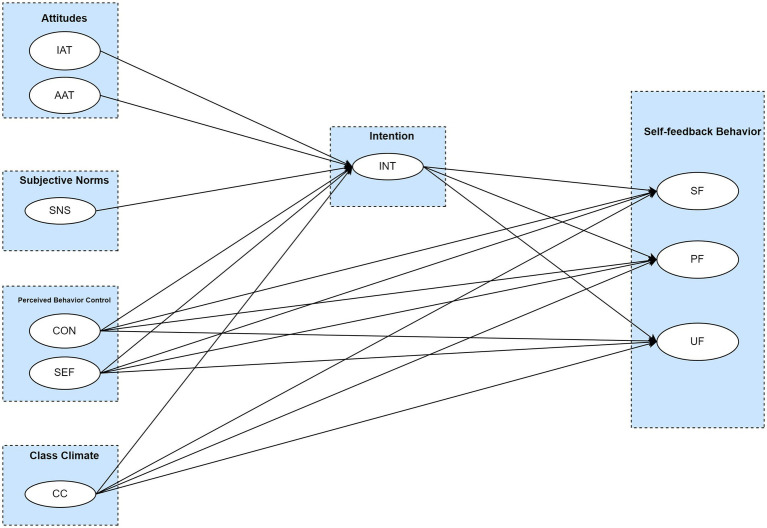 Figure 2
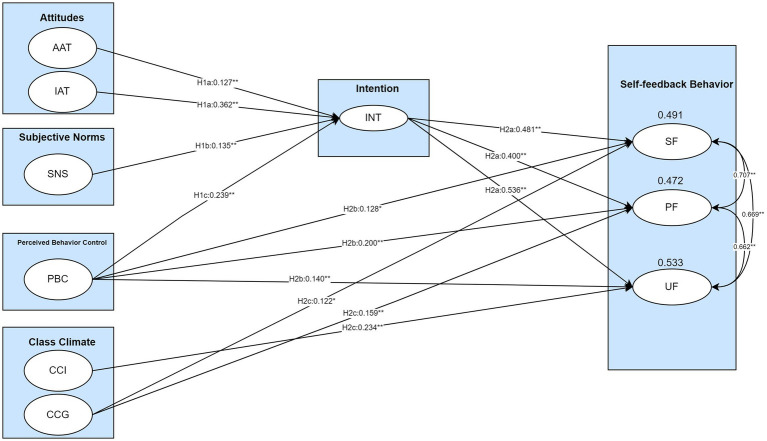 Figure 3
Peer Reviews
No public reviews on file for this paper yet. If you reviewed it on a platform where reviews are public (OpenReview, ICLR, NeurIPS, ICML), you can paste yours below so the community can read it here.
Videos
No videos yet. Explain this paper in a talk, walkthrough, or lecture? Add one.
Taxonomy
TopicsInnovative Teaching and Learning Methods · Educational Assessment and Improvement · Psychometric Methodologies and Testing