Contextual influences on risk-taking in children and adults
Penelope Lacombe, Klaus Zuberbühler, Christoph D. Dahl

TL;DR
The study shows that both children and adults change their risk preferences based on context, similar to non-human primates.
Contribution
The novel contribution is identifying contextual risk-preference shifts in humans and linking them to cognitive mechanisms like exploration and framing effects.
Findings
Human participants showed context-dependent risk preferences similar to non-human primates.
Children exhibited more pronounced shifts in risk preference based on context.
Exploration and framing effects were identified as potential cognitive mechanisms for the preference shifts.
Abstract
Human risk-taking is well known to be influenced by context-dependent factors. In a previous study, we demonstrated that non-human primates similarly exhibit contextual risk-preference: two species of great apes showed risk-prone or risk-neutral choices depending on the manner in which risk was presented. Here, we applied the same experimental paradigm to human participants across different age groups using a computerized online interface. Consistent with the findings in great apes, we observed shifts in risk preference contingent on the experimental context, with these effects particularly pronounced in children. In a subsequent experiment, we explored potential cognitive mechanisms underlying this preference shift, identifying a general propensity for exploration and framing effects as promising explanatory factors common to both humans and animals.
Genes, proteins, chemicals, diseases, species, mutations and cell lines named across the full text — each resolved to its canonical identifier and authoritative record.
Click any figure to enlarge with its caption.
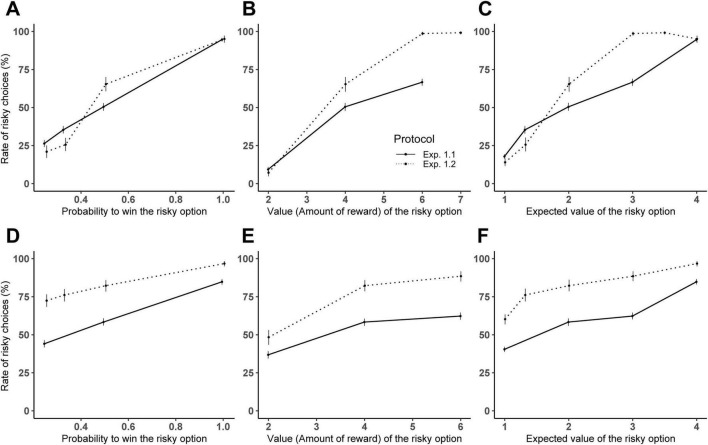 Figure 1
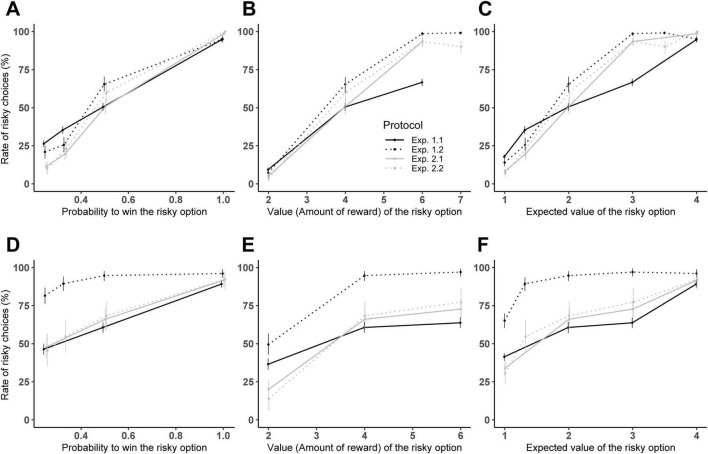 Figure 2
Peer Reviews
No public reviews on file for this paper yet. If you reviewed it on a platform where reviews are public (OpenReview, ICLR, NeurIPS, ICML), you can paste yours below so the community can read it here.
Videos
No videos yet. Explain this paper in a talk, walkthrough, or lecture? Add one.
Taxonomy
TopicsDecision-Making and Behavioral Economics · Behavioral Health and Interventions · Risk Perception and Management