Sudden restructuring of memory representations in recurrent neural networks with repeated stimulus presentations
Jonathon R. Howlett

TL;DR
This paper shows that simple brain-like networks can experience sudden jumps in learning performance when repeatedly exposed to a stimulus, similar to human learning patterns.
Contribution
The study demonstrates that Amari-Hopfield networks exhibit discontinuous learning jumps with repeated stimulus exposure, mirroring human learning behavior.
Findings
Attractor basin size increases in discrete jumps rather than gradually with repeated stimulus exposure.
The distribution of these jumps follows a lognormal pattern, indicating a heavy-tailed distribution.
Newly acquired states form hierarchically branching structures with branch sizes following a power law distribution.
Abstract
While acquisition curves in human learning averaged at the group level display smooth, gradual changes in performance, individual learning curves across cognitive domains reveal sudden, discontinuous jumps in performance. Similar thresholding effects are a hallmark of a range of nonlinear systems which can be explored using simple, abstract models. Here, I investigate discontinuous changes in learning performance using Amari-Hopfield networks with Hebbian learning rules which are repeatedly exposed to a single stimulus. Simulations reveal that the attractor basin size for a target stimulus increases in discrete jumps rather than gradual changes with repeated stimulus exposure. The distribution of the size of these positive jumps in basin size is best approximated by a lognormal distribution, suggesting that the distribution is heavy-tailed. Examination of the transition graph structure…
Genes, proteins, chemicals, diseases, species, mutations and cell lines named across the full text — each resolved to its canonical identifier and authoritative record.
Click any figure to enlarge with its caption.
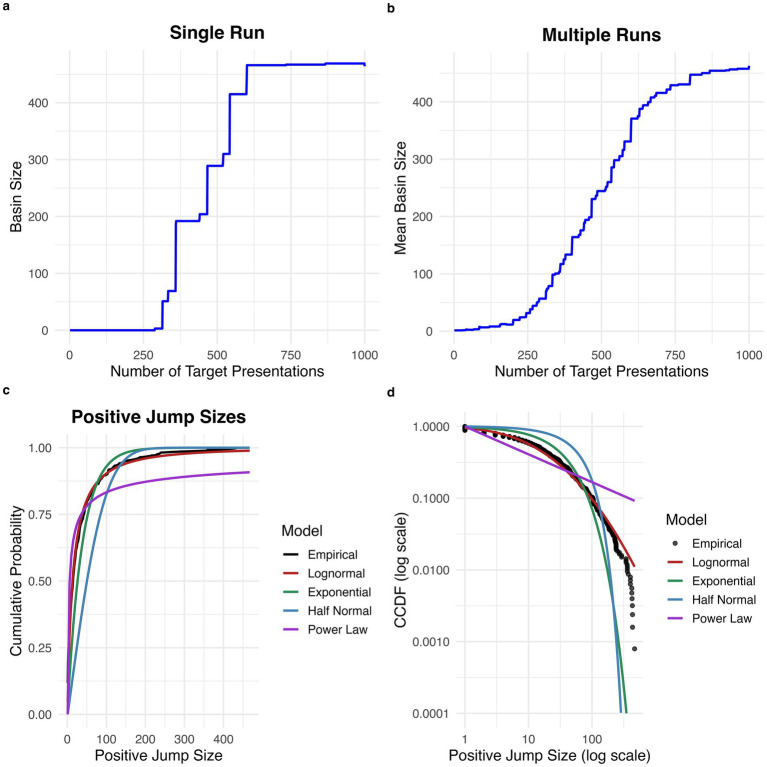 Figure 1
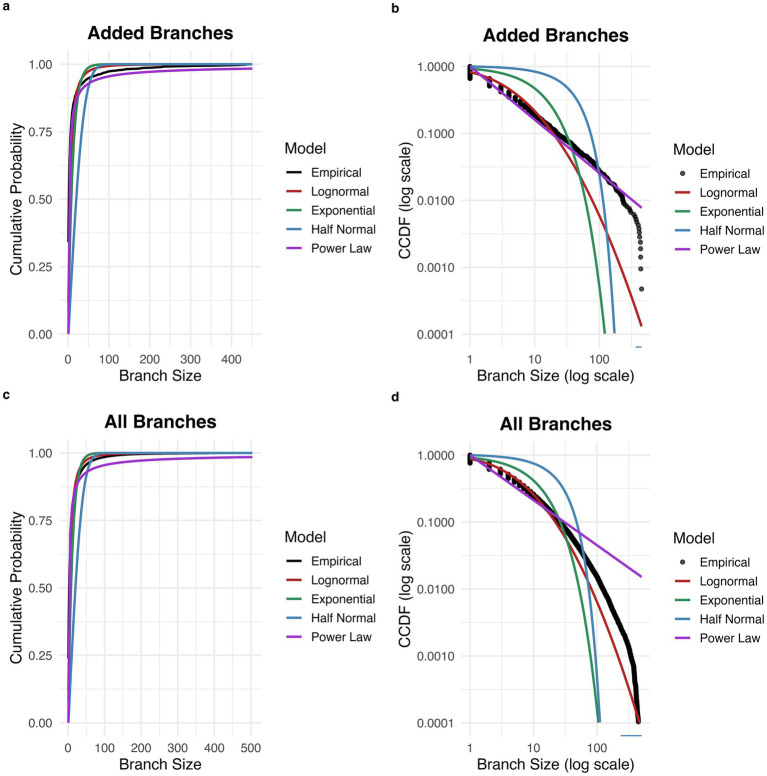 Figure 2
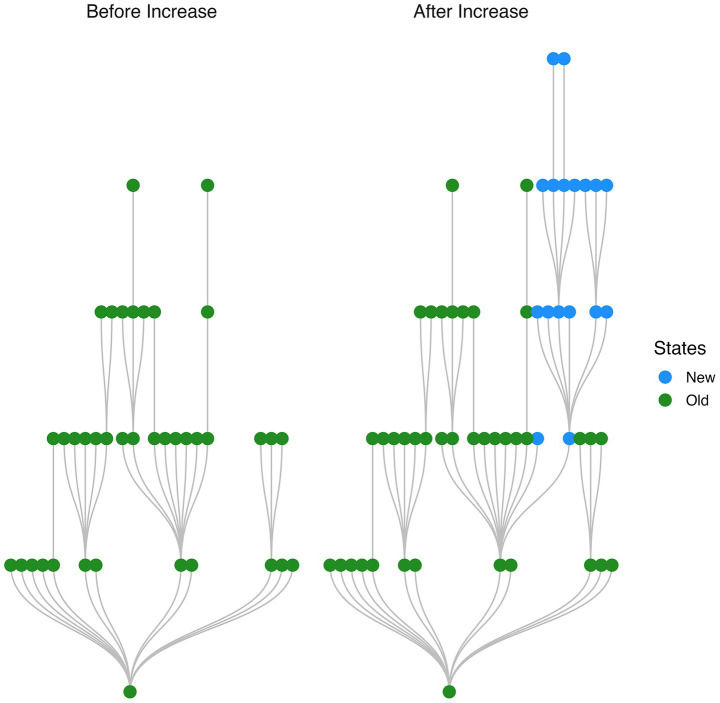 Figure 3
 Figure 4
Peer Reviews
No public reviews on file for this paper yet. If you reviewed it on a platform where reviews are public (OpenReview, ICLR, NeurIPS, ICML), you can paste yours below so the community can read it here.
Videos
No videos yet. Explain this paper in a talk, walkthrough, or lecture? Add one.
Taxonomy
TopicsNeural dynamics and brain function · Neural Networks and Applications · Advanced Memory and Neural Computing