Elevated TyG-BMI significantly increases the 1-year stroke recurrence risk in patients with acute ischemic stroke and hypertension
Yan Liu, Zhongzhong Liu, Qingli Lu, Pei Liu, Mi Zhang, Qiaoqiao Chang, Tong Liu, Linna Peng, Lanping Rao, Chao Sun, Guo Li, Shundao Cao, Xuemei Lin, Songdi Wu

TL;DR
A study finds that higher TyG-BMI is linked to increased stroke recurrence risk in women with acute ischemic stroke and hypertension.
Contribution
The study identifies a sex-specific nonlinear relationship between TyG-BMI and stroke recurrence risk in patients with acute ischemic stroke and hypertension.
Findings
Elevated TyG-BMI is significantly associated with increased 1-year stroke recurrence risk in women with acute ischemic stroke and hypertension.
Women in the highest TyG-BMI quartiles had significantly higher stroke recurrence risks compared to those in the lowest quartile.
The association between TyG-BMI and stroke recurrence risk was nonlinear and more pronounced in women with TyG-BMI below 221.97.
Abstract
To investigate the association between triglyceride-glucose-body mass index (TyG-BMI) and the 1-year stroke recurrence risk in patients with acute ischemic stroke (AIS) and hypertension. In this retrospective, multicenter cohort study, multivariable Cox proportional hazards models were constructed, and curve fitting and subgroup analyses were performed to evaluate the aforementioned association. TyG-BMI was analyzed as a continuous variable and in quartiles (Q1–Q4). Sex-specific stratified analyses were performed to explore potential effect modifications. Among 1,620 enrolled patients (39.6% women; mean age 65.2 ± 11.5 years), elevated TyG-BMI was significantly associated with increased 1-year stroke recurrence risk after adjusting for potential confounding factors (hazard ratio [HR]=1.06, 95% confidence interval [CI]: 1.01–1.11, P = 0.032). This association was particularly prominent…
Genes, proteins, chemicals, diseases, species, mutations and cell lines named across the full text — each resolved to its canonical identifier and authoritative record.
Click any figure to enlarge with its caption.
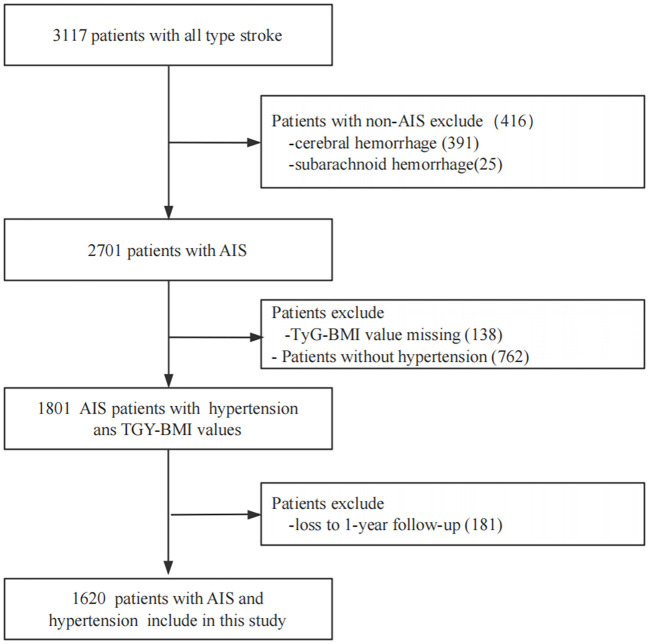 Figure 1
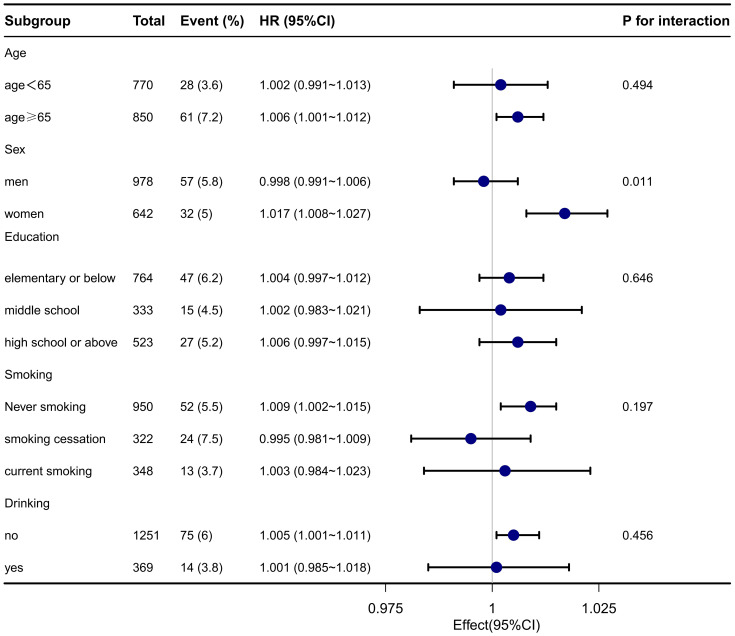 Figure 2
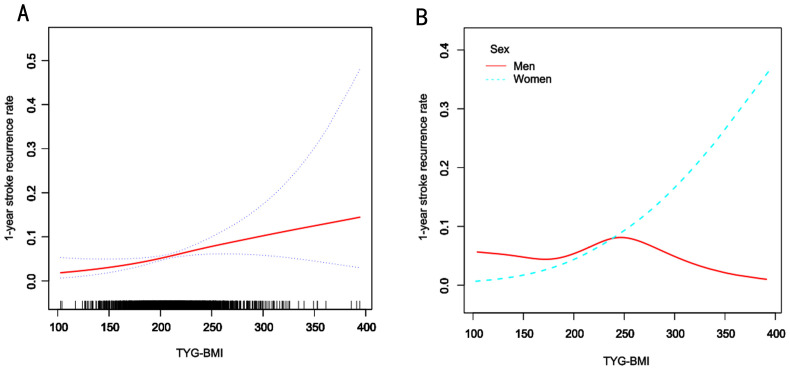 Figure 3
Peer Reviews
No public reviews on file for this paper yet. If you reviewed it on a platform where reviews are public (OpenReview, ICLR, NeurIPS, ICML), you can paste yours below so the community can read it here.
Videos
No videos yet. Explain this paper in a talk, walkthrough, or lecture? Add one.
Taxonomy
TopicsCerebrovascular and Carotid Artery Diseases · Cardiovascular Health and Disease Prevention · Cardiovascular Disease and Adiposity