Effect of formononetin on progressive pulmonary pathologies: multitarget mechanisms and therapeutic prospects
Dan Yan, Saibin Wang

TL;DR
Formononetin, a natural compound, shows promise for treating various lung diseases by targeting multiple biological pathways, though its use is limited by poor solubility and bioavailability.
Contribution
This review highlights formononetin's multitarget mechanisms and novel delivery systems to enhance its therapeutic potential for respiratory diseases.
Findings
Formononetin reduces oxidative stress, inflammation, and fibrosis in lung diseases through Nrf2/HO-1 activation and NF-κB inhibition.
Novel delivery systems like FMN@BSA nanoparticles improve formononetin's stability and bioavailability.
Preclinical studies show formononetin attenuates lung injury and slows fibrosis progression.
Abstract
Formononetin (FMN), an isoflavone derived from Radix Astragali and red clover, has promising therapeutic potential for a wide spectrum of respiratory diseases, including acute lung injury (ALI), pulmonary arterial hypertension (PAH), chronic obstructive pulmonary disease (COPD), asthma, and pulmonary fibrosis (PF). Mechanistically, FMN alleviates oxidative stress, inflammation, and fibrotic remodelling by activating Nrf2/HO-1, inhibiting NF-κB, and modulating the activity of the TGF-β/Smad signalling pathway. Evidence from cellular and animal studies has shown that FMN attenuates lung injury, prevents vascular remodelling, and slows the progression of fibrosis. However, its clinical translation is hampered by poor solubility, rapid metabolism, and low oral bioavailability, which limit its therapeutic effectiveness. To overcome these challenges, novel delivery systems—such as…
Genes, proteins, chemicals, diseases, species, mutations and cell lines named across the full text — each resolved to its canonical identifier and authoritative record.
Click any figure to enlarge with its caption.
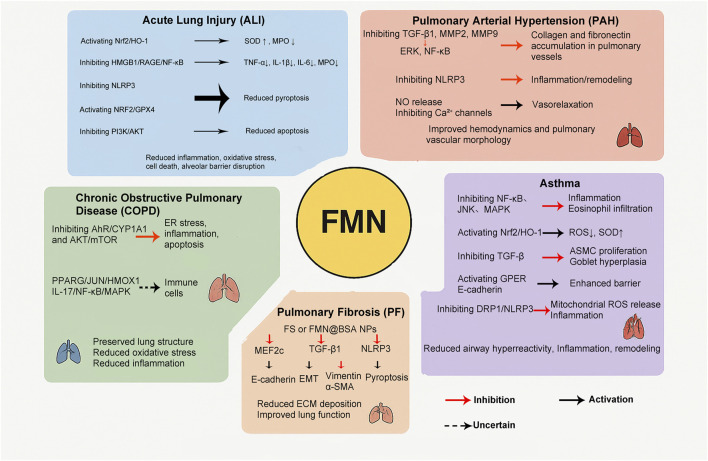 Figure 1
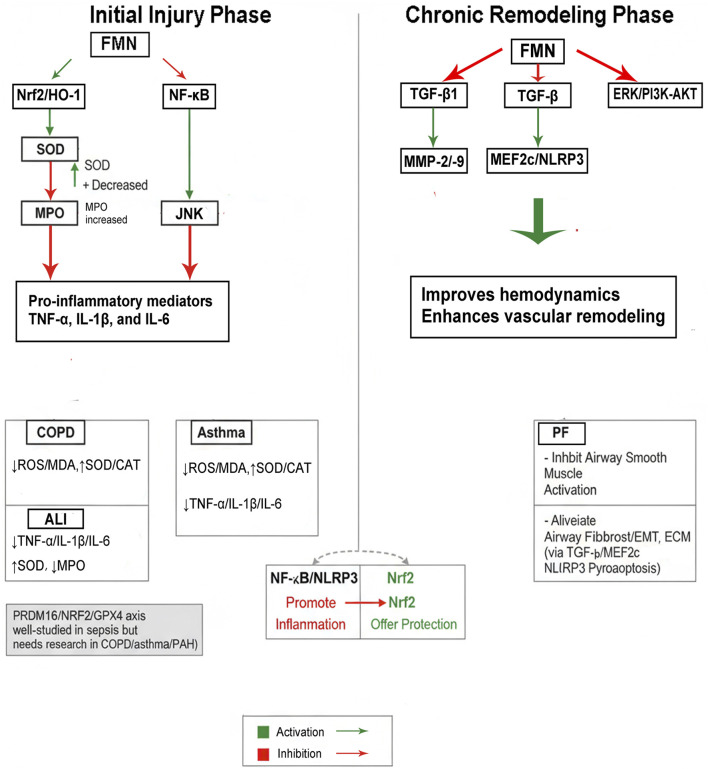 Figure 2
Peer Reviews
No public reviews on file for this paper yet. If you reviewed it on a platform where reviews are public (OpenReview, ICLR, NeurIPS, ICML), you can paste yours below so the community can read it here.
Videos
No videos yet. Explain this paper in a talk, walkthrough, or lecture? Add one.
Taxonomy
TopicsChronic Obstructive Pulmonary Disease (COPD) Research · Redox biology and oxidative stress · Biochemical effects in animals