Synthetic cells for phage therapy: a perspective
Vishwesh Kulkarni, Nadanai Laohakunakorn, Sahan B. W. Liyanagedera

TL;DR
This paper discusses how synthetic cells can improve phage therapy by enabling on-site phage production and smart antimicrobial materials.
Contribution
The paper introduces synthetic cells as a novel platform for programmable and evolvable phage therapy solutions.
Findings
Synthetic cells enable modular genome assembly and high-yield phage TXTL systems.
Smart hydrogel encapsulation supports logic-responsive antimicrobial biomaterials.
The proposed roadmap outlines translational clinical adoption of synthetic cells in phage therapy.
Abstract
A synthetic cell is a membrane-bound vesicle that encapsulates cell-free transcription/translation (TXTL) systems. It represents a transformative platform for advancing bacteriophage therapy. Building on experimental work that demonstrates (i) modular genome assembly, (ii) high-yield phage TXTL systems, and (iii) smart hydrogel encapsulation, we explore how synthetic cells can address major limitations in phage therapy. The promising advances include point-of-care phage manufacturing, logic-responsive antimicrobial biomaterials, and new chassis to dissect the dynamics of phage-host interactions. We also propose a roadmap for the deployment of synthetic cells as programmable and evolvable tools in the context of laboratory research and translational clinical adoption.
Genes, proteins, chemicals, diseases, species, mutations and cell lines named across the full text — each resolved to its canonical identifier and authoritative record.
Click any figure to enlarge with its caption.
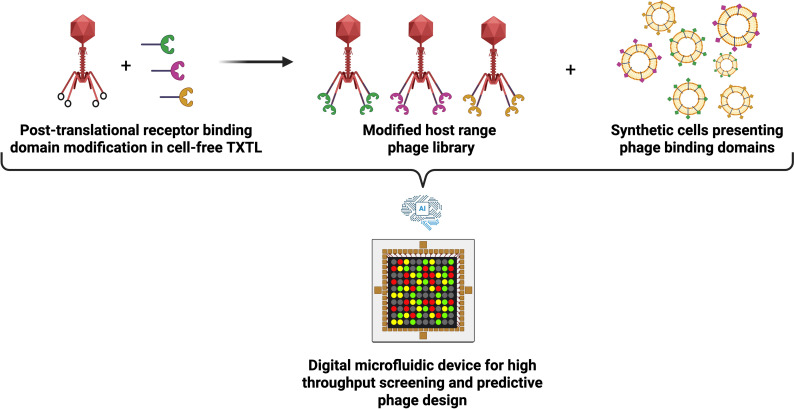 Figure 1
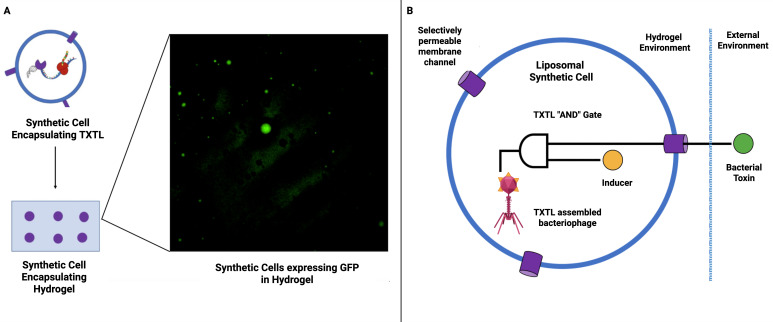 Figure 2
Peer Reviews
No public reviews on file for this paper yet. If you reviewed it on a platform where reviews are public (OpenReview, ICLR, NeurIPS, ICML), you can paste yours below so the community can read it here.
Videos
No videos yet. Explain this paper in a talk, walkthrough, or lecture? Add one.
Taxonomy
TopicsBacteriophages and microbial interactions · Advanced biosensing and bioanalysis techniques · RNA Interference and Gene Delivery