Z-drug abuse and dependence: clinical guideline of the Brazilian Academy of Neurology for diagnosis and management
Fernando Gustavo Stelzer, Andrea Bacelar, Alan Luiz Éckeli, André Brooking Negrão, Carlos Maurício Oliveira Almeida, Clélia Maria Ribeiro Franco, Gabriel Natan Pires, Lívia Leite Goés Gitaí, Manoel Alves Sobreira-Neto, Márcia Assis, Paulo Afonso Mei, Rosa Hasan

TL;DR
This paper provides clinical guidelines for diagnosing and managing Z-drug abuse and dependence in Brazil, emphasizing safe discontinuation and treatment strategies.
Contribution
The paper introduces a consensus-based clinical guideline for Z-drug dependence management in Brazil, developed through systematic review and multidisciplinary collaboration.
Findings
Gradual tapering and comprehensive patient assessment are essential for Z-drug discontinuation.
Non-pharmacological therapies like cognitive behavioral therapy are recommended alongside optional pharmacological treatments.
Intermediate- or long-acting benzodiazepines are recommended for withdrawal, while short-acting ones are not.
Abstract
Benzodiazepine (BZD) receptor agonists, commonly known as Z-drugs, are non-BZD hypnotics primarily prescribed for the treatment of insomnia. Their use is recommended for no longer than four weeks to minimize the risk of adverse effects, including dependence and withdrawal. However, these guidelines are frequently disregarded, and the abuse of and dependence on Z-drugs has emerged as a growing public health concern in Brazil. The present article reviews the current evidence on Z-drug use disorder—including dependence and withdrawal—and proposes clinical guidelines for the management of discontinuation. The recommendations were developed based on a systematic review of the literature and refined using the Delphi methodology. The consensus was developed by a multidisciplinary task force, with coordination and voting led by a steering committee. An advisory committee, consisting of…
Genes, proteins, chemicals, diseases, species, mutations and cell lines named across the full text — each resolved to its canonical identifier and authoritative record.
Click any figure to enlarge with its caption.
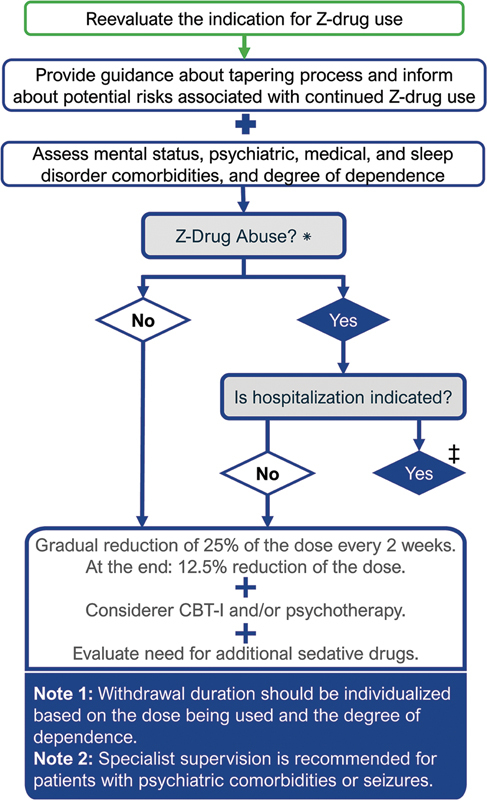 Figure 1
Peer Reviews
No public reviews on file for this paper yet. If you reviewed it on a platform where reviews are public (OpenReview, ICLR, NeurIPS, ICML), you can paste yours below so the community can read it here.
Videos
No videos yet. Explain this paper in a talk, walkthrough, or lecture? Add one.
Taxonomy
TopicsSleep and related disorders · Substance Abuse Treatment and Outcomes · Treatment of Major Depression