Essential and dispensable domains of DivIVA for walled growth in filamentous Actinomycetota
Maarten Lubbers, Belmin Bajramović, Véronique Ongenae, Joost Willemse, Dieuwertje de Bruin, Niels Mulder, Le Zhang, Bastienne Vriesendorp, Francisco Barona-Gomez, Ariane Briegel, Gilles P. van Wezel, Klas Flärdh, Dennis Claessen

TL;DR
This study identifies key parts of the DivIVA protein needed for polar growth in Actinomycetota bacteria and shows how different regions affect cell structure and survival.
Contribution
The study reveals specific domains of DivIVA essential for polar growth and demonstrates functional conservation within Actinomycetota.
Findings
Deleting the intercoil or C-terminal region of DivIVA affects branching in Actinomycetota.
A minimized DivIVA variant with only the N-terminal domain and second coiled-coil causes severe growth defects.
Chimeric DivIVA from Mycolicibacterium smegmatis supports growth, but not from Bacillus subtilis, showing phylum-specific motifs are essential.
Abstract
The morphogenetic protein DivIVA exhibits diverse functions across bacterial phyla. In Bacillota, DivIVA is primarily involved in cell division, whereas in Actinomycetota, it plays a central role in coordinating polar growth. Due to its essentiality in Actinomycetota, gaining insight into its structural functions is challenging. We studied truncated DivIVA proteins using a unique divIVA deletion mutant in cell wall-deficient Kitasatospora viridifaciens L-forms. DivIVA comprises an N-terminal domain consisting of a coiled-coil segment bearing a membrane-targeting structure at the N-terminal end, followed by an intercoil region, a larger coiled-coil and a C-terminal domain. Deleting either the intercoil or C-terminal region affected branching. We also created a minimized variant in which both were deleted simultaneously, retaining the N-terminal domain and the second coiled-coil.…
Genes, proteins, chemicals, diseases, species, mutations and cell lines named across the full text — each resolved to its canonical identifier and authoritative record.
Click any figure to enlarge with its caption.
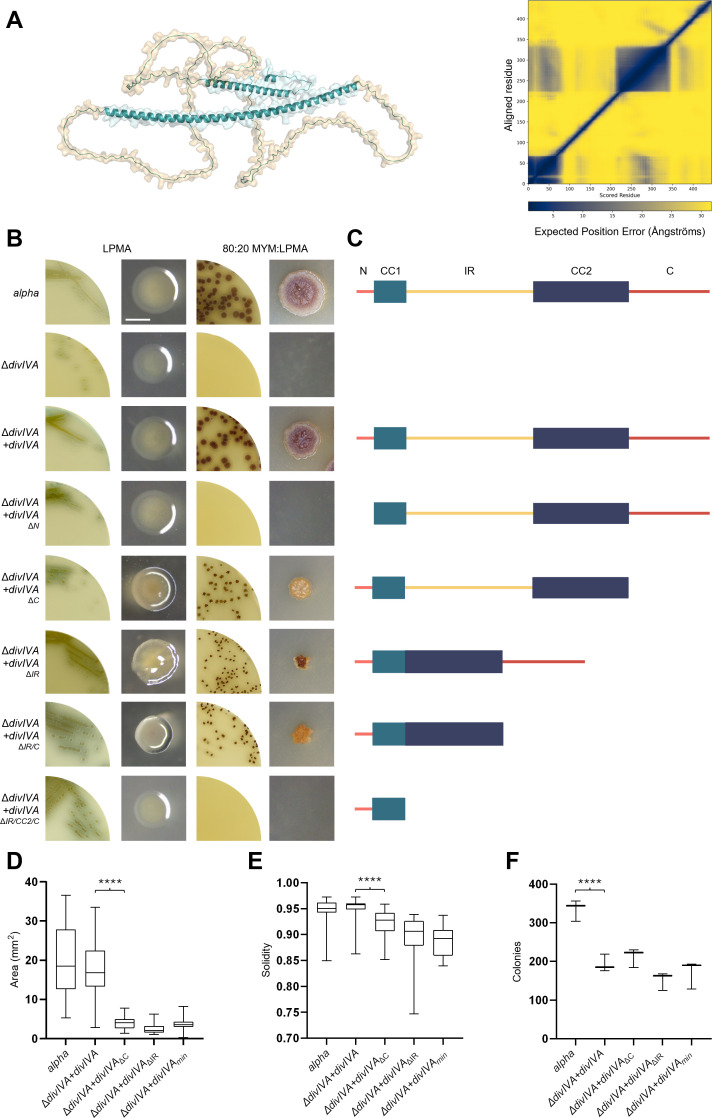 Figure 1
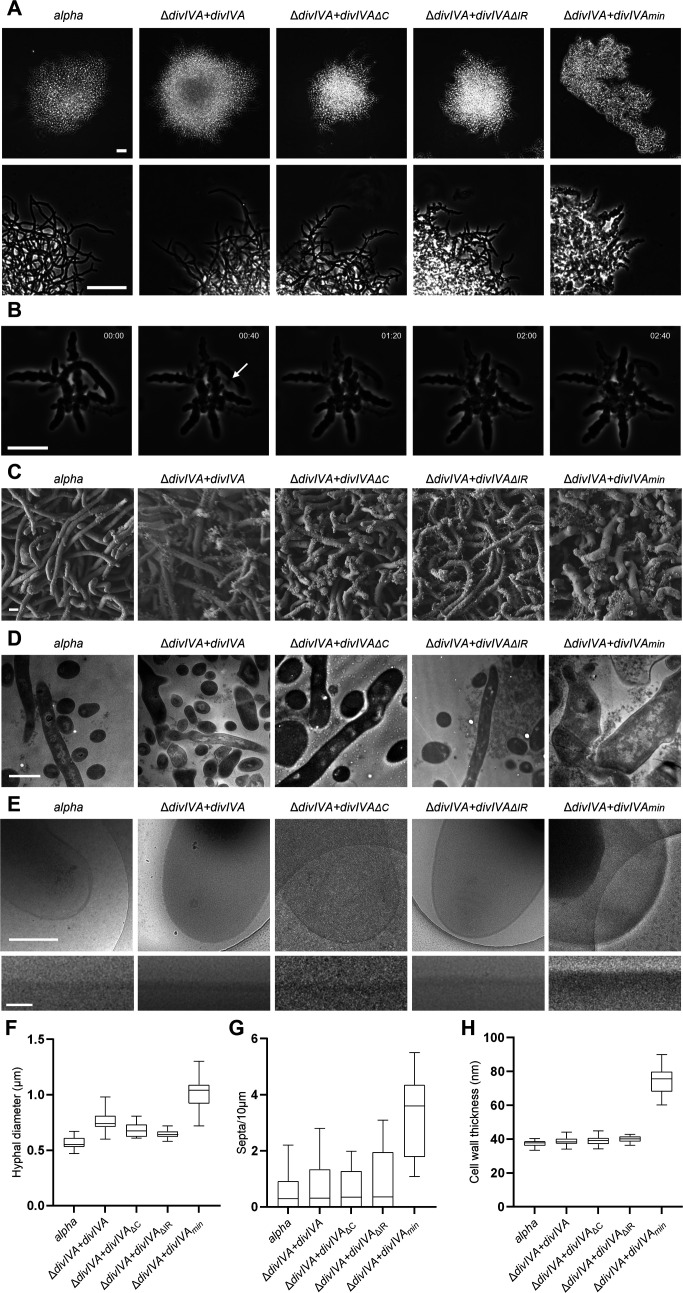 Figure 2
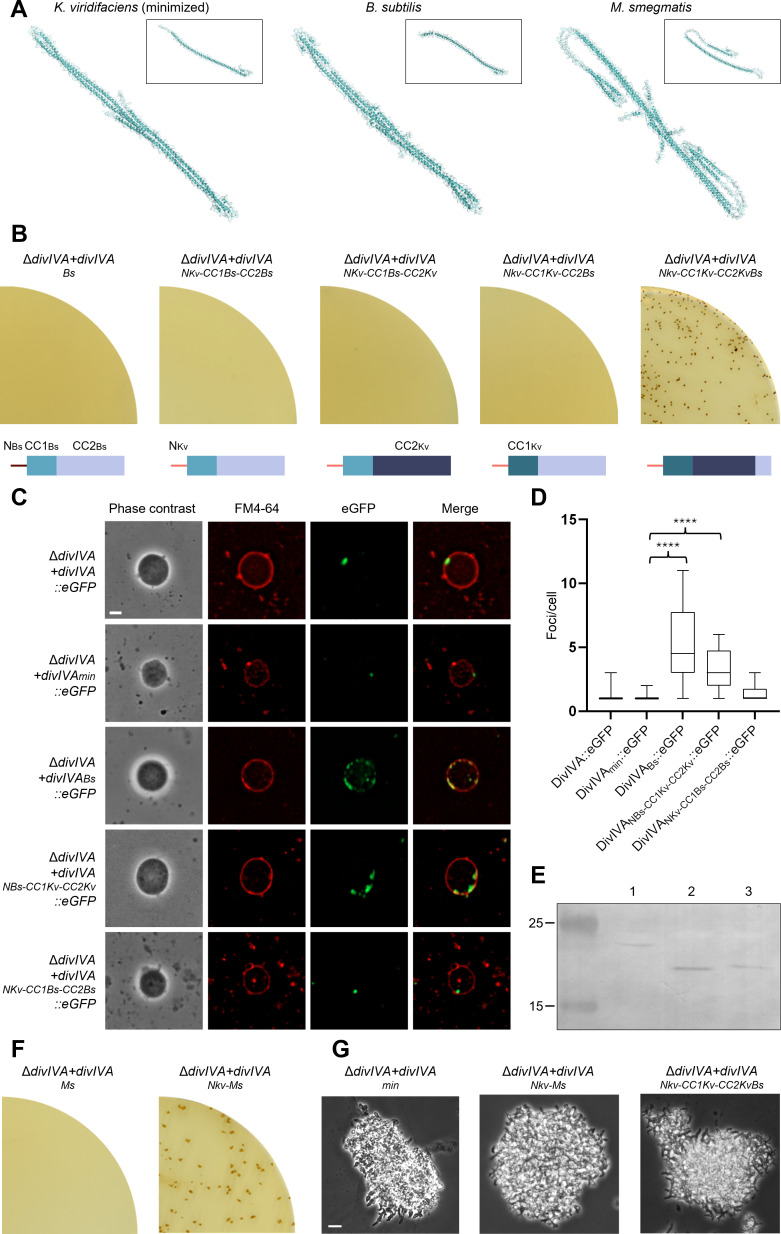 Figure 3
 Figure 4
Peer Reviews
No public reviews on file for this paper yet. If you reviewed it on a platform where reviews are public (OpenReview, ICLR, NeurIPS, ICML), you can paste yours below so the community can read it here.
Videos
No videos yet. Explain this paper in a talk, walkthrough, or lecture? Add one.
Taxonomy
TopicsBacterial Genetics and Biotechnology · Probiotics and Fermented Foods · Metalloenzymes and iron-sulfur proteins