Determination of Knee Joint Line Positioning by Femoral Bicondylar and Epicondylar Distances in the Brazilian Population
Leonardo Augusto Melo de Andrade, Márcio de Castro Ferreira, Carlos Eduardo da Siveira Franciozi, Enzo Salviato Mameri, Marcelo Seiji Kubota, Marcus Vinícius Malheiros Luzo

TL;DR
This study measures knee joint line positioning in the Brazilian population using femoral anatomical references.
Contribution
Provides population-specific formulas for knee joint line positioning based on femoral bicondylar and epicondylar distances in Brazil.
Findings
Mean CBA distance was 72.11 mm with a standard deviation of 5.93 mm.
Formulas MED = 0.4618 x CBA and LED = 0.3615 x CBA for males, and MED = 0.4653 x CBA and LED = 0.3767 x CBA for females were derived.
CBA can serve as a reference for joint line positioning from medial and lateral epicondyles.
Abstract
To determine the positioning of the knee joint line height based on anatomical references, that is, the distance of the femoral condylar bicortical axis and the medial and lateral epicondylar distances in the Brazilian population. We analyzed 500 magnetic resonance imaging tests of the knees of 250 women and 250 men to measure the condylar bicortical axis (CBA) and the distance of the joint height to the medial epicondyle (MED) and to the lateral epicondyle (LED). The mean age of the patients was 50.91 years old, with a standard deviation (SD) of ± 14.76. The mean CBA distance was 72.11 ± 5.93 mm. The mean MED and LED values were 33.39 ± 3.50 mm and 26.32 ± 4.08 mm, respectively. The formulas to estimate the distance of the joint line from the medial and lateral epicondyles were MED = 0.4618 x CBA and LED = 0.3615 x CBA for male subjects and MED = 0.4653 x CBA and LED = 0.3767 x CBA…
Genes, proteins, chemicals, diseases, species, mutations and cell lines named across the full text — each resolved to its canonical identifier and authoritative record.
Click any figure to enlarge with its caption.
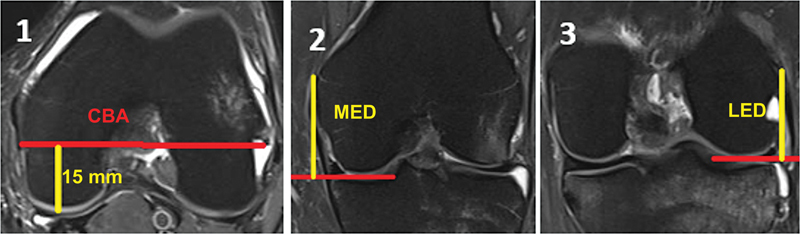 Figure 1
Peer Reviews
No public reviews on file for this paper yet. If you reviewed it on a platform where reviews are public (OpenReview, ICLR, NeurIPS, ICML), you can paste yours below so the community can read it here.
Videos
No videos yet. Explain this paper in a talk, walkthrough, or lecture? Add one.
Taxonomy
TopicsTotal Knee Arthroplasty Outcomes · Knee injuries and reconstruction techniques · Osteoarthritis Treatment and Mechanisms