Surveys to substantiate elimination of trachoma as a public health problem in the Republic of the Union of Myanmar
Mg Mg Myo Wynn, Ye Win, Ye Lin, San San Win, Thapa Badri, Jamsheed Mohamed, Lin Zaw, Anthony W Solomon, Michael Dejene, Caleb Mpyet, Yilikal Adamu, Aemero Abateneh, Mohammed Shafi, Cristina Jimenez, Ana Bakhtiari, Sarah Boyd, Anna Harte, Emma M Harding-Esch, Jeremiah M Ngondi

TL;DR
This study confirms that trachoma is no longer a public health issue in Myanmar after surveys showed it had met elimination thresholds.
Contribution
The study provides evidence that Myanmar has achieved trachoma elimination thresholds, leading to WHO validation.
Findings
Trachomatous inflammation-follicular prevalence in children was below 5% in all surveyed areas.
Trachomatous trichiasis prevalence unknown to the health system was below 0.2% in adults.
Myanmar was validated by WHO in 2020 for eliminating trachoma as a public health problem.
Abstract
To determine whether trachoma elimination thresholds have been met in Myanmar, surveys were undertaken in 2019 to estimate the prevalence of trachomatous inflammation—follicular (TF) in children ages 1–9 y and the prevalence of trachomatous trichiasis (TT) unknown to the health system in adults ≥15 y of age. Surveys were conducted in 14 townships (evaluation units [EUs]) that were considered formerly endemic for trachoma. A two-stage cluster survey design was applied, whereby 30 villages and 30 households per village were sampled. Consenting eligible participants ≥1 y of age were examined for trachoma using the World Health Organization (WHO) simplified trachoma grading system. A total of 12 594 households were surveyed, with a total of 5901 children ages 1–9 y and 31 097 people ≥15 y of age examined. In all 14 EUs, the prevalences of TF and TT unknown to the health system were below…
Genes, proteins, chemicals, diseases, species, mutations and cell lines named across the full text — each resolved to its canonical identifier and authoritative record.
Click any figure to enlarge with its caption.
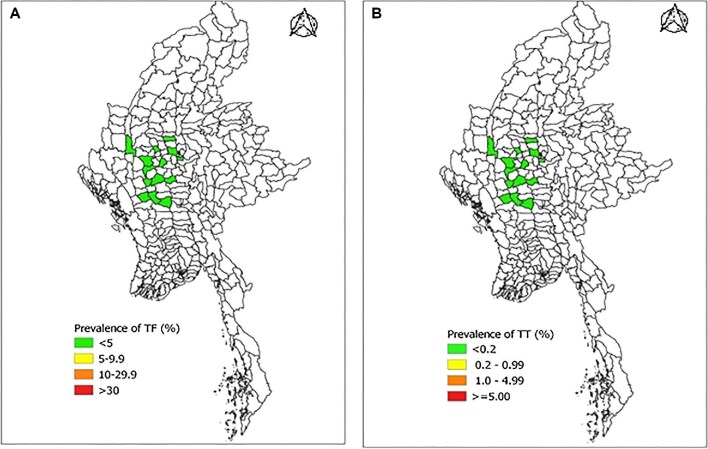 Figure 1
Peer Reviews
No public reviews on file for this paper yet. If you reviewed it on a platform where reviews are public (OpenReview, ICLR, NeurIPS, ICML), you can paste yours below so the community can read it here.
Videos
No videos yet. Explain this paper in a talk, walkthrough, or lecture? Add one.
Taxonomy
TopicsReproductive tract infections research · Breastfeeding Practices and Influences · Reproductive System and Pregnancy