Framing Pro-Anorexia Discourse on YouTube in South Korea: Social Network and Exponential Random Graph Model Analysis of Video Communities
Daseul Oh, Shin Haeng Lee

TL;DR
This study examines how pro-anorexia content spreads on YouTube in South Korea, revealing fragmented communities and the potential of mid-tier influencers to bridge harmful and recovery-focused discussions.
Contribution
The study introduces a novel framework combining social network and exponential random graph models to analyze pro-anorexia discourse and identify intervention opportunities on YouTube.
Findings
Pro-anorexia content is predominantly spread through micro- and meso-individual channels, forming fragmented, echo-chamber-like networks.
Recovery frames in meso-individual channels are more likely to connect across polarized communities, offering a potential pathway for intervention.
Anti-pro-ana frames are structurally peripheral and show strong homophily, reinforcing echo chambers rather than bridging divides.
Abstract
YouTube, as a participatory platform, allows algorithmic curation and user engagement to shape health information flows. This dynamic amplifies and isolates harmful narratives, producing enclosed “refracted publics.” Pro-anorexia (pro-ana) content exemplifies this, glamorizing extreme thinness as self-control and promoting disordered eating while distancing viewers from evidence-based health discourse. Despite concerns about public health consequences, few studies have examined how channel characteristics and framing strategies drive engagement and echo chamber formation. This study analyzed how pro-ana discourse circulates on YouTube and identified entry points for intervention. It (1) compared pro-ana, anti–pro-ana, and recovery frames by channel type (institutional vs individual) and subscriber scale (mega [≥1,000,000], meso [100,000-999,999], or micro [10,000-99,999]); (2)…
Genes, proteins, chemicals, diseases, species, mutations and cell lines named across the full text — each resolved to its canonical identifier and authoritative record.
Click any figure to enlarge with its caption.
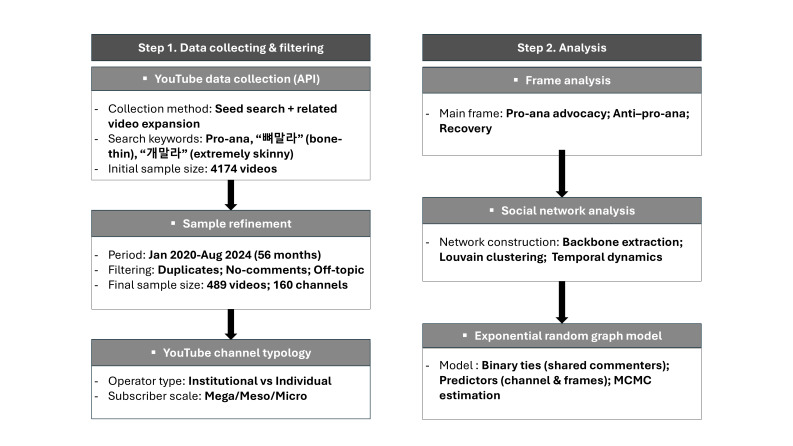 Figure 1
 Figure 2
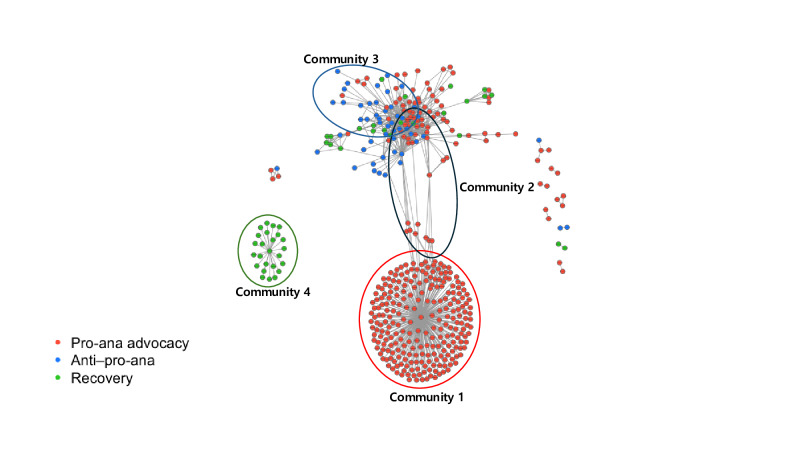 Figure 3
Peer Reviews
No public reviews on file for this paper yet. If you reviewed it on a platform where reviews are public (OpenReview, ICLR, NeurIPS, ICML), you can paste yours below so the community can read it here.
Videos
No videos yet. Explain this paper in a talk, walkthrough, or lecture? Add one.
Taxonomy
TopicsMental Health via Writing · Eating Disorders and Behaviors · Media Influence and Health