Revealing tissue architecture through the hypercomplex Fourier analysis of spatial transcriptomics data
Hildreth Robert Frost

TL;DR
This paper introduces a new method using quaternions to analyze spatial transcriptomics data, enabling advanced image analysis and visualization techniques.
Contribution
The novel contribution is applying quaternions and Fourier analysis to spatial transcriptomics data for enhanced analysis and visualization.
Findings
The quaternion-based model allows multidimensional ST data analysis using Fourier techniques.
Transformations in transcriptomic state can be interpreted as three-dimensional rotations.
The model supports visualization of transcriptomic uncertainty in spatial data.
Abstract
We present an approach for analyzing spatial transcriptomics (ST) data using a quaternion-domain discrete Fourier transform. Quaternions are four-dimensional hypercomplex numbers that have been primarily employed to represent rotations in computer graphics with biomedical applications focused on biomolecule structure and orientation. According to our proposed model, the quaternion associated with each location in an ST dataset represents a vector in R3 whose length captures sequencing depth and whose direction captures three transcriptomic features (individual genes, gene sets, or latent variables). This representation has several important benefits: (i) it enables the use of powerful Fourier-based image analysis techniques on a multidimensional representation of ST data, (ii) it implies that transformations in transcriptomic state can be viewed as three-dimensional rotations with a…
Genes, proteins, chemicals, diseases, species, mutations and cell lines named across the full text — each resolved to its canonical identifier and authoritative record.
Click any figure to enlarge with its caption.
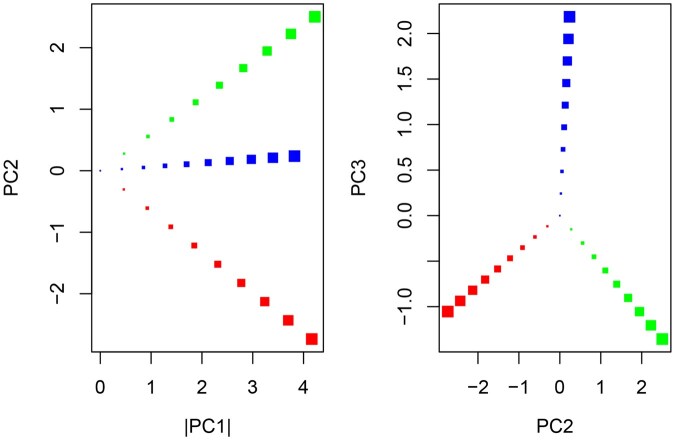 Figure 1
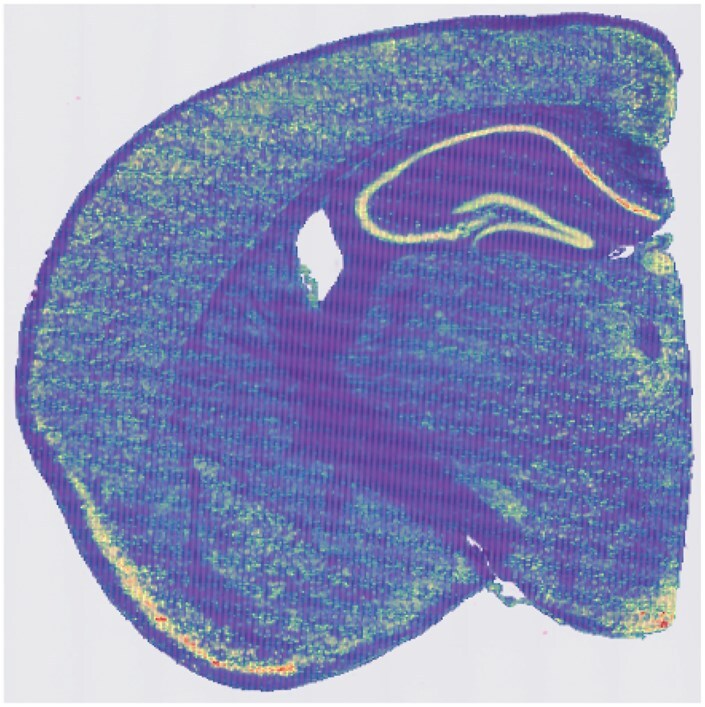 Figure 2
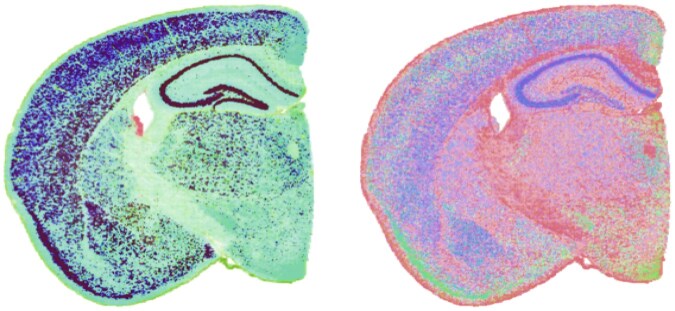 Figure 3
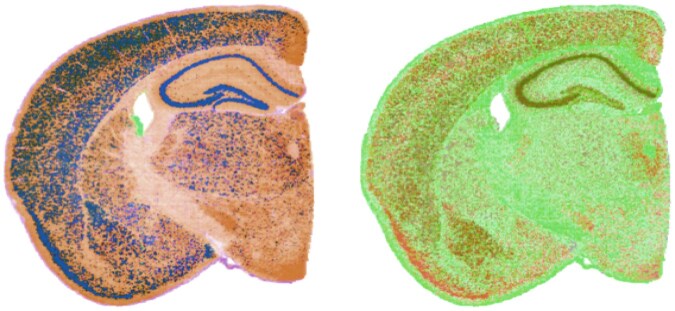 Figure 4
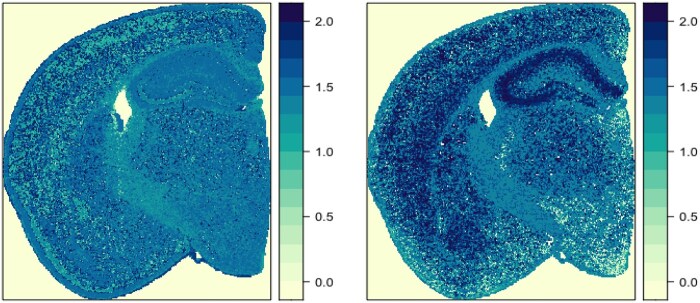 Figure 5
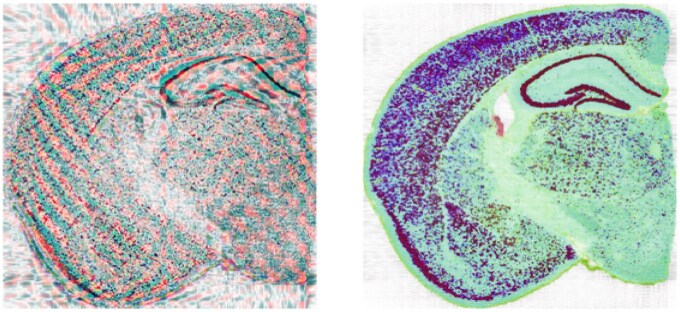 Figure 6
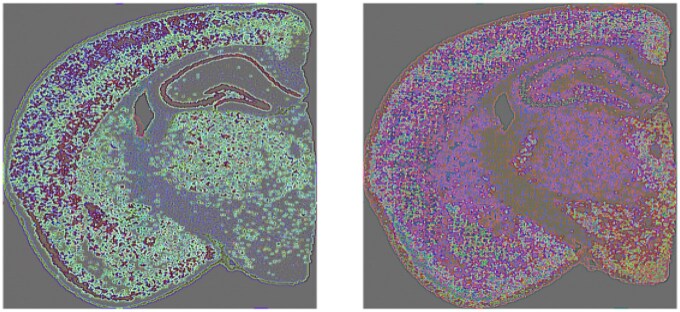 Figure 7
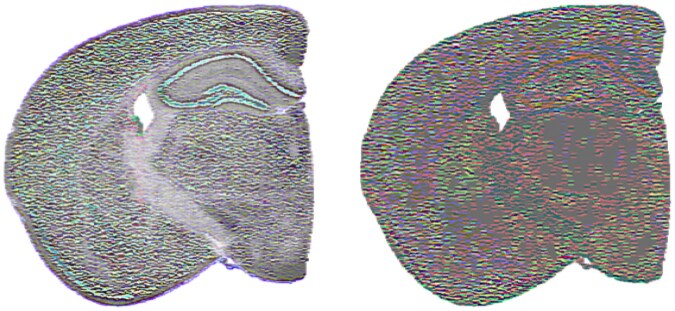 Figure 8
Peer Reviews
No public reviews on file for this paper yet. If you reviewed it on a platform where reviews are public (OpenReview, ICLR, NeurIPS, ICML), you can paste yours below so the community can read it here.
Videos
No videos yet. Explain this paper in a talk, walkthrough, or lecture? Add one.
Taxonomy
TopicsGene expression and cancer classification · Single-cell and spatial transcriptomics · Cell Image Analysis Techniques