Fluoride‐Induced Corrosion of Stainless Steel: A Case Study for its Application as Proton Exchange Membrane Water Electrolysis Bipolar Plate Material
Lena Fiedler, Darius Hoffmeister, Tien‐Ching Ma, Julian Schwarz, Ferdinand Günther, Thomas Przybilla, Erdmann Spiecker, Simon Thiele, Dominik Dworschak, Karl J. J. Mayrhofer, Andreas Hutzler

TL;DR
This study shows that fluoride can cause stainless steel used in water electrolysis to corrode more quickly, leading to a dangerous cycle of degradation.
Contribution
The study introduces a novel method to investigate fluoride-induced corrosion of stainless steel in real-time using SFC-ICP-MS.
Findings
Fluoride increases stainless steel dissolution exponentially, reaching ≈50% efficiency at 20 ppm.
Higher fluoride concentrations lead to increased pitting corrosion severity and occurrence.
Fluoride impurities combined with exposed stainless steel may cause self-accelerating degradation in electrolyzers.
Abstract
Stainless steel is a promising material for bipolar plates (BPP) in proton exchange membrane water electrolysis (PEMWE) that could drastically reduce stack costs. However, dissolution of Fe from stainless steel BPP might trigger membrane degradation, which releases fluoride. Fluoride in turn could accelerate stainless steel corrosion. Therefore, the influence of fluoride contamination (namely 0, 1, 5, and 20 ppm in 0.5 mM H2SO4) on the dissolution stability of stainless steel (316L) is investigated utilizing a scanning flow cell coupled on‐line to an inductively coupled plasma mass spectrometer (SFC‐ICP‐MS). Fluoride enhances the dissolution exponentially, resulting in enhanced dissolution efficiencies with increased fluoride concentration reaching ≈50% at 20 ppm. Complementary micro and nanostructure analysis (laser profilometry, scanning electron microscopy, and scanning transmission…
Genes, proteins, chemicals, diseases, species, mutations and cell lines named across the full text — each resolved to its canonical identifier and authoritative record.
Click any figure to enlarge with its caption.
 Figure 1
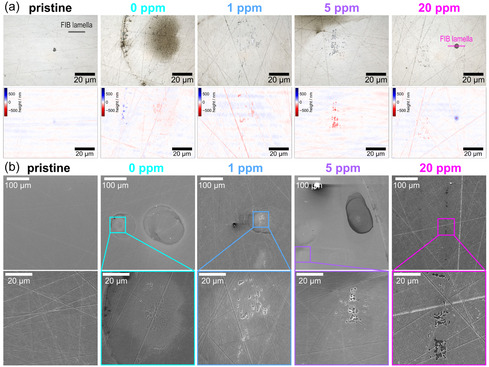 Figure 2
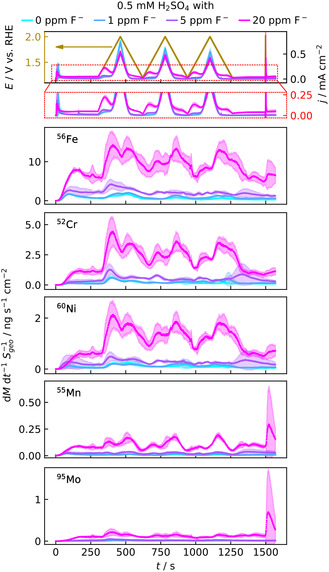 Figure 3
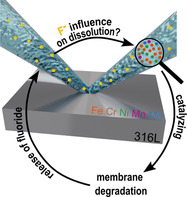 Figure 4
Peer Reviews
No public reviews on file for this paper yet. If you reviewed it on a platform where reviews are public (OpenReview, ICLR, NeurIPS, ICML), you can paste yours below so the community can read it here.
Videos
No videos yet. Explain this paper in a talk, walkthrough, or lecture? Add one.
Taxonomy
TopicsFuel Cells and Related Materials · Hybrid Renewable Energy Systems · Hydrogen Storage and Materials