Emergence of ST8-USA300 and ST8-USA300-Latin American variant: a changing landscape of community-associated methicillin-resistant Staphylococcus aureus in Chile
Alejandro Aguayo-Reyes, Felipe Morales-León, Mario Quezada-Aguiluz, Andrés Opazo-Capurro, Helia Bello-Toledo, Sergio Mella, Néstor Herrera-Chávez, Maximiliano Matus-Köhler, Juan Carlos Hormazábal, Gerardo González-Rocha

TL;DR
This study tracks the spread of antibiotic-resistant Staphylococcus aureus in Chile, showing that specific strains are becoming dominant in the community.
Contribution
The study identifies the emergence and dominance of ST8-USA300 and ST8-USA300-Latin American variant clones in Chilean CA-MRSA populations.
Findings
ST8-USA300-Latin American variant (USA300-LV) was the most prevalent clone (43%) among CA-MRSA isolates in Chile.
Most isolates carried SCCmec IVc and showed resistance to cefoxitin, with some also resistant to erythromycin.
The study highlights the clonal nature and evolution of CA-MRSA in Chile, posing a public health threat.
Abstract
Staphylococcus aureus is a versatile pathogen capable of causing various infections. Since the 1960s, the emergence of methicillin-resistant S. aureus (MRSA) has posed a significant challenge due to its antibiotic resistance. Among these, community-associated MRSA (CA-MRSA) emerged in the 1990s, which traditionally harbors the mecA gene and the Panton-Valentine leukocidin, affecting individuals without traditional risk factors. In this study, we aimed to describe the genetic and phenotypic characteristics of 54 CA-MRSA isolates circulating in Chile, collected between 2007 and 2023 from various healthcare centers across the country. All strains carried mecA, with SCCmec IVc being the most prevalent (67%). The predominant clone was USA300-Latin American variant (USA300-LV) (ST8-SCCmec IVc-COMER+) 43%, followed by USA300 (ST8-SCCmec IVa-ACME+) 15%, ST30-SCCmec IVc (15%), and ST5-SCCmec IVa…
Genes, proteins, chemicals, diseases, species, mutations and cell lines named across the full text — each resolved to its canonical identifier and authoritative record.
Click any figure to enlarge with its caption.
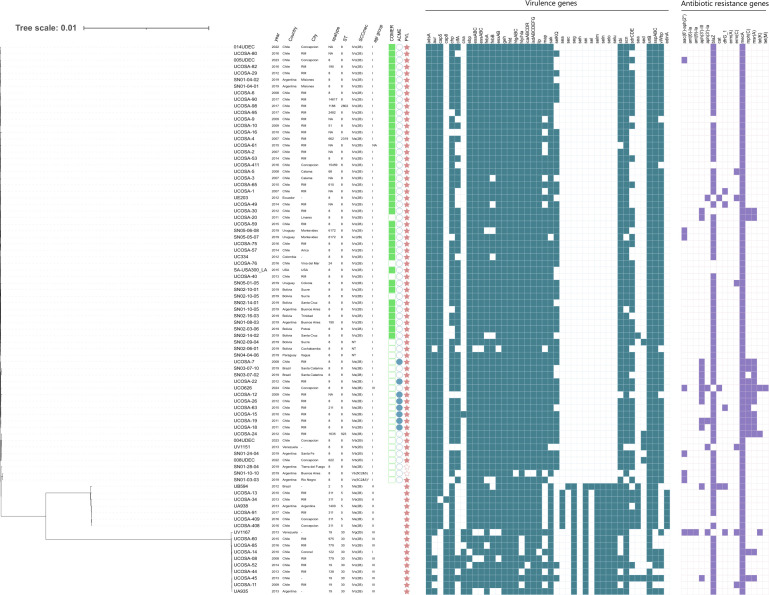 Figure 1
Peer Reviews
No public reviews on file for this paper yet. If you reviewed it on a platform where reviews are public (OpenReview, ICLR, NeurIPS, ICML), you can paste yours below so the community can read it here.
Videos
No videos yet. Explain this paper in a talk, walkthrough, or lecture? Add one.
Taxonomy
TopicsAntimicrobial Resistance in Staphylococcus · Bacterial biofilms and quorum sensing · Bacterial Identification and Susceptibility Testing