Beyond antiparasitic activity: elucidating the antibacterial potency of pyrvinium pamoate
Angela Alcaraz-Martínez, Paloma Muñoz-Báez, Pablo Peñalver, Juan Carlos Morales, Rubén Cebrián

TL;DR
This study explores repurposing pyrvinium pamoate as an antibacterial drug, showing it is effective against gram-positive bacteria and can be enhanced against gram-negative bacteria with additional agents.
Contribution
The study reveals pyrvinium pamoate's antibacterial potential, particularly against gram-positive pathogens and in combination with membrane-permeabilizing agents.
Findings
Pyrvinium pamoate is effective against gram-positive bacteria like Staphylococcus aureus at low concentrations.
Combining pyrvinium pamoate with membrane-permeabilizing agents enhances its activity against gram-negative bacteria.
Efflux pump inhibition increases pyrvinium pamoate retention and reduces its minimum inhibitory concentration in S. aureus.
Abstract
Antimicrobial resistance represents a critical global health threat, demanding innovative therapeutic strategies. In this study, we investigate the repurposing potential of pyrvinium pamoate (PP)—a long-established anthelmintic agent—for antibacterial applications. Comprehensive in vitro analyses revealed that while gram-negative bacteria exhibited inherent resistance due to limited drug uptake, gram-positive pathogens, particularly within the orders Actinomycetales and Bacillales, were markedly susceptible at low micromolar concentrations. Enhanced antibacterial efficacy was observed when PP was combined with outer membrane-permeabilizing agents, such as the peptide D11 or pentamidine, which facilitated increased intracellular accumulation. Additionally, the role of efflux pump activity was explored; its inhibition in Staphylococcus aureus resulted in significant drug retention and a…
Genes, proteins, chemicals, diseases, species, mutations and cell lines named across the full text — each resolved to its canonical identifier and authoritative record.
Click any figure to enlarge with its caption.
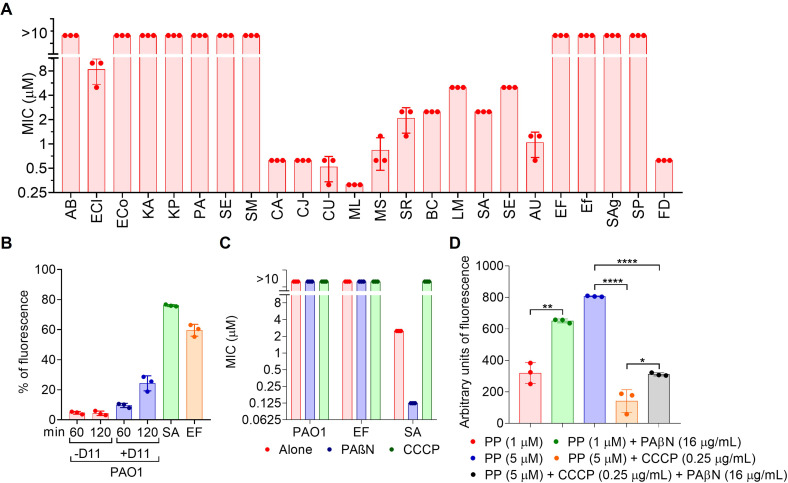 Figure 1
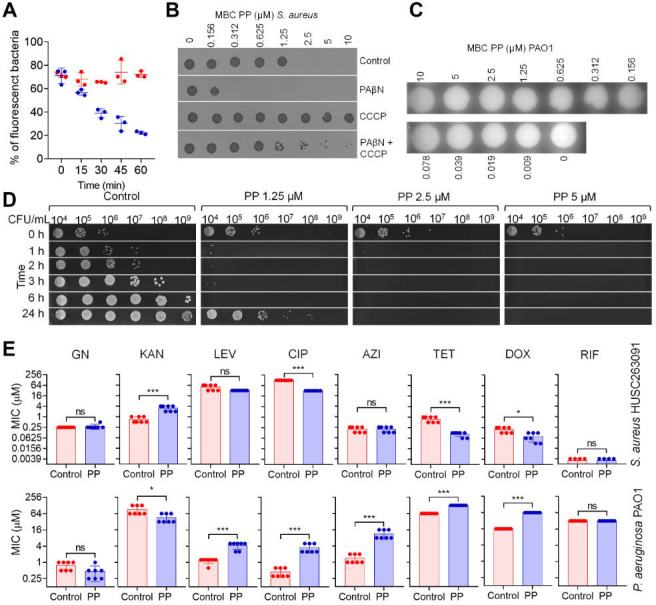 Figure 2
Peer Reviews
No public reviews on file for this paper yet. If you reviewed it on a platform where reviews are public (OpenReview, ICLR, NeurIPS, ICML), you can paste yours below so the community can read it here.
Videos
No videos yet. Explain this paper in a talk, walkthrough, or lecture? Add one.
Taxonomy
TopicsAntibiotic Resistance in Bacteria · Antimicrobial Peptides and Activities · Phenothiazines and Benzothiazines Synthesis and Activities