Emergence of the coexistence of optrA and fexA in Campylobacter coli strains isolated from the market
Xiaoli Wang, Xue Zheng, Jiangang Ma, Xiujuan Wang, Guoping Zhao, Biao Tang

Abstract
Genes, proteins, chemicals, diseases, species, mutations and cell lines named across the full text — each resolved to its canonical identifier and authoritative record.
Click any figure to enlarge with its caption.
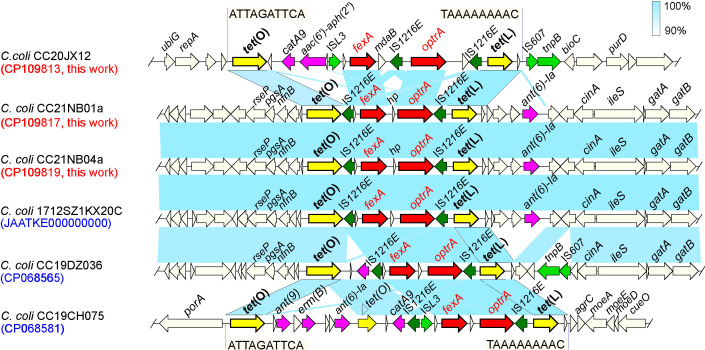 Fig 1
Fig 1| Antibiotics | Strains | ||
|---|---|---|---|
| CJ21NB01a | CC21NB04a | CC20J × 12 | |
| CIP | 64 | 64 | 32 |
| NAL | 128 | >128 | >128 |
| GEN | 64 | 64 | >64 |
| TET | >64 | >64 | >64 |
| CLI | 8 | 8 | >32 |
| ERY | >64 | >64 | 64 |
| AZM | >32 | >32 | >32 |
| TEL | 32 | 32 | 32 |
| florfenFFC | 32 | 32 | >32 |
| acquired AMR genes | |||
| mutation | |||
| 23S (2075A > G) | 23S (2075A > G) | ||
| sequence type | ST828 | ST828 | ST112510 |
| GC content | 31.45% | 31.45% | 31.47% |
| genome size | chr: 1,778,927 | chr: 1,779,054 | chr:
1,698,077 |
- —the 'Leading Goose' R&D Program of Zhejiang Province
- —Zhejiang Provincial Natural Science Foundation of China
- —Research Funds of Hangzhou Institute for Advanced Study, UCAS
Peer Reviews
No public reviews on file for this paper yet. If you reviewed it on a platform where reviews are public (OpenReview, ICLR, NeurIPS, ICML), you can paste yours below so the community can read it here.
Videos
No videos yet. Explain this paper in a talk, walkthrough, or lecture? Add one.
Taxonomy
TopicsSalmonella and Campylobacter epidemiology · Listeria monocytogenes in Food Safety · Bacteriophages and microbial interactions
LETTER
As an important foodborne bacterium, Campylobacter encounters diverse antimicrobials during livestock production. Consequently, it has evolved different resistance strategies, notably the acquisition of multidrug-resistance genomic islands , to enhance survival under antimicrobial pressure (1, 2). The fexA gene mediates resistance to florfenicol (2–4), whereas optrA not only confers phenicol resistance but also elevates resistance to the oxazolidinone drug linezolid (3, 5, 6). Accordingly, Campylobacter strains harboring both fexA and optrA raise important public health concerns due to their expanded resistance profile (7). In this study, the co-occurrence of optrA and fexA was identified in Campylobacter coli isolates obtained from retail meat. Complete genome sequencing was performed to characterize the genetic context of these resistance genes.
A total of 88 Campylobacter strains were isolated from 417 samples collected in 2021 across four cities in Zhejiang Province, China (Fig. S1). Among these, 37 were identified as Campylobacter jejuni and 51 as C. coli isolates (Table S1). The isolates exhibited high resistance rates to nalidixic acid (95.45%), ciprofloxacin (93.18%), and tetracycline (97.73%), compared to other tested antibiotics. The lowest resistance rates were observed for erythromycin and telithromycin, both at 39.77% (Fig. S2A). In total, 25 distinct antimicrobial resistance (AMR) patterns were identified among the isolates (Table S2). The predominant AMR pattern of Campylobacter isolates was ciprofloxacin (CIP)-nalidixic acid (NAL)-gentamicin (GEN)-tetracycline (TET)-clindamycin (CLI)-erythromycin (ERY)-azithromycin (AZM)-telithromycin (TEL)-florfenicol (FFC). Fig. S2B illustrates the number and proportion of isolates resistant to different classes of antibiotics. Specifically, 3.41% (3/88) of the isolates were susceptible to all tested antibiotics, 1.13% (1/88) were resistant to a single class, and 75.00% (66/88) exhibited multidrug resistance, defined as resistance to three or more antibiotic classes.
The fexA and optrA genes were detected by polymerase chain reaction (PCR) amplification (Table S3 and Fig. S3). Among the fexA-positive strains, 3 (9.38%; 3/32) were C. jejuni, while 29 (90.62%; 29/32) were C. coli. Notably, all three isolates co-harboring optrA and fexA were C. coli. For detailed characterization of these isolates and their resistance gene environments, we generated complete genome assemblies using a hybrid strategy that integrated Illumina short reads with Oxford Nanopore long reads. (2, 8) (Table 1). The genetic environment of optrA and fexA genes in C. coli genomes appeared to be conserved (Fig. 1). Interestingly, the mdaB–IS1216E structure observed in strain CC20J × 12 has not been reported previously. In silico MLST analysis showed that seven optrA–fexA–positive isolates (three from our collection and four from GenBank) were assigned to three sequence types: ST825, ST828, and a novel sequence type (designated ST112510 in this study) (Fig. S4).
Genetic environment of optrA and fexA genes in C. coli genomes. Arrows indicate the positions of the genes and the direction. Regions with >90% homology are marked with blue shading. Genes are distinguished by different colors.
TABLE 1: The AMR and genome characteristics of three optrA+ fexA+ isolates in this studya
The fexA-hp-optrA sequence was found to be highly conserved based on BLAST analysis against the GenBank database (Fig. S5). A total of 127 optrA-hp-fexA sequences (approximately 4.3 kb) were extracted from our Campylobacter isolates and publicly available genomes in GenBank. Multiple sequence alignment was performed, and a maximum likelihood phylogenetic tree was constructed to assess their evolutionary relationship. This genetic fragment was identified in Enterococcus faecalis, Enterococcus faecium, Staphylococcus spp., and Vagococcus lutrae, with E. faecalis being the predominant host. Notably, the sequence was detected in E. faecalis strains C25, AR_0780, and CVM_N48037F, each harboring two copies of the element. (Fig. S5). Phylogenetic analysis revealed that eight Campylobacter strains clustered within the same branch. Interestingly, C. jejuni strain ZS007 grouped closely with Enterococcus species, showing no sequence divergence and was clearly distinct from other Campylobacter isolates (Fig. S5). These findings provide molecular evidence supporting the horizontal transfer of this resistance gene fragment from Enterococcus to Campylobacter.
Campylobacter ranks among the most important foodborne pathogens, and its rising AMR represents an increasing public health challenge (9, 10). In this study, we report the detection of coexisting resistance genes optrA and fexA in C. coli strains isolated from retail meat. Although this gene arrangement has been identified previously, its presence in Campylobacter from meat sources remains relatively uncommon and thus noteworthy. Phylogenetic analysis of 127 conserved sequences within the optrA-hp-fexA region suggested that this gene arrangement may have originated from Enterococcus spp. Collectively, our findings underscore the urgent need to monitor and control the spread of key AMR genes within the food chain to mitigate potential risks to human health.
The reference list from the paper itself. Each links out to its DOI / PubMed record.
- 1Shen Z, Wang Y, Zhang Q, Shen J. 2018. Antimicrobial resistance in Campylobacter spp. Microbiol Spectr. doi:10.1128/microbiolspec.ARBA-0013-2017 PMC 1163356829623873 · doi ↗ · pubmed ↗
- 2Tang B, Tang Y, Zhang L, Liu X, Chang J, Xia X, Yang H, Shen Z. 2020. Emergence of fex A in mediating resistance to florfenicols in Campylobacter. Antimicrob Agents Chemother 64:e 00260-00220. doi:10.1128/AAC.00260-2032366706 PMC 7317992 · doi ↗ · pubmed ↗
- 3Schwarz S, Zhang W, Du XD, Krüger H, Feßler AT, Ma S, Zhu Y, Wu C, Shen J, Wang Y. 2021. Mobile oxazolidinone resistance genes in gram-positive and gram-negative bacteria. Clin Microbiol Rev 34:e 0018820. doi:10.1128/CMR.00188-2034076490 PMC 8262807 · doi ↗ · pubmed ↗
- 4Liu D, Li X, Wang Y, Schwarz S, Shen J. 2020. Emergence of the phenicol exporter gene fex A in Campylobacter coli and Campylobacter jejuni of animal origin. Antimicrob Agents Chemother 64:e 00240-20. doi:10.1128/AAC.00240-2032229488 PMC 7269465 · doi ↗ · pubmed ↗
- 5Liu D, Yang D, Liu X, Li X, Feßler AT, Shen Z, Shen J, Schwarz S, Wang Y. 2020. Detection of the enterococcal oxazolidinone/phenicol resistance gene optr A in Campylobacter coli. Vet Microbiol 246:108731. doi:10.1016/j.vetmic.2020.10873132605743 · doi ↗ · pubmed ↗
- 6Li D, Li XY, Schwarz S, Yang M, Zhang SM, Hao W, Du XD. 2019. Tn 6674 is a novel enterococcal optr A-carrying multiresistance transposon of the Tn 554 family. Antimicrob Agents Chemother 63:e 00809–19. doi:10.1128/AAC.00809-1931209008 PMC 6709469 · doi ↗ · pubmed ↗
- 7Tang B, Zheng X, Lin J, Wu J, Lin R, Jiang H, Ji X, Yang H, Shen Z, Xia F. 2022. Prevalence of the phenicol resistance gene fex A in Campylobacter isolated from the poultry supply chain. Int J Food Microbiol 381:109912. doi:10.1016/j.ijfoodmicro.2022.10991236081243 · doi ↗ · pubmed ↗
- 8Tang B, Wang Y, Luo Y, Zheng X, Qin X, Yang H, Shen Z. 2021. Coexistence of optr A and fex A in Campylobacter. m Sphere 6:e 00125-21. doi:10.1128/m Sphere.00125-2133980673 PMC 8125047 · doi ↗ · pubmed ↗