Clinical Trial Schedule of Activities Specification Using Fast Healthcare Interoperability Resources Definitional Resources: Mixed Methods Study
Andrew Richardson, Patrick Genyn

TL;DR
This study improves digital representation of clinical trial schedules using graph-based models and FHIR standards, enabling accurate and automated protocol execution.
Contribution
The study introduces a graph-based model with FHIR extensions to represent complex clinical trial schedules, including conditional rules and multiple paths.
Findings
Graph-based SoA models successfully captured complex scheduling features like conditional branching and unscheduled events.
FHIR PlanDefinition extensions enabled full representation of SoA graphs without information loss during bidirectional conversion.
More than 25 study protocols were tested and accurately modeled using the proposed approach.
Abstract
Clinical research studies rely on schedules of activities (SoAs) to define what data must be collected and when. Traditionally presented in tabular form within study protocols, SoAs are critical for ensuring data quality, regulatory compliance, and correct study execution. Recent efforts, such as the Health Level 7 Vulcan SoA Implementation Guide, have introduced Fast Healthcare Interoperability Resources (FHIR) as a standard for representing SoAs digitally. However, current approaches primarily handle simple schedules and do not adequately capture complex requirements such as conditional branching, repeat cycles, or unscheduled events—features essential for many study designs, particularly in oncology. This study aimed to extend SoA representation methods to address these limitations. Specific objectives were to (1) develop methods for defining multiple SoA paths within a single…
Genes, proteins, chemicals, diseases, species, mutations and cell lines named across the full text — each resolved to its canonical identifier and authoritative record.
Click any figure to enlarge with its caption.
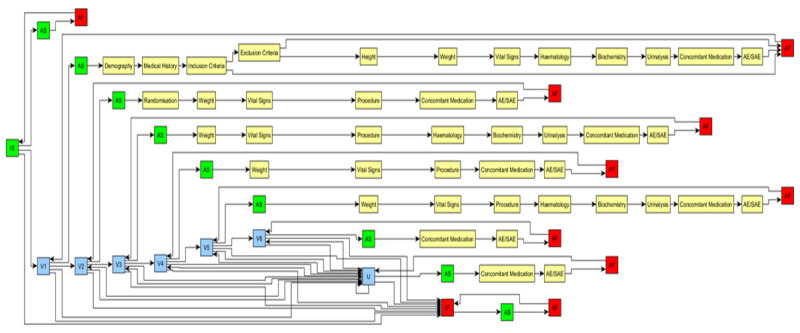 Figure 1
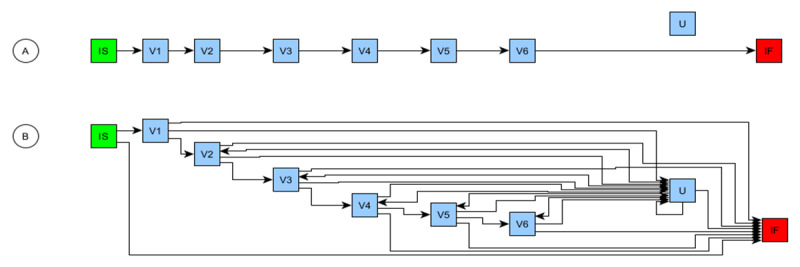 Figure 2
 Figure 3
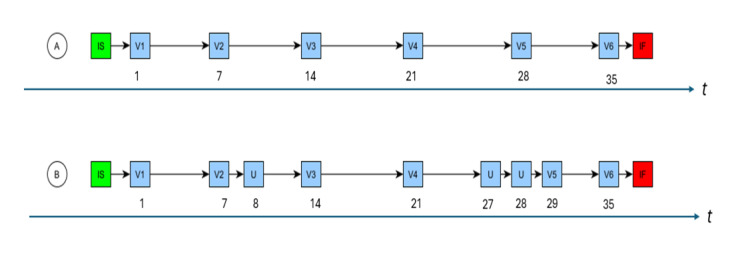 Figure 4
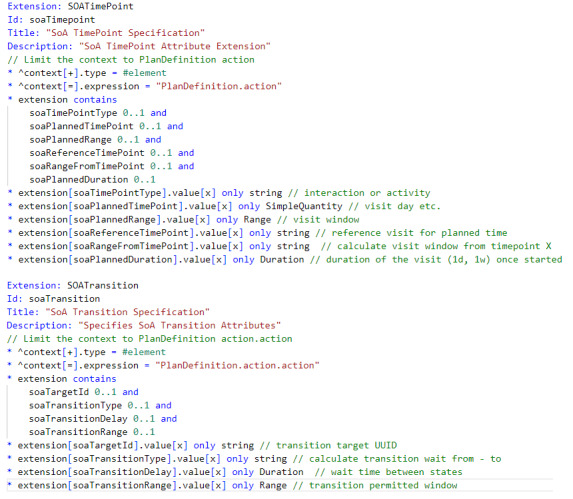 Figure 5
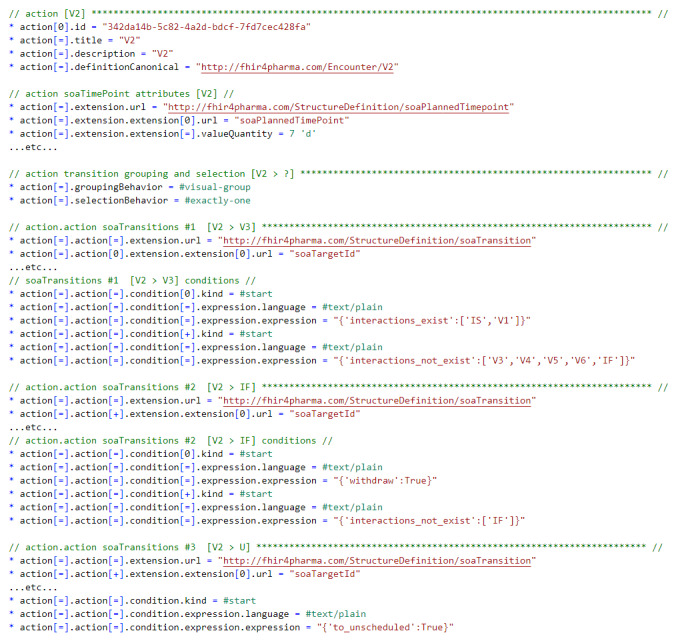 Figure 6
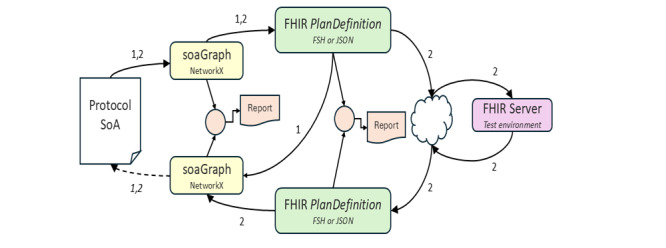 Figure 7
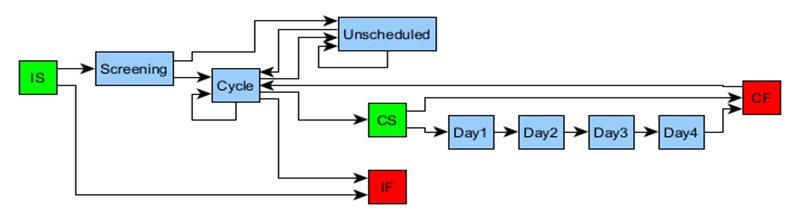 Figure 8
| Phase | Screening | Study period | Unscheduled | |||||
| Visit ID | 1 | 2 | 3 | ...a | 6 | U | ||
| Visit timing | –Days 28 to 1 | Day 1 | Day 7 | ... | Day 28 | As required | ||
|
| ||||||||
|
| Demographics | X |
|
|
|
|
| |
|
| Medical history | X |
|
|
|
|
| |
|
| Inclusion and exclusion criteria | X |
| X |
|
|
| |
|
| Vital signs | X | X | X | X | X | X | |
|
| Procedure | X | X |
|
|
|
| |
|
| ...b |
|
|
|
|
|
| |
|
| Concomitant medication | X | X | X | X | X | X | |
|
| AEc and SAEd | X | X | X | X | X | X | |
| Attribute | Minimal required attribute | Notes or example |
| ||||
|
|
| ||||||
|
| nodeID | Yes | Universally unique identifier | ||||
|
| Type | Yes | “Interaction” or “activity” | ||||
|
| Subtype | No | For example, clinic visit and telephone call | ||||
|
| Name | Yes | Protocol name of interaction or activity | ||||
|
| Description | No | Description of interaction or activity | ||||
|
| plannedTiming | Yes | Schedule timing (D1 etc) | ||||
|
| referenceTimepoint | Yes | Schedule t(zero) | ||||
|
| plannedWindow | No | Schedule timing permitted variance | ||||
|
| plannedDuration | No | Duration of interaction or activity (eg, 24 h) | ||||
|
|
| ||||||
|
| edgeID | Yes | Universally unique identifier | ||||
|
| transitionType | No | Timing relationship between nodes | ||||
| Edge attribute | Minimal required attribute | Notes or example |
| transitionDelay | Yes | “Wait” time before moving from source to target nodes (ie, V1>V2 7d) |
| transitionWindow | No | Permitted transitionDelay variance |
| transitionType | No (default) | start-to-start, default; start-to-finish; finish-to-start; and finish-to-finish |
Peer Reviews
No public reviews on file for this paper yet. If you reviewed it on a platform where reviews are public (OpenReview, ICLR, NeurIPS, ICML), you can paste yours below so the community can read it here.
Videos
No videos yet. Explain this paper in a talk, walkthrough, or lecture? Add one.
Taxonomy
TopicsMachine Learning in Healthcare · Biomedical Text Mining and Ontologies · Electronic Health Records Systems
Introduction
Background
Healthcare interoperability standards such as the Fast Healthcare Interoperability Resources (FHIR) [1] are providing new methodological approaches for the collection, collation, and confirmation of clinical research data for both observational studies and trials supporting product regulatory submissions [2-4]. To be successful, clinical research studies require that (1) the correct data are available to answer the research question and (2) these data are collected at the correct times. These are detailed in the study protocol, where the schedule of activities (SoAs), usually in the form of a square table, provides the key data and scheduling requirements. Various recent projects are underway to explore methods for digitizing all or parts of study protocols with FHIR as a key interoperability component (International Council for Harmonization M11, CDISC Unified Study Definitions Model, and Vulcan Utilizing the Digital Protocol) [5,6].
In a previous paper [7], a graph-based minimum viable set of characteristic attributes needed to define a study’s SoA was developed, along with commentary on the range of “variations on the theme” encountered in different clinical study types and therapeutic areas. Operational use cases that depend on the SoA were also considered. The resulting graph representations of an SoA were converted to FHIR PlanDefinitions compliant with the Health Level 7 (HL7) Vulcan clinical study SoA Implementation Guide (IG) [8].
While the current Vulcan SoA IG can model a wide variety of clinical study SoAs, it is recognized that it is principally limited to defining relatively simple SoAs. It works well to convert SoA tables to FHIR resources; however, it does not have methods to define schedules that repeat (cycle), an essential part of most oncology studies. Similarly, it does not offer methods for conditional switching or to select different permitted (multiple) study paths. It may be coerced in some cases to manage specific situations, but this is not ideal when these “fixes” are key scheduling requirements. This can mean that a Vulcan SoA IG–compliant SoA will specify only part of the total scheduling options that a specific study requires. Subsequent use by consuming applications, such as electronic health record (EHR) systems, may or will require additional tooling to implement all study scheduling variations and control.
Considering previous work, this study investigated (1) what attributes or modifications to a graph model are needed to cover the extended use cases outlined earlier and (2) develop a FHIR PlanDefinition representation that can communicate these requirements. Additional tooling—such as FHIRPath expressions, clinical quality language, or system-specific methods (eg, EHR)—will be required to fully implement the FHIR PlanDefinition into the operational workflow of a clinical system.
This Study
The primary objectives of this study were to (1) develop methods for defining multiple SoA paths within a single graph, (2) develop methods for defining SoA conditional scheduling requirements, (3) develop a human-understandable syntax to support specific study specification, (4) reflect these requirements as FHIR definitional resources, and (5) test and confirm converting the graph representations to FHIR and vice versa
Methods
Graphical SoA Definition
Overview
The adopted methodological approach was to (1) build on previous work to investigate and develop the necessary attributes required to meet the objectives described earlier and (2) develop and test FHIR resource options to accurately describe and exchange these requirements.
Table 1 shows part of an SoA as might be presented in a protocol, and Figure 1 [7] shows a graphical representation of the primary schedule elements. The minimum set of characteristic attributes required to reflect it in this form is shown in Table 2 (refer to the study by Richardson [7] for more details). Two SoA graph node types are used in this model: “interactions,” modeling study events, visits, or other direct or indirect contacts with research participants and “activities,” defining the tasks required to be undertaken to meet the study objectives. These have a simple and easily understood correspondence with the tabular forms found in protocols. These were used to convert the SoAs into Vulcan SoA IG–compliant FHIR resources [7].
Example study of a schedule of activities directed graph. The schedule of activities has 6 planned visits and 1 unscheduled visit (U; blue). The activities at each visit are shown in yellow. The green and red nodes delineate the start and finish of graph instantiation and the activities to be undertaken contiguously. AS: activity start; AF: activity finish; IS: instantiation start; IF: instantiation finish.
Multiple SoA Paths
Standard graph methods were used to develop and test the attributes necessary to model and define the routing objectives (use cases) established earlier. The primary considerations were to (1) accurately reflect different study scheduling options using property graph methods and (2) ensure that the resulting models had a user-friendly correspondence to standard clinical trial scheduling concepts. Only methods using directed graphs were considered.
Conditional Scheduling
Methods to accurately model the conditional scheduling requirements within a single SoA graph initially used path analysis to identify the set of adjacency matrices required for each scenario. These were then used to develop a specification syntax that could define any specific conditional requirement, which, with appropriate tooling, can be implemented such that any subgraph can be extracted from the primary specification. Consideration was given to ensure that (1) permitted routes, such as those required by schedules with different treatment arms, could be defined and (2) the method could support controlling individual schedules dynamically (eg, as individual research participants were reviewed during their visits)
FHIR PlanDefinition
The Vulcan SoA IG [8] was used as the starting point for reviewing and evaluating methods to reflect the approaches mentioned earlier as FHIR resources. The primary resources used were PlanDefinition, ActivityDefinition, and the associated resources that are required to configure a complete description for a specific study (ie, ReseachStudy, ResearchSubject, etc). The main PlanDefinition elements investigated were action.condition, action.relatedAction, action.timing, and the 5 action.<xxx>Behaviors. All work was undertaken using version FHIR Release #5 (version 5.0.0) resources [1].
Model Testing and Proof of Concept
Graph database methods were used to develop and test the specification methods. Proof-of-concept example graphs were built using the Python generalized programming language [9], the NetworkX graph and network libraries [10], and the pandas data analysis library [11].
FHIR resource examples were generated using the Python fhir.resources library [12,13] and HL7 FHIR Shorthand definitions [13]. The yED graph editor (yWorks GmbH) was used to create the visual graph presentations and as an editor to create specific test examples [14]. The accuracy of the FHIR resources versus the graph model was confirmed by visual and programmed comparisons of the resulting definitions. The FHIR resources generated from each proof-of-concept example were confirmed as valid FHIR resources by loading them to publicly available FHIR end points, recovering the specifications using FHIR searches, and confirming that the full original specifications could be recovered without information loss.
SoA Example
Examples and illustrative figures used in this paper are based on the SoA graph shown in Figure 1.
Ethical Considerations
The study does not include human participants, use of medical records, or patient information.
Results
Multiple SoA Paths
Figure 2 illustrates the general problem that arises even with a simple study design when considering how to define all protocol-defined permitted paths. Figure 2A shows how the scheduled visits of Table 1 might be presented as a directed graph. However, the “unscheduled” visit “floats” independently as it is to be used on an “as required” basis over the period of the planned visits.
Defining all permitted paths (ie, extending Figure 2A to add all protocol-implied paths) is shown in Figure 2B and is easily achieved simply by adding appropriate visit-visit edges. Similarly, all potential activity sequencing options can be defined using the same method (Figure 3).
The schedule of activities directed graph representations of the visit schedule described in Table 1. (A) Protocol explicitly defined schedule with “floating” unscheduled visit (U). (B) Expanded version with all implied permitted paths defined. Two important implied paths are now present: routes for a participant to leave the study at any point (eg, V1>IF), and routes to and from U, if required. IS: instantiation start; IF: instantiation finish.
The schedule of activities directed graph representation of visit V1 activities from Figure 1, showing the protocol specified order (left to right) with the added requirements for those cases where (A) the inclusion criteria are not met, or (B) exclusion criteria are present. These paths formally define how to finish the visit “early.” The resulting visualizations, although busy, remain user-friendly from a review or quality control perspective. AS: activity start; AF: activity finish.
No additional node or edge attributes beyond those listed in Table 2 are required to define all permitted paths. However, ensuring that the timing calculations for any path are computable cannot be achieved using the planned timings alone. Here, the problem is that the scheduled planned timings are node (visit) attributes, but calculating the timings for any path requires a summation of the transitions along whichever path is selected (Figure 4).
(A) Timing calculation attributes per protocol schedule, together with the relative day on which the visit occurred. (B) The same schedule but with 3 unscheduled visits. The first unscheduled visit (U; day D8) has no effect on the planned schedule, whereas the second (D27) and third (D28) U caused V5 to occur on D29 rather than on D28. In this case, the relative day of the visits cannot be determined from the planned timings alone. IS: instantiation start; IF: instantiation finish.
Unscheduled visits may necessitate rescheduling of scheduled events. The addition of a transitionDelay edge attribute (Table 3; defined as the time to wait before transitioning to the next node) was found to provide the necessary timing information. It also provides the basis for a key timing consistency check.
Conditional Scheduling Attributes
Figures 2B and 3 also illustrate that there are many cases where specific conditions require different (but permitted) routes to be followed. Some cases are generic and are present in any study (eg, participant’s right to withdraw at any time), some are protocol-specific (eg, if the participant is male, a pregnancy test is not required), and some complex, as illustrated in Figure 2B for managing all “unscheduled” path options (eg, an “unscheduled” visit following V_n_ cannot return to early visits, only being able to proceed to the next planned visit).
To accurately carry all conditional scheduling requirements within a single SoA graph, it was found that 3 things were required as follows:
A method to specify (and therefore recognize) a graph within the graph.A syntax to define how to select a subgraph and restrict access to identified paths in the graph.A method that can be implemented as a dynamic graph (ie, as the graph changes over time).
Both graph node attributes and edge attributes in the model here could be used to hold conditional scheduling information. Adding conditions to the nodes (eg, [visit] repeatAllowed: true/false) was found to satisfy some standard requirements (eg, can a visit be repeated? V2: repeatAllowed: false, and Unscheduled: repeatAllowed: true), but the other requirements were very poorly satisfied (particularly regarding what routes are available following an unscheduled visit). Adding the following edge attribute was found to accurately and easily model all the SoA tested use cases:
Attribute: transitionRuleMinimal required: yesExplanation: rule specifications that can be resolved to True (path can be selected) or False (path unavailable)
This approach was also user-friendly, as only the conditions on each edge (transition) were needed to ensure the use of any specific path (ie, by answering the question “under what conditions can this path be selected or is not available?” and this can also include multiple conditions).
Conditional Scheduling Syntax
A parameterized specification syntax was developed to hold the edge attribute conditions that can be consumed as inputs to a truth table engine that would resolve all edge conditions to the single “true” or “false” as described above. Simple {“function”: “inputs”} pairs were used to specify the “true” or “false” state at runtime for that condition (eg, {“consentObtained”: true}) or any combination of conditions.
The following examples show how several commonly required SoA conditional requirements can be defined using this approach.
Dynamic Graph Specification
The primary use case here is the definition of permitted paths through the study, including, but not limited to, the primary path. For example, in Figure 2B, paths exist to and from “unscheduled” to all “visits” permitting return to the primary schedule. However, “unscheduled” visits cannot return to a previously visited “visit” (discussed earlier). Two rules are required for this case: one to confirm the existence of previously visited visits, and one to ensure that all “future” visits have not yet been visited. The following example shows the rules required on edge U>V3 in Figure 2B, which will ensure that only this path is available at runtime:
{‘interactions_exist’: [‘IS’, ‘V1’,’V2’]}, {‘interactions_not_exist’: [‘V3’, ‘V4’, ‘V5’, ‘V6", ‘IF’]}
(ie, If visits instantiation start [IS], V1, and V2 have occurred and visits V3, V4, V5, V6, and instantiation finish [IF] have not occurred, moving from unscheduled visit [U] to V3 is allowed).
Similar rule pairs, when applied to all U>V_n_ edges, can then ensure that only “forward” paths are available for selection.
Conditional Activity Selection
Restricting, adding, or skipping activities dependent upon participant conditions is a very common feature of SoAs, with the details often provided as footnotes to SoA tables. Examples include requiring pregnancy testing if the participant is female (and conversely not requiring this if the participant is male) and not proceeding with further tasks if inclusion criteria cannot be met (Figure 3). Example rules for these cases are simple to define, but consideration of all edge options is usually required, as follows:
On edge to “exclusion criteria” {“if_criteria_met”:true}
On edge to “AF” {“if_criteria_met”:false}
Conditional Repeats
An important feature of many SoAs is the requirement to repeat activities (eg, blood pressure measurements) or to repeat visit blocks. This last use case is particularly important in the case of many oncology studies where repeating treatment cycles is an inherent part of the study design and will have some limit on the number of cycles and the requirement to exit the study if too many cycles are proving necessary. Typical edge rules for controlling repeat or cycle situations include the following:
Repeat blood pressure measurement 3x. On edge to “self”: {“maxRepeats”:4}
*Limit the number of cycles to a max of 5.*On edge to start of cycle: {“n_cycles”: “<6”}
Subject States, Milestones, and Events
Often, the requirement to select different SoA paths is dependent upon states, milestones, or events, as, for instance, defined by the FHIR ResearchSubject resource [1]. This can be illustrated by the following examples:
To enter an off-label extension study.
On edge to Open Label Extension schedule: {“continue_to_OLE”: true}
If an adverse event occurs.
On edge to adverse event activity: {“record_AE”: true}
Multiple Conditions
The syntax also permits any number of conditions to be defined easily within a single SoA graph for any given edge to obtain a sample for genetic testing. This can be illustrated by the following example:
{“studyPhase”:”onStudy”}, {“sampleObtained”:”true”}, {“geneticTestingConsent”:”true”},
The runtime assessment of each condition then serves as the input to a logic engine that determines the final true or false state.
Undefined SoA Graphs: Implied Edges
Undefined SoA paths can also be recognized using this approach. An undefined path is defined here as one that may occur but is not recognized formally within the SoA graph. A good example of this is the right to withdraw from a study at any time or skip an activity. Formally recognizing every point where these conditions may occur and providing a defined path may add too much complexity to the graph, and it may be unreasonable to model it. However, placing a general requirement on all transitions (edges) of {“withdrawn”: false} will permit proceeding through the schedule until {“withdrawn”: false} == “false” (ie, withdraw is now “true”). Using suitable runtime coding, the “undefined” transition can be applied to the specific participants’ SoA graph instance.
FHIR SoA PlanDefinition Review
The primary objective of this study was to identify methods that enable SoAs to be more fully defined using FHIR resources. The SoA graph review identified the necessary additional requirements needed to satisfactorily model SoA specifications, such as those shown in Figure 1. To successfully define these specifications using FHIR resources, they must meet the following requirements:
Represent all SoA-identified pathsRecognize and “respond” to conditional casesAllow consuming applications to be able to “walk” any permitted path
The Vulcan SoA IG [8] was used as the starting point for developing a more comprehensive SoA FHIR model with the goal of extending or modifying it to be able to manage the complex designs, conditions, and “variations on the theme” as discussed earlier.
FHIR PlanDefinition SoAGraph Definition
From the graph attributes model developed earlier, it follows that for the PlanDefinitions to fully specify all SoA requirements, it needs to hold a definition of the SoA graph, and not the SoA table. Reviewing the use of the PlanDefinition.action and PlanDefinition.action.action elements, the basic graph node and edge relationship can be defined. Specifically, with nodes (visits) mapped to PlanDefinition.actions and edges(transitions) mapped to PlanDefinition.action.actions, all the relationships defined, for example, in Figure 1, can be specified within a single PlanDefinition.
PlanDefinition.action in its standard form does not support those elements (attributes) to hold all the necessary SoA specification details. These have been added using 2 extensions, that is, soaTimePoint and soaTransition (Figure 5 [7]) to hold the graph information, which in turn then forms the basis for an soaPlanDefinition profile (Multimedia Appendix 1).
Fast Healthcare Interoperability Resources extensions (as FHIR shorthand) used to associate the soaGraph node and edge attributes with PlanDefinition.action (SOATimePoint) and PlanDefinition.action.action (SOATransition), respectively.
FHIR PlanDefinition SoAGraph Condition and Selection Definition
Conditional SoA requirements can now be specified using the PlanDefinition.action element condition (applied to PlanDefinition.action.action), with each edge having all or any true or false conditions for that transition. When combined with PlanDefinition.groupingBehaviour and PlanDefinition.selectionBehaviour, path selection can be restricted to 1 path only, with only those transitions that are permitted being available for selection. Figure 6 shows the FHIR Shorthand specification for node V2 in Figure 2 and Multimedia Appendix 2.
FHIR shorthand annotated version of PlanDefinition definition of visit V2 (.action) and its associated soaGraph transitions: V2>V3, V2>IF (instantiation finish; withdrawal), V2>U (unscheduled visit; .action.action). V2 attributes are defined using the ...action.soaPlannedTimepoint extension. The selection behavior is defined by ...action.groupingBehaviour and ...action.selectionBehaviour. For each path from V2, the conditions that must be met for that path to be available for selection are given in ...action.action.condition(s). V2, V3, U, and IF are the schedule of activities time points in Figure 2.
To operationalize the FHIR PlanDefinition within the workflow of a clinical system, such as an EHR, additional tooling is required. The illustrative syntax presented in the examples—for instance, *expression = “{‘interactions_not_exist’: [‘V3’, ‘V4’, ‘V5’, ‘V6’, ‘IF’]}”—*serves to demonstrate the underlying logic but is not directly executable within an FHIR environment. In practice, these expressions must be translated into an FHIR-compatible solution, typically by leveraging FHIRPath, clinical quality language, or system-specific functionality. Such translation ensures that the abstract representations in the PlanDefinition can be implemented as concrete, machine-interpretable instructions within the clinical system’s workflow.
Proof of Concept
All the interim and final products, methods, and results described earlier were validated using the testing schedule shown in Figure 7. Once interim inconsistencies were reviewed and resolved, no SoA information loss was present after recovering an soaGraph from a FHIR PlanDefinition (Figure 7; test cycle 1) or after loading and recovery from test FHIR servers (test cycle 2).
Proof-of-concept testing overview. The numbers highlight the 2 principal testing cycles used. Recovered products were compared with the original for reviewing structural equivalence and information loss throughout the development process. FHIR: Fast Healthcare Interoperability Resources; FSH: FHIR Shorthand; SoA: schedule of activities.
More than 25 studies, ranging from relatively simple designs, as shown in Figure 1, to complex studies incorporating cycles and multiple SoAs (not shown), were used to test and validate the approach. All tests could be accurately defined, with the most frequent finding during this exercise being that it highlighted inconsistencies in the protocol specifications themselves. It also lends itself to defining SoAs more succinctly and potentially more accurately. Figure 8 is a template for studies that includes cycles and shows that each required visit (interaction) is only defined once. With appropriate edge (transition) attributes and conditions, this can be modified to define many specific study scenarios.
Template soaGraph for studies with cycles. Using appropriate edge attributes and conditions, it can be modified for various study designs. The green and red nodes are included to delineate the graph instantiation and the start and finish of the treatment cycle. CS: cycle start: CF: cycle finish; IF: instantiation finish; IS: instantiation start.
Discussion
Overview
The HL7 FHIR standard is becoming, if not already, the de facto healthcare interoperability standard [2,15-18]. The primary source of many clinical trial data is EHRs, and studies usually require manual transcription of these data into electronic data capture systems. For both quality and volume reasons, this is often not optimal and has led to efforts to obtain data directly from electronic data capture systems (direct data capture) [19-22].
This study’s protocol and the SoA provide the primary definitional source for a study’s required research data and details of other operational requirements. The value of definitional FHIR resources to support clinical research and similar initiatives has been recognized in the Specialized Definitional Artifacts category [1].
The PlanDefinition resource is the primary resource for defining “a predefined group of actions to be taken in particular circumstances.” The Vulcan SoA IG [23] has developed a set of profiles using this resource to define SoAs. As mentioned earlier, this model does not include methods to define either conditional scheduling, certain study designs (notably cycles), or the scheduling of expected but not planned events (particularly “unscheduled visits”). This work has re-evaluated how PlanDefinition might be modified, revised, or extended to model these situations.
Principal Findings
Using a systematic review of the relationships and attributes required to define the SoA characteristics discussed earlier, a graph-based method has been developed that can manage all these cases. Subsequently, by associating PlanDefinition.action and PlanDefinition.action.action directly with graph nodes and edges, respectively, SoAs with all scheduling variations, conditional paths, and methods to manage planned but unscheduled events can be defined within a single PlanDefinition. Recognizing that an SoA “activity” has both timing and task elements (ie, is “X” in tabular SoAs), the model formally disassociates the scheduling information from the task or activity definitions, which can then be linked using the PlanDefinition.action.relatedAction.targetId element. This approach also enables SoA activities as described in study protocols (or not described) to be fully traceable in the SoA schedule, but specified fully using other appropriate FHIR definitional resources (eg, ActivityDefinition and ObservationDefinition)
Comparison With Prior Work
Earlier work based on using both graph methods for SoA definition [23,24] and FHIR for interoperability [25-27] has shown the value of this approach for communicating sponsor protocol requirements systematically for implementation in EHRs and similar systems [4,21,22,28-31]. The work here has re-evaluated the approach to specifying SoAs as FHIR PlanDefinitions to find solutions to several key required SoA characteristics not addressed previously. The model described here uses a radically different conceptual approach, redefining several PlanDefinition elements to be able to hold a graph representation of an SoA. The current method can successfully represent a wider range of SoA concepts than before and can also specify a large range of other SoA use cases that are key to many protocol designs (not shown). Because here all SoA requirements can be accurately specified within a single PlanDefinition, this should simplify the implementation by consuming applications. It is also clear that, with modification or the use of standard PlanDefinition elements, it can support other important SoA use cases not directly considered here (eg, protocol amendments with SoA consequences)
Limitations
The methods in this study were developed using FHIR Release #5 (version 5.0.0) [1] and are not necessarily compatible with earlier FHIR versions.
Conclusions
The methods described in this study offer an alternative approach to defining clinical study SoAs using FHIR definitional resources compared to previously published articles and may offer advantages with regard to some key requirements not addressed by other proposed approaches.
The reference list from the paper itself. Each links out to its DOI / PubMed record.
- 1Welcome to FHIRHL 7 Fast Healthcare Interoperability Resources 2025-09-28 https://hl 7.org/fhir/
- 2Pimenta N Chaves A Sousa R Abelha A Peixoto H Interoperability of clinical data through FHIR: a review Procedia Computer Science 20232208566110.1016/j.procs.2023.03.115 · doi ↗
- 3Real-world data: assessing electronic health records and medical claims data to support regulatory decision-making for drug and biological products U.S. Food & Drug Administration 202472025-09-20 https://www.fda.gov/regulatory-information/search-fda-guidance-documents/real-world-data-assessing-electronic-health-records-and-medical-claims-data-support-regulatory 10.1002/pds.5444 PMC 932093935471704 · doi ↗ · pubmed ↗
- 4Chatterjee A Pahari N Prinz AHL 7 FHIR with SNOMED-CT to achieve semantic and structural interoperability in personal health data: a proof-of-concept study Sensors (Basel)2022051522103756 10.3390/s 2210375635632165 s 2210375635632165 PMC 9147872 · doi ↗ · pubmed ↗
- 5Clinical electronic Structured Harmonised Protocol (Ce S Harp)International Council for Harmonisation of Technical Requirements for Pharmaceuticals for Human Use 2025-01-02 https://ich.org/page/multidisciplinary-guidelines#11
- 62025 - 05 Vulcan utilizing the digital protocol (UDP)Confluence 202510042025-09-28 https://confluence.hl 7.org/spaces/FHIR/pages/324961379/2025+-+05+Vulcan+Utilizing+the+Digital+Protocol+UDP
- 7Richardson A Representing clinical study schedule of activities as FHIR resources: required characteristic attributes J Soc Clin Data Manag 202442 10.47912/jscdm.266 · doi ↗
- 8Clinical study schedule of activities HL 7 International 202304182025-09-28 https://build.fhir.org/ig/HL 7/Vulcan-schedule-ig/