Paxillin’s nuclear switch: orchestrating gene splicing for brain plasticity
Souren Sadhukhan, Vijay K Tiwari

TL;DR
Paxillin, a protein known for cell adhesion, now acts in the nucleus to control gene splicing during brain development.
Contribution
Paxillin's nuclear role in regulating alternative splicing during synaptic refinement is newly identified.
Findings
Paxillin's phosphorylation at serine 119 enables its nuclear translocation.
Nuclear paxillin fine-tunes gene splicing programs in developing neurons.
This process is critical for synaptic refinement during sensitive developmental periods.
Abstract
Paxillin, long known as a cytoplasmic scaffold protein involved in cell adhesion and migration, emerges in a new role as a nuclear regulator of alternative splicing in developing neurons. In this issue of The EMBO Journal, Chu and colleagues reveal that activity-dependent phosphorylation of paxillin at serine 119 promotes its nuclear translocation, enabling it to fine-tune gene splicing programs critical for synaptic refinement during sensitive periods of brain development. Recent work in The EMBO Journal uncovers the regulatory role of nuclear paxillin in alternative splicing for synaptic refinement during brain development.
Genes, proteins, chemicals, diseases, species, mutations and cell lines named across the full text — each resolved to its canonical identifier and authoritative record.
Click any figure to enlarge with its caption.
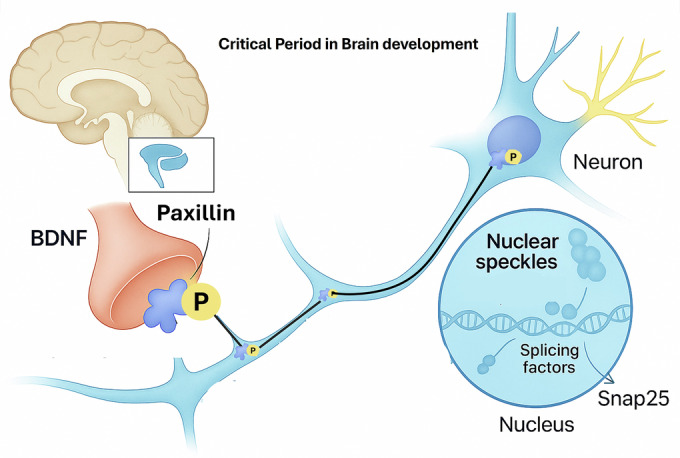 Figure 1
 Figure 2
- —http://dx.doi.org/10.13039/501100009708Novo Nordisk Fonden (NNF)
- —Danish National Research Foundation
- —Danish Cancer Society
Peer Reviews
No public reviews on file for this paper yet. If you reviewed it on a platform where reviews are public (OpenReview, ICLR, NeurIPS, ICML), you can paste yours below so the community can read it here.
Videos
No videos yet. Explain this paper in a talk, walkthrough, or lecture? Add one.
Taxonomy
TopicsGenetics and Neurodevelopmental Disorders · RNA Research and Splicing · CRISPR and Genetic Engineering
The brain’s ability to adapt and refine neural circuits during early postnatal life is fundamental to learning, memory, and overall cognitive function. This “sensitive period” of plasticity relies on precise molecular mechanisms that respond to sensory experiences, ensuring that neurons form appropriate connections. Alternative splicing (AS) plays a pivotal role here, generating diverse protein isoforms that modulate synaptic strength and morphology. However, the molecular switches that synchronize AS with neuronal activity have remained elusive. Chu et al. now position paxillin—a protein traditionally associated with focal adhesions—as a key activity-dependent mediator in the nucleus, bridging synaptic signals to genomic responses (Fig. 1).Figure 1. Paxillin’s activity-dependent nuclear role in neuronal splicing.This schematic illustrates the novel nuclear function of paxillin in neurons. Upon NMDA receptor activation or sensory stimulation, paxillin is phosphorylated at serine 119 (p-Paxillin^S119^), triggering its nuclear import via interaction with importin-β2. Once in the nucleus, p-Paxillin^S119^ localizes to nuclear speckles, where it interacts with RNA-binding proteins such as U2AFs, FUS, and NOVA1/2. This interaction modulates alternative splicing of synaptic genes, including Snap25, facilitating synaptic refinement and plasticity during sensitive periods of brain development. Disruption of this pathway leads to impaired synaptic transmission and memory deficits, highlighting paxillin’s critical role in bridging synaptic activity to genomic responses.
In their study, the authors demonstrate that paxillin phosphorylated at serine 119 (p-Paxillin^S119^) is enriched in the developing mouse brain, peaking during postnatal weeks when sensory inputs refine circuits. This phosphorylation, triggered by NMDA receptor activation or sensory stimulation (e.g., whisker tactile input), facilitates paxillin’s nuclear import via proline-tyrosine nuclear localization signals and interaction with importin-β2 (Fig. 1). Once in the nucleus, p-Paxillin^S119^ localizes to nuclear speckles—hubs of splicing machinery—where it interacts with RNA-binding proteins like U2AFs, FUS, and NOVA1/2. This association modulates AS of synaptic genes, such as Snap25, shifting isoforms to support presynaptic function and plasticity.
These findings build on prior work showing paxillin’s nuclear presence in non-neuronal cells, where it influences transcription and proliferation (Dong et al, 2009; Ma and Hammes, 2018). In neurons, however, Chu et al uncover a novel, activity-gated mechanism: without S119 phosphorylation of paxillin, mice exhibit delayed Snap25 isoform switching, impaired hippocampal synaptic transmission, and deficits in short-term memory. This echoes studies on activity-regulated proteomes, where synaptic inputs alter nuclear factors to drive transcription and splicing (Yap and Greenberg, 2018; Chen et al, 2021; Thakurela et al, 2015).
For instance, similar to how MeCP2 mutations disrupt splicing in neurodevelopmental disorders (Amir et al, 1999), paxillin’s role highlights how post-translational modifications can act as “molecular switches” for experience-dependent gene regulation.
This study expands paxillin’s repertoire beyond cytoskeletal dynamics, positioning it as a versatile regulator in genomic signaling. It aligns with emerging evidence of adhesion proteins moonlighting in the nucleus (Sathe et al, 2016) and underscores the importance of phosphoproteomics in uncovering hidden neuronal functions (Tsien, 2013). Broader implications extend to disorders like autism or schizophrenia, where splicing dysregulation during critical periods contributes to pathology (Quesnel-Vallières et al, 2016). Therapeutically, targeting paxillin phosphorylation could enhance plasticity in neurorehabilitation or mitigate age-related cognitive decline.
This work also raises intriguing questions: How does paxillin selectively influence certain splicing events? And could similar mechanisms operate in other cell types? By linking peripheral signals to nuclear alternative splicing, Chu et al provide a framework for understanding how experiences sculpt the brain, with potential ripple effects across developmental biology and beyond.