Long noncoding RNAs involved in therapeutic response: implications for cervical cancer drug resistance
Samuel Trujano-Camacho, Carlos Contreras-Romero, Verónica García-Castillo, David Sánchez-Marín, Mercedes Olvera-Valencia, Mauricio Rodríguez-Dorantes, Oscar Peralta-Zaragoza, David Cantú de León, Eduardo López-Urrutia, Carlos Pérez-Plasencia

TL;DR
This paper reviews how long noncoding RNAs contribute to drug resistance in cervical cancer and highlights their potential as targets for improving treatment.
Contribution
The paper compiles current knowledge on lncRNAs in cervical cancer drug resistance and identifies gaps for future research.
Findings
Long noncoding RNAs are involved in multiple drug resistance mechanisms in cervical cancer.
Current understanding of lncRNAs in cervical cancer resistance is limited and requires further investigation.
lncRNAs are promising candidates for biomarkers and therapeutic strategies in cervical cancer.
Abstract
Cervical cancer (CC) remains among the top causes of death for women worldwide, especially in low-income countries, where screening strategies are less widespread. Treatment strategies are mainly based on DNA-damaging agents, though resistance mechanisms still pose a substantial challenge. Among the cellular components that mediate treatment resistance, long non-coding RNAs (lncRNAs) stand out because of their broad regulatory effects. They are involved in virtually all drug resistance mechanisms, such as drug efflux, DNA repair, evasion of cell death, and aberrant epigenetic modifications. Although resistance mechanisms are fundamentally similar in most cancers, the underlying regulatory networks vary substantially. Here, we review the literature for lncRNAs involved in treatment resistance mechanisms in general, and then focus on lncRNAs that mediate resistance in CC. We found a broad…
Genes, proteins, chemicals, diseases, species, mutations and cell lines named across the full text — each resolved to its canonical identifier and authoritative record.
Click any figure to enlarge with its caption.
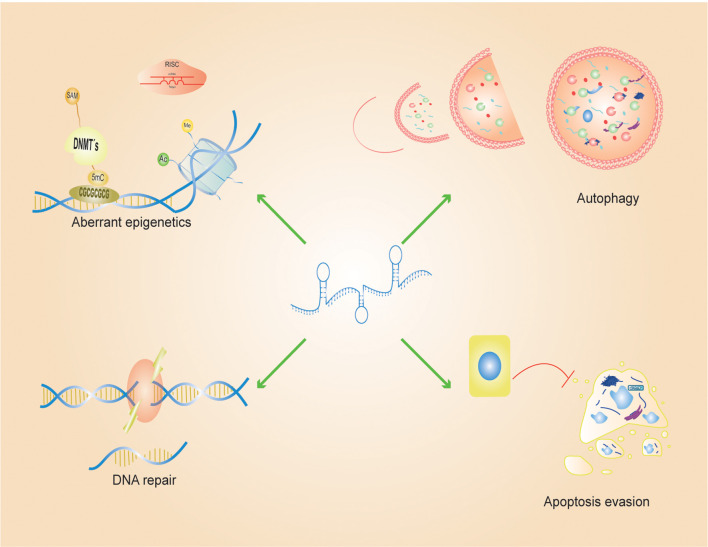 Figure 1
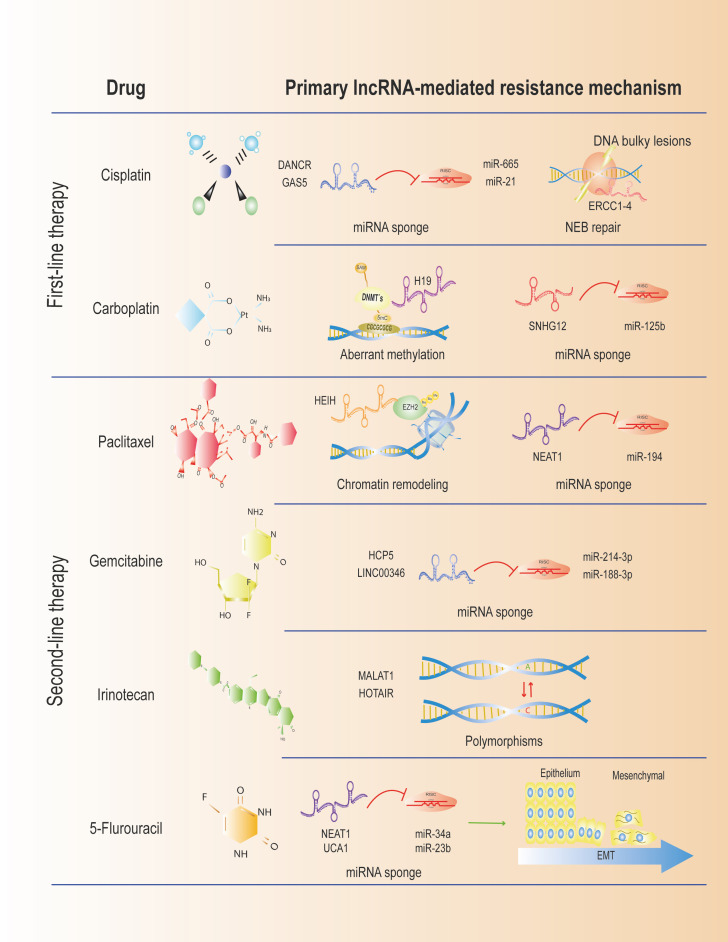 Figure 2
Peer Reviews
No public reviews on file for this paper yet. If you reviewed it on a platform where reviews are public (OpenReview, ICLR, NeurIPS, ICML), you can paste yours below so the community can read it here.
Videos
No videos yet. Explain this paper in a talk, walkthrough, or lecture? Add one.
Taxonomy
TopicsCancer-related molecular mechanisms research · Circular RNAs in diseases · MicroRNA in disease regulation