Growth hormone therapy and chromosomal mosaicism in turner syndrome: 25 years of growth outcomes in Taiwan
Yu-Ting Chang, Ying-Hua Huang, Fu-Sung Lo

TL;DR
A 25-year study in Taiwan shows that chromosomal mosaicism in Turner syndrome does not significantly affect final adult height, with treatment outcomes more influenced by factors like bone age and parental height.
Contribution
The study provides long-term growth data in Asian Turner syndrome patients, showing karyotype mosaicism does not significantly impact final height.
Findings
Mosaic and non-mosaic Turner syndrome patients had similar final adult heights despite different growth velocities.
Baseline bone age, initial height, and mid-parental height were significant predictors of final height.
Karyotype, IGF-1 levels, and pubertal status were not independently associated with growth outcomes.
Abstract
Turner syndrome (TS), a chromosomal disorder affecting females, is commonly associated with short stature due to haploinsufficiency of the SHOX gene. Recombinant human growth hormone (rhGH) and estrogen replacement therapy (ERT) are standard treatments to improve height and induce puberty. However, the impact of chromosomal mosaicism and other clinical variables on long-term growth outcomes remains controversial, particularly in Asian populations. To evaluate the influence of karyotype and other clinical predictors on growth velocity and final adult height in Taiwanese patients with TS undergoing rhGH and ERT. This 25-year retrospective multicenter study included 107 TS patients treated at three medical centers between 1997 and 2022. Patients were stratified into non-mosaic and mosaic karyotype groups. Growth patterns, treatment duration, and final adult height were assessed.…
Genes, proteins, chemicals, diseases, species, mutations and cell lines named across the full text — each resolved to its canonical identifier and authoritative record.
Click any figure to enlarge with its caption.
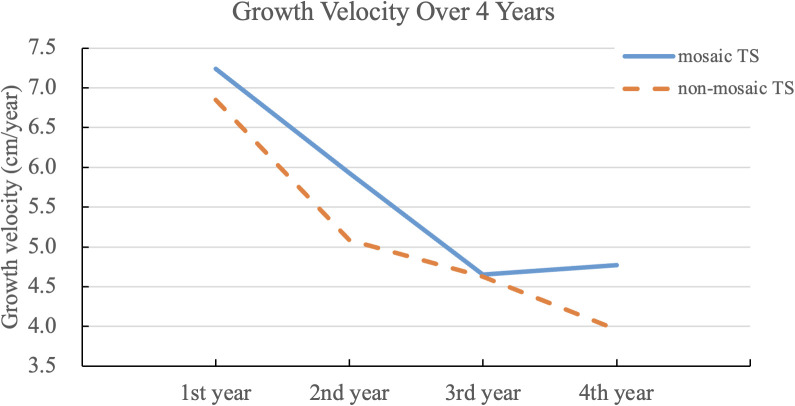 Figure 1
Peer Reviews
No public reviews on file for this paper yet. If you reviewed it on a platform where reviews are public (OpenReview, ICLR, NeurIPS, ICML), you can paste yours below so the community can read it here.
Videos
No videos yet. Explain this paper in a talk, walkthrough, or lecture? Add one.
Taxonomy
TopicsGenetic and Clinical Aspects of Sex Determination and Chromosomal Abnormalities · Sexual Differentiation and Disorders