Long-term effectiveness of ACE inhibitors or angiotensin receptor blockers in myocardial infarction with preserved left ventricular ejection fraction
Anna B C Humphreys, Bertil Lindahl, Anita Berglund, Vanessa Voelskow, Si Fang, Ole Fröbert, Robin Hofmann, Tomas Jernberg, Miguel A Hernán, Anthony A Matthews

TL;DR
This study finds that ACE inhibitors or angiotensin receptor blockers do not significantly benefit heart attack patients with normal heart function over five years.
Contribution
The study is the first to evaluate long-term benefits of ACEi/ARBs in myocardial infarction patients with preserved left ventricular ejection fraction using real-world data.
Findings
The 5-year risk of a composite outcome (death, heart attack, heart failure) was 7.8% in ACEi/ARB users and 8.1% in non-users.
After adjusting for adherence, the risk was 6.5% in ACEi/ARB users and 6.7% in non-users.
No significant benefit of ACEi/ARB treatment was observed in patients with preserved left ventricular ejection fraction.
Abstract
Angiotensin-converting enzyme inhibitors (ACEi) and angiotensin receptor blockers (ARB) are effective in the long-term treatment of myocardial infarction with reduced left ventricular ejection fraction (LVEF). However, it is unknown whether there is a benefit in myocardial infarction with preserved LVEF (≥50%). We used Swedish healthcare registries to emulate a target trial of ACEi/ARBs vs. no ACEi/ARBs for the prevention of a composite outcome (death, myocardial infarction, or heart failure) and its individual components among individuals under 75 years with myocardial infarction and LVEF ≥ 50% between September 2010 and June 2021. We estimated observational analogues of the intention-to-treat effect and the per-protocol effect with confounding adjustment via inverse probability weighting. The 10 697 individuals in the ACEi/ARB group were on average older (median 61 vs. 60 years) and…
Genes, proteins, chemicals, diseases, species, mutations and cell lines named across the full text — each resolved to its canonical identifier and authoritative record.
Click any figure to enlarge with its caption.
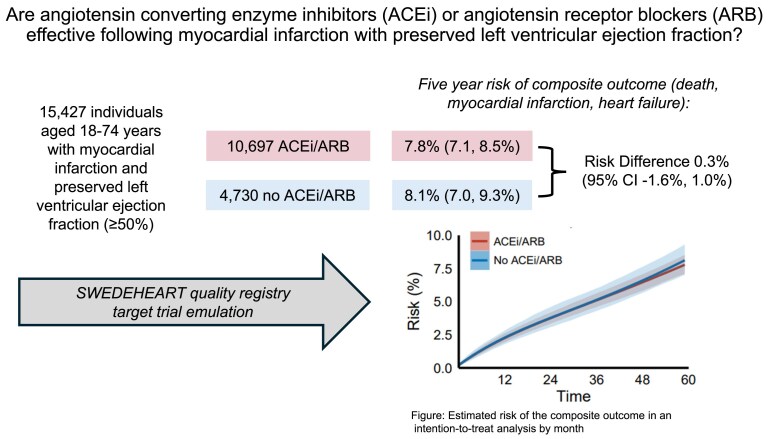 Figure 1
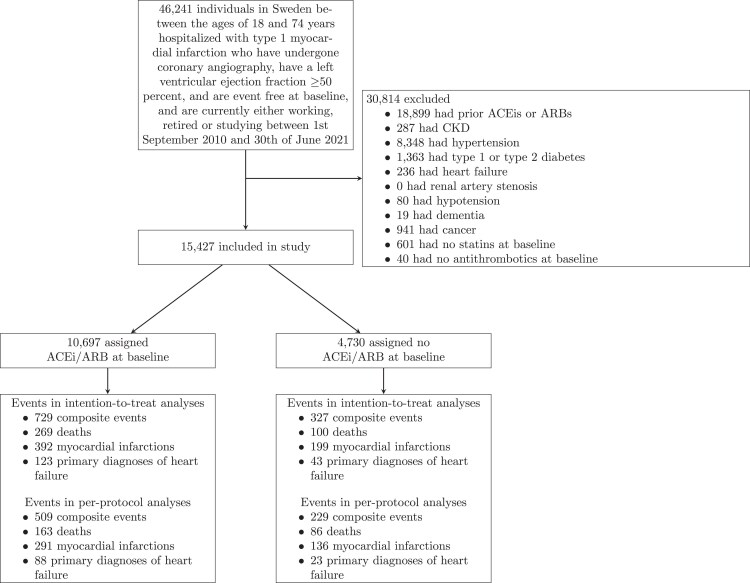 Figure 2
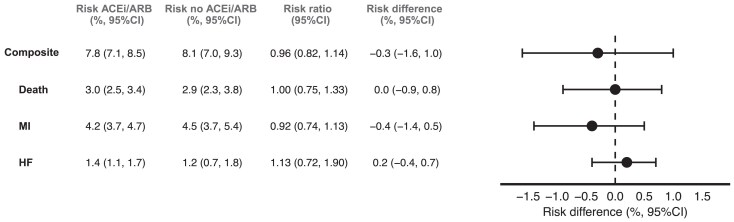 Figure 3
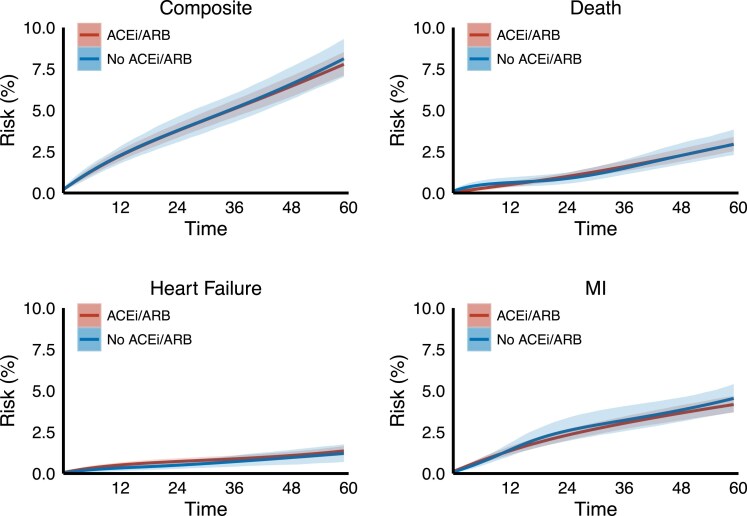 Figure 4
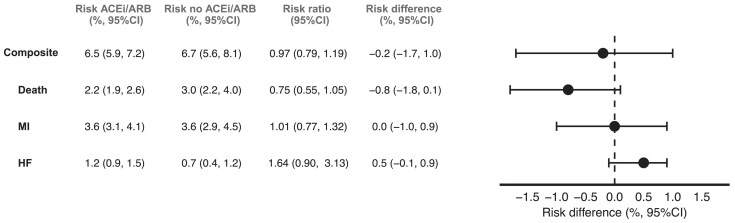 Figure 5
Peer Reviews
No public reviews on file for this paper yet. If you reviewed it on a platform where reviews are public (OpenReview, ICLR, NeurIPS, ICML), you can paste yours below so the community can read it here.
Videos
No videos yet. Explain this paper in a talk, walkthrough, or lecture? Add one.
Taxonomy
TopicsAcute Myocardial Infarction Research · Cardiac electrophysiology and arrhythmias · Heart Failure Treatment and Management