Association of Modifiable Lifestyle and Metabolic Factors With the Risk of Developing Sepsis: 2-Sample Mendelian Randomized Study
Haifeng Lv, Jing Liu, Yelin Cao, Weina Fan, Guojie Shen, Feifei Wang, Qingqing Ye, Xiaoliang Wu, Kaijin Xu

TL;DR
This study finds that lifestyle and metabolic factors like smoking, physical activity, and waist circumference are linked to sepsis risk, suggesting potential targets for prevention.
Contribution
The study uses Mendelian randomization to establish causal links between modifiable lifestyle and metabolic factors and sepsis risk.
Findings
Genetically predicted smoking and higher cigarette consumption increase sepsis risk.
Higher education and light physical activity are protective against sepsis.
Waist circumference remains an independent risk factor for sepsis after adjusting for obesity.
Abstract
Sepsis is a life-threatening condition characterized by organ dysfunction resulting from dysregulated host response to infections. Approximately 48.9 million people worldwide are diagnosed with sepsis annually, leading to 11 million deaths and representing 19.7% of all global deaths. No specific, effective treatments for sepsis, which has a poor prognosis, are available. The study aimed to systematically explore the association between genetically predicted modifiable risk factors and sepsis. Univariable 2-sample Mendelian randomization (MR) analysis was performed to explore the association between 30 modifiable risk factors (12 lifestyle, 3 educational and psychological, and 15 metabolic factors) and sepsis. Heterogeneity was evaluated using the Cochran Q analysis. Sensitivity analyses were conducted using the MR-Egger regression intercept tests and leave-one-out analyses.…
Genes, proteins, chemicals, diseases, species, mutations and cell lines named across the full text — each resolved to its canonical identifier and authoritative record.
Click any figure to enlarge with its caption.
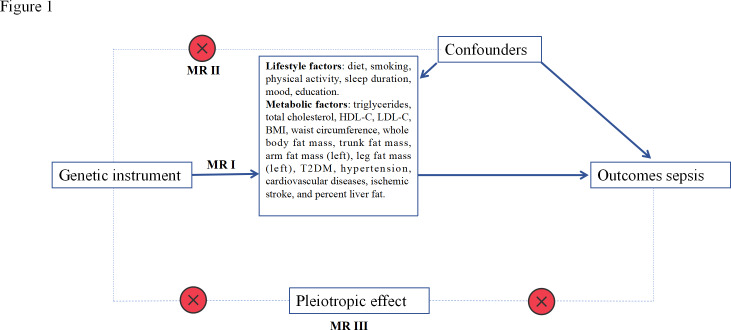 Figure 1
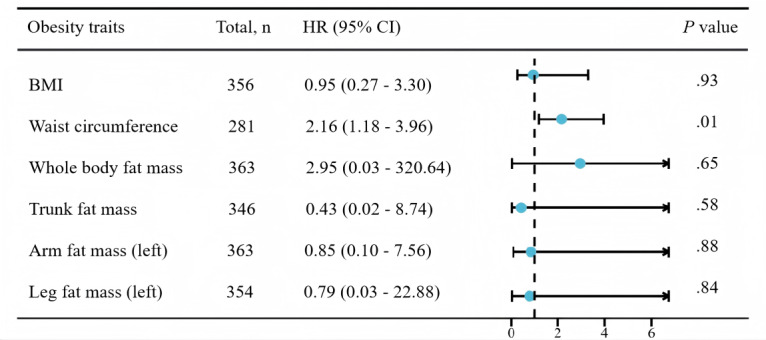 Figure 2
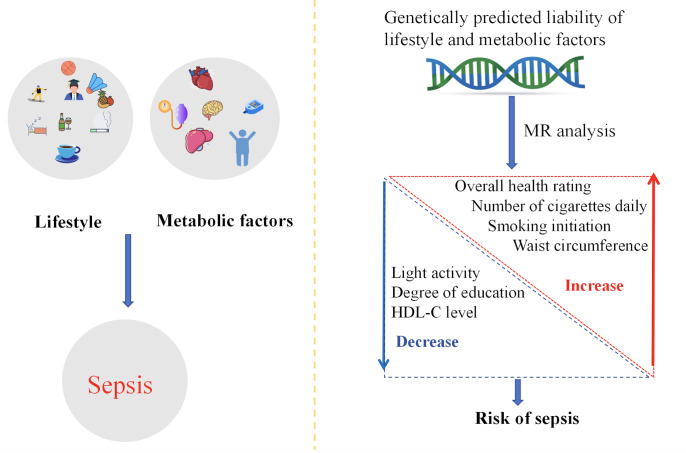 Figure 3
Peer Reviews
No public reviews on file for this paper yet. If you reviewed it on a platform where reviews are public (OpenReview, ICLR, NeurIPS, ICML), you can paste yours below so the community can read it here.
Videos
No videos yet. Explain this paper in a talk, walkthrough, or lecture? Add one.
Taxonomy
TopicsSepsis Diagnosis and Treatment · Immune Response and Inflammation · Inflammation biomarkers and pathways