Group Cognitive Behavioral Therapy With Virtual Reality Exposure Versus In-Vivo Exposure for Social Anxiety Disorder and Agoraphobia: Underpowered Results From the SoREAL Pragmatic Randomized Clinical Trial
Benjamin Arnfred, Fatime Zeka, Carsten Hjorthøj, Clas Winding Christensen, Kirsten Stengaard Moeller, Mette Øllgaard Pedersen, Nicole Rosenberg, Lars Clemmensen, Louise Birkedal Glenthøj, Merete Nordentoft

TL;DR
A study compared virtual reality exposure and in-person exposure in group therapy for social anxiety and agoraphobia but found no significant differences due to limited data.
Contribution
The study explored the use of virtual reality in group cognitive behavioral therapy for anxiety disorders, highlighting feasibility challenges.
Findings
Both VR-CBT and traditional CBT groups showed significant reductions in anxiety symptoms.
No significant differences were found between the two treatment groups at posttreatment or follow-up.
Insufficient recruitment and missing data limited the ability to draw definitive conclusions.
Abstract
Social anxiety disorder (SAD) and agoraphobia are common, impairing conditions often treated with cognitive behavioral therapy (CBT) conducted in groups. In CBT, exposure therapy is a core element. However, in-vivo exposure therapy is logistically challenging and aversive for both patient and therapist, especially in a group context, often leading to exposure being skipped altogether in clinical practice. Virtual reality exposure (VRE), in which phobic stimuli are presented through immersive virtual reality technology, has shown promise as a flexible alternative to in-vivo exposure. We thus hypothesized that using VRE would result in more overall exposure and more individualized exposure, resulting in statistically significant symptom reduction compared with a group using in-vivo exposure. This trial evaluated the efficacy of group CBT with VRE (VR-CBT) versus CBT with in-vivo exposure…
Genes, proteins, chemicals, diseases, species, mutations and cell lines named across the full text — each resolved to its canonical identifier and authoritative record.
Click any figure to enlarge with its caption.
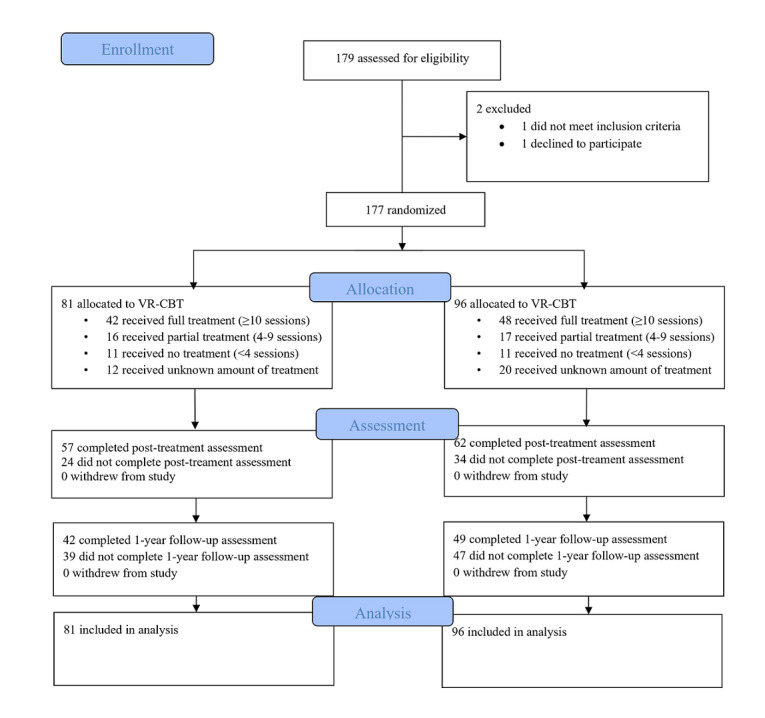 Figure 1
Peer Reviews
No public reviews on file for this paper yet. If you reviewed it on a platform where reviews are public (OpenReview, ICLR, NeurIPS, ICML), you can paste yours below so the community can read it here.
Videos
No videos yet. Explain this paper in a talk, walkthrough, or lecture? Add one.
Taxonomy
TopicsPerfectionism, Procrastination, Anxiety Studies · Digital Mental Health Interventions · Mental Health Research Topics