Using a World Health Assembly simulation to explore undergraduate students’ perceptions and confidence in analyzing complex global health challenges: A mixed-methods evaluation
Ahmad Firas Khalid, Megan A. George, Clarissa Eggen, Aaranee Sritharan, Faiza Wali, A. M. Viens

TL;DR
This study explores how a global health simulation boosts undergraduate students' confidence in tackling complex health challenges through experiential learning.
Contribution
The study introduces a novel mixed-methods evaluation of a World Health Assembly simulation's impact on student confidence and learning in global health education.
Findings
Participants reported increased confidence in skills like research, critical analysis, and leadership.
Students gained a deeper appreciation of complex global health issues through the simulation.
The simulation provided career-relevant insights and supported reflective learning.
Abstract
Traditional didactic teaching approaches fall short of adequately supporting diverse student learning styles. Complementing didactic teaching approaches with simulation-based experiential learning can bridge the gap between theoretical knowledge and practical application. However, few studies have rigorously examined the outcomes of this approach in global health education and training. This study describes participants’ self-reported experiences with the World Health Assembly Simulation (WHA SIM), a complex hybrid simulation consisting of a three-day educational exercise, including a tabletop exercise followed by live-action role play, designed to simulate practical global health governance settings. We conducted a descriptive, sequential exploratory study between September 2022 and July 2023, beginning with an anonymous pre-simulation survey among undergraduate students in the Faculty…
Genes, proteins, chemicals, diseases, species, mutations and cell lines named across the full text — each resolved to its canonical identifier and authoritative record.
Click any figure to enlarge with its caption.
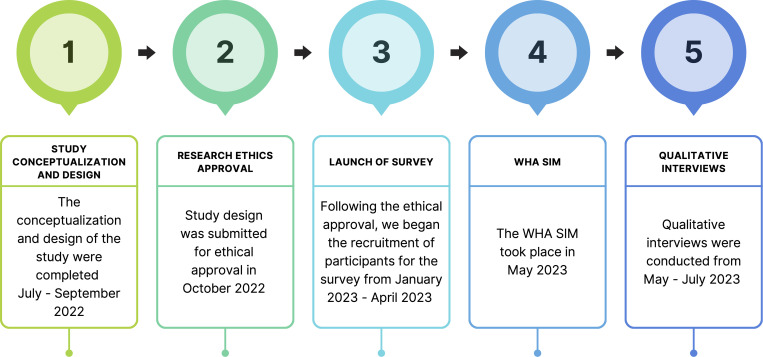 Figure 1
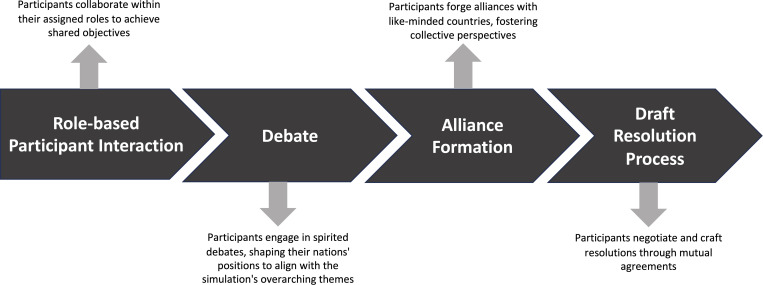 Figure 2
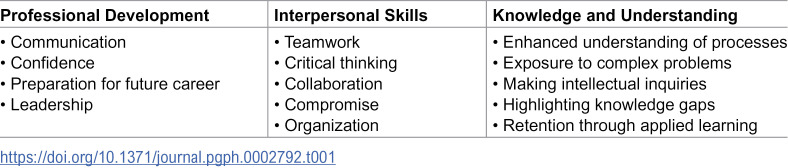 Figure 3
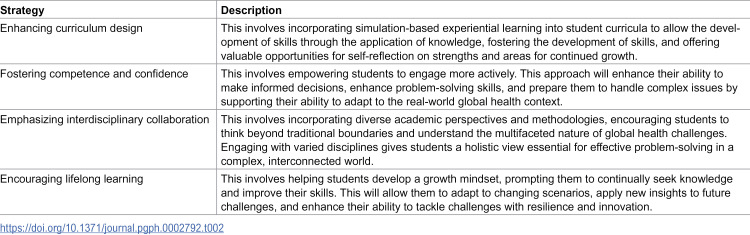 Figure 4
Peer Reviews
No public reviews on file for this paper yet. If you reviewed it on a platform where reviews are public (OpenReview, ICLR, NeurIPS, ICML), you can paste yours below so the community can read it here.
Videos
No videos yet. Explain this paper in a talk, walkthrough, or lecture? Add one.
Taxonomy
TopicsSimulation-Based Education in Healthcare · Global Health and Surgery · Innovative Teaching Methodologies in Social Sciences